Too funny and right on….Seven psychological complaints of bloggers and social media addicts . Not a video, but a Monday funny!
Day: April 28, 2008
Musings on “community management” Part 2
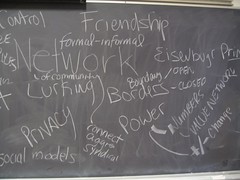 My last post was on the ground, in-the-flow practical stuff of online community management in response to Chris Brogan’s great post, On Managing A Community . This one climbs up to meta-ville a bit and asks a couple of questions.
Are we talking about communities, or are we embarking on the era of network facilitation?
If you read between the lines and through the comments on Chris’s blog I think he has begun to tease out some of the differences between community and network management! (I’ll come back to that word “management.”) Read through his goals which I think are different than what we have come to expect for what I’ll call “traditional online community management.” In the past this has been about the inward set of processes around hosting, moderation and facilitation of web based discussion communities – large or small. He speaks of outreach, of reputation of an organization in the world, and of mechanisms of learn from and with groups of people and even the wider world. It is an outward looking role, not inward. It is about spawning connections, not keeping existing connections organized.
This is not your mother’s discussion board, sweetheart!
When we move to the network, a couple of things happen. The notion of managing becomes even more of an illusion than managing that herd of cats called “community.” (By community, I mean a bounded set of individuals who care about something and who know they are members and interact with each other over time.)
Instead we are talking about scanning for things important for our organizations – conversations about us, niches or needs we can fill, feedback and suggestions for improving what we do. It is filtering and redirecting those messages to where they can do good. It is a little bit like listening to the universe.
Instead of managing conflict or spammers in a walled community, we are seeking to make connections between people that advance our organization’s learning and goals. That includes between disgruntled people and the people who might address that problem, between ideas, links and content to people who might use them, and between communities that exist within the humus of the network garden.
Instead of spawning or archiving threads, we are tagging and remixing. Instead of inviting in or kicking out members, we are mapping the network of relationships, looking for where to respond, and where to catalyze action.
These are not the list of community management skills we have come to know since the first big upswing in online communities in the mid 1990’s. We have moved to from community to network…. what is the word?
If we are talking about communities, are we really talking about managers?
I don’t think it is management in the traditional sense, in the sense of control and mold (or even “facilipulate” – manipulate+facilitate!). It is about sensing, scanning, filtering and connecting. And, it is about learning. Facilitating learning. Living the learning and creating the next iteration of that learning. It is about stewarding technology as wave upon wave of new tools crashes upon our organizations.
It is about weaving between the community and the network.
What the heck would this job be called? Which organizations have the foresight to invest in it — and realize that those who help them weave their organizations in and out of the networks will benefit most from those networks? If we were looking for this person, what skills would they show up with? What would their traces across the internet look like?
Musings on “community management” Part 1

 photo credit: CaseyLessard
Chris Brogan has a great post today on online community management – a must read if you have or are considering an online community in your business or organization. On Managing A Community .
I have two “chunks” I’d like to contribute to this conversation/stream of posts/comments. First relates directly to Chris’ observations about community managers. That is the content of Part 1. Check the next post for a more “meta” reflection in Part 2.
Skills, Experience and Qualities of a “community manager”
1. On the practical side, I would add the following things I’d look for in a candidate (Chris didn’t write about this, but it is on my mind, so what the heck!)
- Fast, accurate and quality reading/writing skills – I always recommend a timed reading/writing test that involves looking at multiple bits of information (posts, etc.), seeing the patterns of those posts then composing a response.
- Ability to think globally, not just in a linear manner. Community is non-linear. A good community manager must be able to skip around, see patterns, scan the whole and then discern if and where to intervene in the system. People who have to go from a, to b, to c often struggle with this and can’t do it fast enough. And alas, speed keeps coming into the picture. (Ah, i still dream of Slow Community.).
- Good at multimembership or meaningfully belonging to a number of communities. A community manager is a bridge – finding the opportunities to connect in and out of the community to both build the community and carry it’s ideas/impact outside of the community. So they should be active on other community sites (as noted by Chris suggesting they have accounts on various key systems.)
- Head and heart. Community requires the emotional intelligence from the heart side and the analytical/strategic and content skills from the head side. I can’t stress enough that this needs to be BOTH, not OR!
- Social network mapping and analysis skills. Today we are not often working in the confines of boundaried communities (see Post 2) so being able to see and understand the larger network is critical.
Adding to Chris’s section on Strategy
- Understand our community’s relationship to other communities and networks in our domain. In other words, watch for connections!
Adding to Chris’s section on Reporting
- I like that Chris framed this as “in my organization.” Reporting structure needs to reflect who can champion the community manager AND, more importantly, steward relationships with other parts of the organization because rarely is an organization’s community important to just one functional area. Again, connections!
Adding to Chris’s section on Measurement
- Quantity and quality of network relationships to key strategic people/communities/other networks.
- Where the person is doing facilitation within a bounded community (traditional), clarity and quantification of the managers appropriate role in the community over time. For example, if you are looking to build internal member capacity to manage their own communities, what evidence do you see that the community manager is reducing her/his visible participation and evidence of members taking up key community facilitation activities? Where that person is to be the public “face” of an organization, the strategy and thus measurement would be quite different.
My second point is about the context – communities — and the word — managers. And I think I need to make it in a separate post as it is quite different and much more meta. I appreciated the tactical, practical quality of Chris’s post, so I wanted to respond in kind. So see you in the next post!
orld?