CPSquare “Connected Futures” week 1 blog post

Week 1 Workshop Blog Post

I’m lending a hand for the CPSquare’s (http://www.cpsquare.org) “Connected Futures” workshop which started the last week in April. As part of our collective “end of the week activity,” we are all to blog a reflection either on the workshop discussion board, or on our own blogs. Since I am currently offline while I write this, my timing will be off, but I decided to share it on my public blog as a “peek in” to an ongoing experiment.

(Why am I offline? I’m currently at ILRI in Addis Ababa, Ethiopia where I’m co-facilitating a face to face element of an ongoing distributed workshop on knowledge sharing in international agricultural research. The network is down. Who knows for how long…???)

The workshop is devoted to looking at the role and impact of new technologies on communities of practice, and how we steward those technologies (or technology stewardship. If I were online, I’d be linking all these things to previous posts and definitions, but that will have to wait until later!)

This is not a workshop for the fainthearted. In the first week we are asked to register and acclimate to a fistful of online tools, from wikis to blog readers. While we have a “home base” on a discussion board, our activities will range across tools and modalities so we have some real experience to reflect upon and learn from. But all this jumping around right off the bat, before we’ve all gotten to know each other, feels pretty challenging. The brave post that they are feeling confused and I suspect others are quietly nodding in agreement in front of their computer screens.

What facilitates coherence? Especially in a complex world? What enables some of us to feel comfortable with incoherence, ambiguity and incompleteness while others take it as natural? Furthermore, how do we reconcile these differences when we are intending to act “in community?”

For me, these questions are always on my mind when I am in the technology steward’s seat. (Or on that keyboard!)

Noticing some nice non-profit wiki work

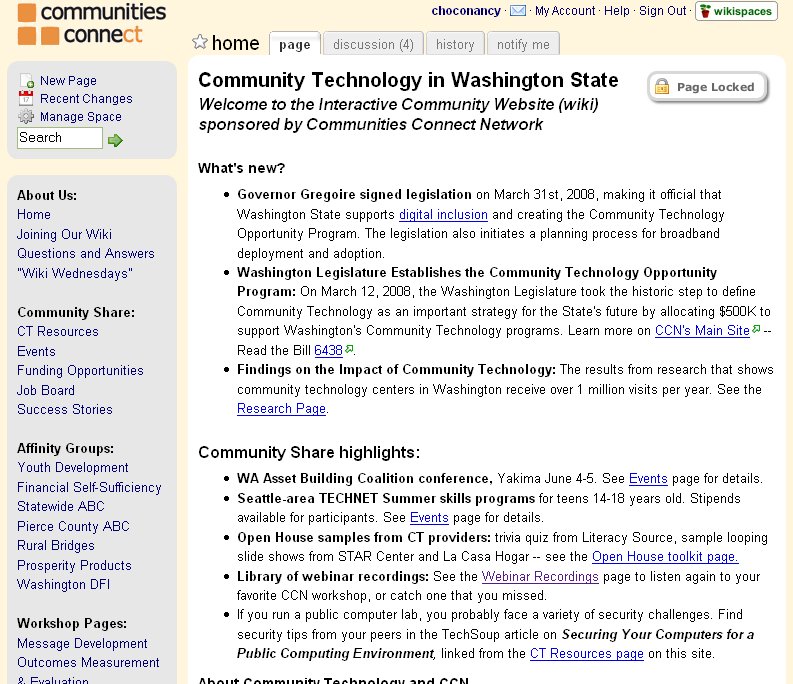
CCN Wiki HomepageA while ago Beth Kanter put out to her network a request to know about useful nonprofit wiki practices. I meant to reply, but, as usual, got distracted. Today I received an email update about a local coalition here in Washington State (USA) that reminded me about their great wiki work. Check out the Communities Connect Network Wiki . Early on, I had the pleasure of working with Peg Giffels who was their main wiki gardener (among many other roles.) Peg “got” that there was both an information architecture and a set of social processes associated with their use of a wiki as both a project communication tool and as a knowledge sharing tool.

Intially the blog was going to be a general place for coalition members to share stuff. But we all know how general stuff goes — slowly if at all. Then Peg hit on using the wiki to be the central point for the coalitions training programs. Now, at the completion of this last round, Peg has a site that is rich in materials (print, audio, video), has an integrated wiki orientation and training component, reflects specific member areas and contributions (for example here and here) and is well organized and “gardened.” The left navigation links to major areas of the wiki.

One of the things that came out of the early “Wiki Wednesday” hour long telephone based orientations was that people came to get trained, but left with new connections to other coalition members. When asked what was best about the calls — it was always the people they connected with. Peg lives that in the way she works with the coalition. While she stewarded the technology and the content, her attention to the people came across to me, as I observed the wiki development over the months and now years.

Like most wikis, there is a relatively small proportion of editors to page views. For example, in April, there was a rough average of 220 unique visitors per day, 2-3 editors and intermittent spikes of editing across the month. This makes sense given the ‘wind down’ phase as well. There was a huge jump in traffic between February and March. I should ask Peg what was going on!

Interestingly, while this wiki is very focused on Washington state, there are viewers from around the world. I really wish I knew what they thought, in what ways, if any, they benefited from visiting the wiki. I appreciate that the Communities Connect project worked with such openness. They have made a contribution that is bigger than their own project work. I like that about public wikis.

Anyway, I just wanted to share this cool wiki with you. Do you have any great wikis you’d like to share with the rest of us?

P.S. Beth, when I went to find the link on your blog, I noticed two things. Your search box is now waaaay down on the left nav bar of your blog – I almost gave up looking for it. And it is a Technorati search, so I have to go to Technorati and THEN link back to your blog. Maybe consider putting in a Google or other direct search option? I want to find your great stuff FAST! And yes, I’m finally becoming a searcher!

The magic between communities and networks

Every time I re immerse myself in thinking about the space between communities and networks, my mind races. I should be doing April billing, prepping for travel, finishing editing, yet I keep jumping into conversations with my networks and communities about NETWORKS and COMMUNITIES! This morning we had a great one on Twitter and I wish I could drop everything, keep conversing and then reflecting. But I can’t. So here is the marker for the conversation, as best I could capture it by favoriting all the related Tweets –> Twitter Network – Community Conversation. If someone can continue to hold the space for this conversation as it wanders across media, please, I thank you in advance. There are some FABULOUS thoughts from aroberts, csessums, edmittance, band, budtheteacher, peterscampbell, stevebridger, melmcbride, CourtneySellers , injenuity
, nandito, coyenator, webb and MtnLaurel. THANKS!

For more of my obsession, tags…
Community
Networks

Want to take your blogging to the next level?

People ask me, “how do I become a better blogger and how can I make money at blogging?” There are tons of great resources out there on how to become a better blogger, and I usually don’t have a good answer for the second part. But today an email from Ben Rattray of Change.org gave me a thought. Change.org is looking for paid bloggers around activist issues. There is a monthly stipend – I’m sure it isn’t huge, but this is a paid gig. It offers a good writer the chance to hone her skill, get exposure and street cred as a paid blogger. And heck, while doing some good! It’s a good combination. Check it out…Change.org

Want to blog on an issue you are passionate about for an audience of hundreds of thousands of activists and nonprofit leaders?

Want to create the premier online space for your issue and become a leading voice for social action?

Change.org is launching a social action blog network this summer and is currently hiring a team of part-time bloggers/editors to help create a movement for change around the major causes of our time.

Each blogger will lead an online community focusing on a different social, political, or environmental issue, maintain a daily blog covering news and offering commentary, convene leading nonprofits and activists working on the issue, and help people translate their interests and passions into concrete action.

More on community management (part 3 or “what’s in a name”)

Otto's ear
Creative Commons License photo credit: os♥to
I hate titling these blog posts with the words “community management.” After writing post 1 and post 2 on this topic (triggered by Chris Brogan), the words just feel wrong. But because this is the label that has been floating across our blog conversations, I’m keeping it in as “connective tissue.” I was actually thinking about “The Giant Ear!”

So why am I writing a third post in three days on community management? (Instead of going for a walk this morning. Uh oh.) It is “in the air.” For those who have had a baby, it’s like once you get pregnant, all of a sudden you notice all the other pregnant women walking around town! Once you start putting blogging your ideas on something, you notice others who have thought/said/tickled around the same thing. The waves of blogging conversations about community management seem to be washing on the shore closer together these days.

While catching up on some feeds, I saw Matt Moore’s bit on
chief conversation officer.

Organisations need Social Media Relations people. And because of the participatory nature of the social media, these people will have to blog. And comment on other blogs. And Twitter. And all that other stuff. They will encourage, advise and look out for bloggers and social media headz in their own organisations. And they will have to believe in what their organisations do (be it curing cancer or causing it) or else they will get found out.

Everyone wants to be Chief Talking Officer. Who wants to be Chief Conversation Officer?

Hm. Matt is talking about something different than this animal we’ve been calling community manager, but some of the functions he lists hearken back to Chris’s list. But do you feel the dissonance that I do? Just the title “officer” shows us the polarities that we activate when trying to reconcile a network activity with a corporate structure.

Control <–> Emergence
Talking <–> Listening
Planned <–> Evolving
Being in charge <–> Being able to be an effective network actor

We are recognizing these polarities or tensions. (YAY!) They are showing up in thousands of blog posts and creeping into books. They emerge from deep roots and cannot be ignored or wished away. Yet it seems to be hard to talk about them within organizations and even the “job descriptions” we see more of every day. (Check the listing of online community manager blogs on Forum One’s site or on Jake McKee’s.)

Let’s make them discussable, and we can discover the way forward. Let’s discuss them — with every boss and leader who will listen. Let’s encourage the network around organizations to tell them how they feel about being managed – or listened to. Let’s find a way to use the power of the network for our organizations, and with it, the multiplied, nested power of the communities that live in and spring from the network. (Oh heck, I’m getting all riled up and haven’t even had a cup of tea this morning!)

To circle back to this idea of “community manager,” and what it is becoming in a network age, the first thing is to be brave enough discuss the idea that it may be “management” in the frame of business structures and some “older ways” of doing things, but in terms of the action in the network, it is not management as we know it. It is is about being connective tissue between an organization and the world/network it lives within. It is about activation, listening, pattern seeking and then bringing that back into the current context of the organization – at whatever stage that organization is in becoming a network organization. It is about reconciling that businesses, in their interaction with the world (customer, vendors, regulators) have opened the door to a new way of being in the system that requires more than management. More than measurable data. More than targets and goals. It requires intuition, intellect and heart.

Heart? Community Managers and HEART she says? INTUITION???

Yes. Heart and intuition, but not in the absence of intellect. Because systems include that beautiful, irrational, impulsive part of human life – emotion. “Community” and “network” both imply human beings. The person you entrust to guide and represent and help your organization learn – this person we have been calling the “community manager” – is your person who stewards your connection to both hearts and minds. Who listens with every available channel, including intuition. How do you measure your ROI on intuition? On heart? I’d ask, what are you losing every day by ignoring them.

So what would you call that role? Magician? The Giant Ear? Elder? I’m currently stumped.

(edited later for a silly typo)