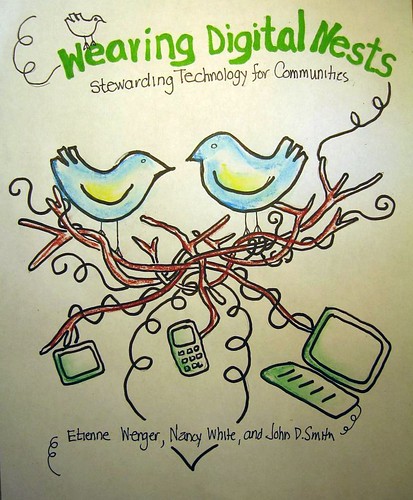
Originally uploaded by Choconancy1
Here is an idea that has been “hatching” for the new book…. What do you think?
Originally uploaded by Choconancy1
Here is an idea that has been “hatching” for the new book…. What do you think?
Here is the third in a series of guest blogs I did for Darren Sidnick, reblogged here with his blessing!) focused on CoPs in a learning context –> From: Darren Sidnick’s Learning & Technology: Community – because without people, you just have a pile of content. Or worse… nothing! Part 1, part 2, part 3, part 4, part 5, part 6, part 7 , part 8 , part 9 and part 1o are all here on the blog.
 This is the third post surfacing a bit more about Community, Domain and Practice mentioned in the series on communities of practice (CoPs). This time we’ll “go social” and talk about the community aspect. From the “no duh” perspective, there is no community without people. Here is Wenger’s explanation of Community in the context of CoPs.
The community: from http://www.ewenger.com/theory/
In pursuing their interest in their domain, members engage in joint activities and discussions, help each other, and share information. They build relationships that enable them to learn from each other. A website in itself is not a community of practice. Having the same job or the same title does not make for a community of practice unless members interact and learn together. The claims processors in a large insurance company or students in American high schools may have much in common, yet unless they interact and learn together, they do not form a community of practice. But members of a community of practice do not necessarily work together on a daily basis. The Impressionists, for instance, used to meet in cafes and studios to discuss the style of painting they were inventing together. These interactions were essential to making them a community of practice even though they often painted alone.
Right off there are the practical implications of Community in the context of elearning.
These questions might give you pause – and for good reason, but lets also look at the benefits of community. From a learning theory perspective, a lot of learning is social, meaning it happens between us, not always as a solo activity. In fact some of us seem to need social learning more than others. When Etienne Wenger and Jean Lave coined the term communities of practice, it was part of their work on understanding learning and the importance of social learning. Again, from Wenger:
Social scientists have used versions of the concept of community of practice for a variety of analytical purposes, but the origin and primary use of the concept has been in learning theory. Anthropologist Jean Lave and I coined the term while studying apprenticeship as a learning model. People usually think of apprenticeship as a relationship between a student and a master, but studies of apprenticeship reveal a more complex set of social relationships through which learning takes place mostly with journeymen and more advanced apprentices. The term community of practice was coined to refer to the community that acts as a living curriculum for the apprentice. Once the concept was articulated, we started to see these communities everywhere, even when no formal apprenticeship system existed. And of course, learning in a community of practice is not limited to novices. The practice of a community is dynamic and involves learning on the part of everyone.
From http://www.ewenger.com/theory/
Community as curriculum — for me, that is a pretty juicy concept. So let’s just end this blog post at the edge of the cliff. What does that mean to you? How might you imagine your learners as community and thus as a way to extend and deepen your curriculum?
 Lest I be accused of taking everything too seriously, I want to remind everyone that today is Talk Like a Pirate Day. To track the action, check out tlapd08 – twemes.com. For the wikipedia version – of course – here.
I had to call the plumber and order a new toilet this morning. He was a bit confused by my “Arrrggg” and “Aye.” At least my husband greeted me this morning, pinching one eye shut and arrrrrging at me.
Now, back to work, or walk the plank!
(Hat tip to John Smith)
 Read the comments on this post Blog comments that make you say “wow!” | BlogHer (which of course, I found because Denise linked to me otherwise I would not have seen it because there are not enough hours in the day.) How do you feel about comments?
People ask me if comments in blogs are important. If you want to connect to others, and hear what they think, then they are. There are also terrific blogs that either have comments turned off, or create an experience where we don’t feel compelled to comment. For instance, people who post things that are just so darned complete and full cause me to simply take it in. And shut up!
Comments, like linking to other people, is an act of reciprocity. Give and get. So if you want comments and links, go forth and comment on things that others post – things the inspire, move you, make you want to offer a different perspective or just thank them for something they wrote that matters to you. And link, link, link to the beautiful work of others. Even ones that haven’t fully emerged yet – keep them on your radar screen!
Photo Credit:
(And grr, now all my right aligned photos are not right-aligning!)
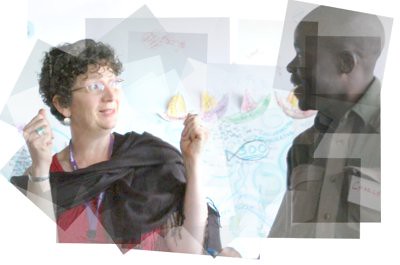
No, I’m not offering advice to Jon Stewart of the Daily Show, nor to Connan O’Brien, nor Oprah. What I’m talking about is an alternative method to boring presentations. It is called the chat show or talk show format. It brings panel presentations a step closer to life. I’m still a strong advocate for more participatory forms, but if you are forced to put something “up front,” this is an option.
First, for a full description of the method, check out this page on the Knowledge Sharing Toolkit:kstoolkit » Chat Shows
Second, read a story of this method in action from Michael Riggs.
Finally, inspired by Michael’s post, I thought I’d share the tips I had for hosting one of these little gigs. I am often asked to be the host, so here are some of the things I try to do. (Yeah, sometimes I fail!)
Re Hosting skills — I agree that a good host is really crucial, so much that I like to run practice groups with potential hosts to give them experience, have the test group offer peer feedback and switch roles (host, panelist, audience) and offer those perspectives.
The key things we have identified around the host role are: (hm, I should blog this)
On an unrelated note, why does the picture show up nicely right aligned in my WordPress composition page, but then show up at the top when I post? It used to work so nice until the last WP update. Sigh