Brandy Agerbeck’s Obama Speach Visual Capture

For those of you interested in visual thinking and graphic recording, take a look at this! Brandy was inspired to do a visual capture of Obama’s inaguration speech – something quite different than she normally does.

Brandy Agerbecks Graphic Facilitation Work

I was really interested to read about her process…

… I ended up scribbling down the main points I heard in pencil on a notebook. Not a real-time drawing. And as I scribbled notes, I realized that it was critical to quote Obamas words. One of my skills is to distill points into shorter, clearer phrases. Because this content was recorded and would be quoted, it was good to keep it in Obamas voice, even if it took my shape, my synthesis.

After I scribbled the notes, I downloaded a transcript. I highlighted the phrases that resonated with me when I listened live. Next, I needed to figure out how to wrap these points around the Obama banner I had drawn as a centerpiece. I started knowing that the O would be a face saying a major point. I chose to make that “Greatness is never a given. It is earned.” I built the main point around the banner, though not strictly in linear order.

I was very curious what pieces of the speech would be made into soundbites. As I prepped this image, I listened to NPR and I was glad to hear a lot of the pieces of the drawing being repeating on air.

Her reflection about capturing Obama’s exact words brought to mind one of the challenges/questions I face when doing either text or visual summaries of group conversations. How important is individual recognition and ownership of the words? When are quotes essential and when does distillation add more. Clearly in this case there was a sole focus on Obama. But Brandy’s articulation of the point gave me food for thought.

What do you do when you summarize online or F2F group interactions? What is your harvesting practice?

SRI and Knowledge Sharing

from http://en.wikipedia.org/wiki/File:Weeding2.JPGLast Friday I had the great fortune to help facilitate a session at IFAD on SRI, or System of Rice Intensification. My botany degree, while neglected as a career path, has always kept my root interest in plants and ecosystems alive. In the course of doing a graphic recording of the presentation part of the session, a few things kept showing up for me.
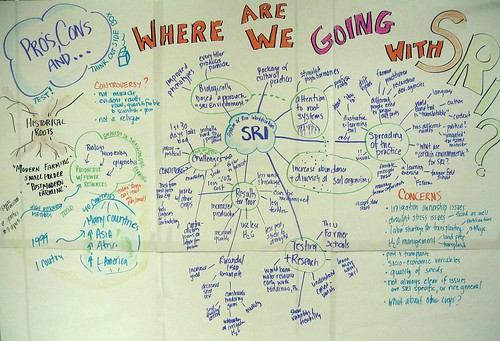
First, the scholars working on SRI were insistent it was not a proscribed method of growing rice that is useful to poor, small holder farmers, but that it was a set of principles for growing rice and other crops.

A set of principles.

Can we view knowledge sharing not as a proscribed set of practices, but instead a set of principles?

While there are a range of tools and methods that we call “knowledge sharing,” they are just tools. And if we overly focus on them, we miss the point that knowledge sharing is embedded in everything we do. Therefore, to make sure we have time for KS and that we do it well and strategically, we might instead focus on the princples that support KS.

Mind map of SRI session at IFAD

So what might those principles be?

Saturday morning, on my way home from Rome at the unnatural hour of 5:15 am, I was surprised to look up in the airport to see a colleague who was at the joint Share Fair in Rome and a past participant of the online KS workshop I have facilitated for FAO and CGIAR. Justin Chisenga of FAO shared the challenges of KS in agriculture in Ghana. He said there were no precedents for sharing agricultural research, but instead a culture of individual ownership, and thus very often loss, of agricultural research knowledge. Locked up in files or personal computers, and unknowingly discarded upon retirement or death, years of knowledge had leaked away. Ownership, not public good.

  • What principles could change from lock down to flow in Ghana?
  • What principles could encourage funders to reframe their support towards openness and learning?
  • What principles could reframe organizational and national policies to support and reward building public instead of private good in fields that ostensibly are dedicated to things like feeding one’s country, region or world?
  • What principles could allow people to share knowledge even in large, complex and necessarily political organizations?

My mind returned to what I learned about SRI. SRI focuses attention on the quality of seed, the timing and method of rice seedling transplantation, and THE HEALTH OF THE SOIL and the microorganisms that live there.

What is the soil for knowledge sharing? How do we know it is healthy? What “transplantation” practices allow us to move fragile new knowledge from one place and allow it to thrive in another, without too much loss, or too much investment in water and fertilizer? How should we “weed” to keep information overload from overwhelming us?

The analogy is intriguing me.

Rice tending image from Wikipedia