I’ve been co-designing and c0-facilitating a number of workshops for the CGIAR and FAO over the past few years about knowledge sharing, and more recently, this phenomenon people call “social media.” Part of this work has been to comb through resources and create some launch pads that are relevant to NGOs and non profits. I thought I’d share a few of them on this blog. I’ve edited this one a bit more since the first writing.
Over time, most of this material will also be added to the every growing “KS Toolkit,” another collaborative resource I’ve pointed to frequently.
Simone Staiger, my frequent collaborator in these efforts, pointed out this quote and URL from Margaret Wheatley that is a good kick off for the topic.
In nature, change never happens as a result of top-down, pre-conceived strategic plans, or from the mandate of any single individual or boss. Change begins as local actions spring up simultaneously in many different areas. If these changes remain disconnected, nothing happens beyond each locale. However, when they become connected, local actions can emerge as a powerful system with influence at a more global or comprehensive level. (Global here means a larger scale, not necessarily the entire planet.)
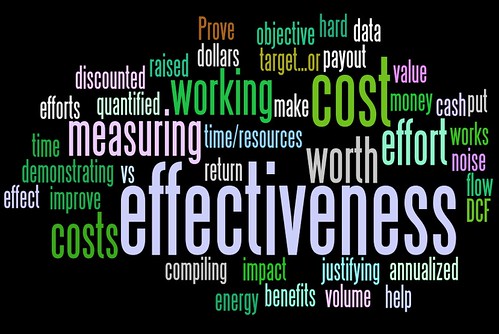 Social Media Strategy Planning & Measurement – What’s Working?
As people responsible for getting things done in your organization, you know the value of having a clear strategy and a way of evaluating if your strategy is working. With social media, however, strategy is a compass, not a map, because it is a fast changing territory.
This topic is designed to give you some tools and ideas for including social media appropriately in your overall organizational strategic plan and to measure its effectiveness.
Strategic Social Media Planning
You might want to look at the very useful “Social Media Strategic Planning Worksheet: from WE ARE MEDIA. Like any good communications strategic planning, social media strategy takes into consideration goals and target audiences AND the technology implications. This is the fundamental part that most of us are familiar with.
Bill Anderson (in a comment on this post, which was so good I’m editing it into the post) wrote:
I have three engineering like questions to add to the list that come directly from the late Neil Postman.
From an engineering perspective any technology, be it a tool, software, or processes and procedures, or new work practices, is a solution. Whenever considering adopting a solution consider asking the following three questions.
(1) What problem will it solve?
(2) Whose problem is it?
(3) What new problems are likely to arise by adopting it?
These three simple questions help me clarify my (sometimes hidden) assumptions about what I’m doing and why I think a particular technology is useful. I think they complement the set of questions you suggest in this post.
While it might be easy to say most of your constituents are not even online, some of your strategic audiences may be, such as funders, researchers and policy makers. So scan your audiences and look for possibilities.
Social media, however, is like a river you swim in. It is always flowing past, sometimes carrying us along, sometimes dumping us on the rocks of the shore. It is important to think iteratively of your strategy so you can adjust to changing conditions. The advice is to experiment often, fail quickly and learn, learn, learn to allow you to adapt your strategy. Think in 6 weeks or 6 months, not 3 year cycles. Keep an eye on the goal, but but ready to switch how you get to it.
Social Media Policies
Often people’s first questions are “how do we manage and control this stuff?” Organizations working with limited bandwidth want to block applications to prioritize internet use. Organizations working in more conservative parts of the world worry about what people will access if they start using web based tools. The first thing to know here is that you can’t control all of this. So building on your core values and developing agreements is a sound strategy.
Some organizations find having a social media policy useful — as long as the policy doesn’t squash the initiatives right from the start! Always try and look at policies from two perspectives: control and emergence. Too much control and you will miss the innovation and inventiveness that is a core benefit of social media.
Here are two articles that you might find helpful from IBM:
And a few more if you like to read…
What we have observed is that NGOs have been slower to consider their policies. This can be an advantage to the early innovators (few barriers) but may cause worry as leadership, not familiar with social media themselves, want to overreact rather than thoughtfully consider policy.
Work Iteratively – Measure as You Go
The good thing about using social media is it is fairly simple to experiment, iterate or throw out an experiment that is not working for you. Think small, frequent experiments and low risk, rather than trying to build “the perfect system” and over investing in any one thing until you understand the value. For example, you may try a blog as an alternative to a traditional email newsletter. Track how many times a blog post has been viewed (using your blog software or a tool like Google Analytics). See how many comments you get when you post entries that specifically ask for feedback. (People are more likely to respond to open ended questions rather than traditional press releases!). Do a search to see who has linked to that post? (Do you know how to do this on Google, Yahoo or Microsoft search? What about the new Bing.com?)
These are examples of using quantitative metrics. For a great list of more metrics you might consider, see Rachel Happe’s blog post on Social Media Metrics. See what blog posts are more read and then start adjusting your posting style. Some people call this “social listening.” In the early phases of using social media, you are trying things out and “listening” for the response as indicated by page views, links, responses or even action by your target audience. To read more about this, check out Beth Kanter’s blog post about evaluating first projects.
Qualitative Evaluation
There is more than quantitative metrics for evaluating your social media ROI. As you know, communications is as much a qualitative thing as a quantitative thing. Some things are intangible. Like a funder reading a blog post that told the STORY of some work and begins to engage more deeply to support the project. Or the people who start following the messages you send out on Twitter and gain a deeper appreciation for food and hunger in the world and start making small changes in their own lives. These things require a deeper listening – finding stories, doing interviews with people from your target audience. For more on this, here is another blog post from Beth Kanter.
As you get a sense of how social media is helping you achieve your communications strategy, you can begin to fold social media evaluation into your overall communications evaluation work. Keep what is working. Adjust the things that might be working. Stop doing the things that aren’t working. Just a note on this. Sometimes it takes both experimentation and time to find out if something is working. So don’t give up too quickly.
Examples of social media evaluation efforts:
Questions:
- What communications objective do you want to try and support with social media?
- Do you want or need to have a social media policy?
- What are the benefits, both tangible and intangible, that a social media strategy might offer? What value does our social media strategy provide to our organization or stakeholders?
- What type of quantitative and qualitative information do we need to track to measure our success or learn how to improve our social media strategy?
Additional Resources:
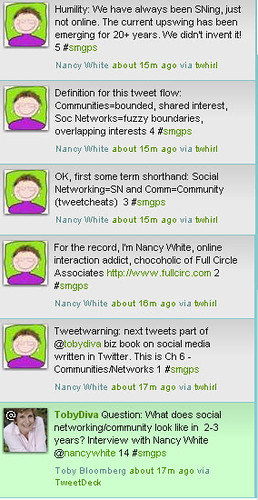 Toby Bloomberg is not the type to let the dust gather. She is always looking at things, asking “what can we do with that” and, rather than just asking, she starts trying and doing. She is a force to be reckoned with!
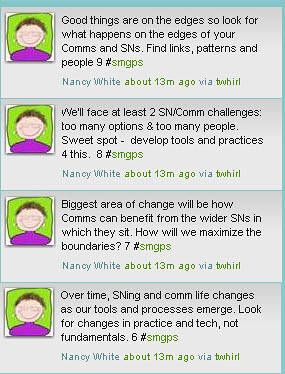 Now that Toby is on chapter six, she has sussed out the process a bit and suggested earlier in the week that preparation is worth it, and that trying to not get carried away with too many tweets is also useful. That asks the writer to be both succinct per post (140 characters) and overall. With the size of the question Toby asked me, that was challenging. How to be brief but substantive, eh? It is harder than it looks.
 Are we pushing a medium too far or is this a useful, creative application? Or something all together different?