When people ask what I’m up to work-wise, I vaguely mention my “rewirement.” I’ve been in the process of redesigning my “working” life into a more consciously designed life flow. In other words, I’m doing less “paid work,” and devoting more time, attention and prioritization of family, my own learning, playing my guitar and spending time in my garden.
What does this mean if you want to hire me? I’m only taking on 1-2 clients at a time. I’m done juggling many work balls, now reveling in a more spacious life. And I have three criteria for saying “yes.”
1. Work that matters in the world. Is your project trying to solve for a community? The world? Does your work echo beyond an event or project? I’m interested.
2. Great people. I’m deeply attached to who I am working with. This is a relationship, not a transaction. We are in it together long enough to supports relating to each other as people?
3. Everyone’s learning edge. I’ll refer you to wonderful folks to provide you a known service. I’m interested in the edge where we all learning. Together. Further, we are committed to sharing that learning.
If you and your work resonate with this, let’s talk.
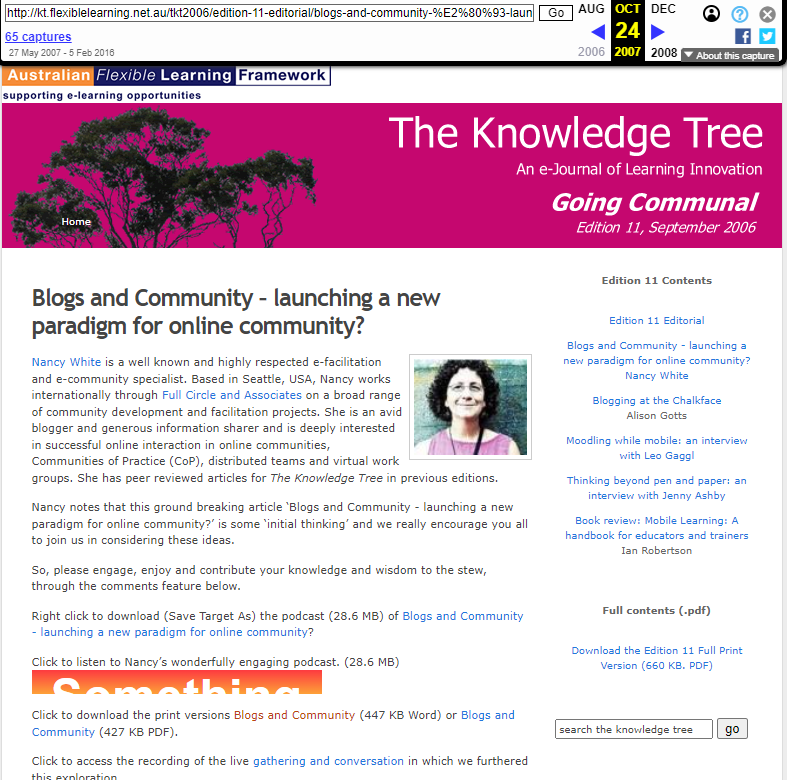
A recent email from the wonderful Alan Levine (a.k.a. cogdog, with his still-vibrant CogDogBlog) reminded me that once upon a time, I wrote a thing. What feels like forever-ago in 2006.
Thanks to the Wayback Machine, it can still be read. I was optimistic about online communities then. I don’t recall if term “social media” had ascended yet. It was after the first Internet bust and into the second bubble, where things were beginning to shift toward what I now recognize as full on commodification. Most of us hadn’t yet realized we, and and our digital traces, were turning into products for businesses to sell.
But I was still hopeful because of the amazing people I met. First there was the incredible Northern Voice blogging confab in Vancouver, BC. I connected to a fabulous network of folks in education who were experimenting with tech, specifically blogs. They were young, excited and our conversations about online community (me) and blogging communities (them) intersected with a glorious BANG! We floated ideas of any stripe, outrageous or not. We shared openly.
Eventually, I wrote about it.
Online community has been an important part of the Internet, mainly forming around email lists, bulletin boards and forums. In recent years, the ascendancy of blogs has introduced a new platform for communities. This article looks at some of the emerging patterns of blog based communities and raises some questions for their strategic application.
Community continues to be reshaped by not just technology, but society, climate change, positive and negative groups of people. And, in the end, it is fundamentally about connecting, not just consuming content. I try to stay positive! What about you?
I was reading the spectacular, “When Women Were Birds: Fifty-four Variations on Voice” by Terry Tempest Williams and this quote jumped out at me.
“Perfection is a flaw disguised as control.”
Terry Tempest Williams
I’ve been working on a writing project with Keith McCandless around Liberating Structures and time and time again we reflect on how control shows up. Perfection is one of the ways. When trying to work with emergent ideas, this is a huge, wet blanket.
Introduction: I am happy to share the blog space with guest author Philip Clark along with Michelle Laurie sharing some of the learnings of our little CoP on strategy knotworking. You can read their bios at the end of the post!
From Philip: Special thanks to Nancy, Lynda, Fisher, Michelle, Barry, Susan
The strategy game starts with being honest with yourself.
Simon Wardley
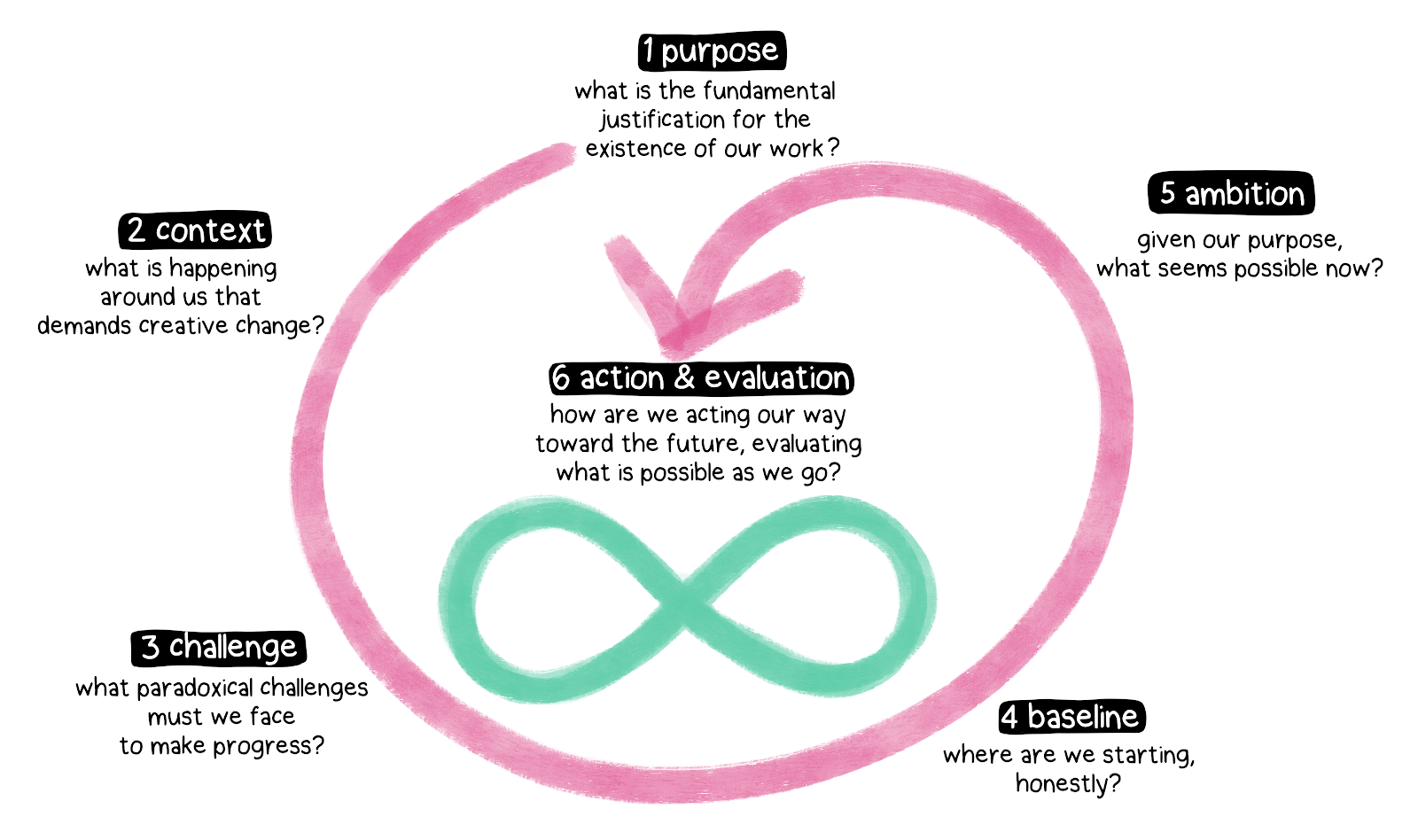
Within the larger Liberating Structures network there is a community of practice devoted to the development and understanding of Strategy Knotworking, a set of six questions, often answered using various Liberating Structures, that lends itself to complex contexts and where there is a desire to engage everyone in planning.
Late in 2023 we started doing a series of Users Experience Fishbowls with seasoned practitioners to hear their stories, learn from them and share their experience with our community at large. So far, we have had the pleasure to talk to Lynda Frost, Fisher Qua, Michelle Laurie, and Barry Overeem. We also had the chance to listen in on a presentation Keith McCandless did of a knotworking case of his own. It started a few months back when Keith went on a tour of LS communities presenting a case study about StrategyKnotworking (SK).
The amount of wisdom, heuristics, different usages and details provided by our guests is substantial and will take some time to digest. All our sessions are recorded, all have transcripts. You can access these materials via our # Knotworking group on Slack (leave a comment with your email below and Nancy will invite you) and our GoogleDrive folder (https://drive.google.com/drive/folders/1573AmVQpJhQW20UgbTqLvwVfiHIhUNfp)
One of the sessions that resonated with me was Michelle Laurie’s. Here are a few nuggets I have found particularly enlightening.
Michelle’s work takes place in particularly complex environments where her clients can include communities, local and regional governments, non-profit organizations, etc… The specificity here is that multiple players have multiple objectives. There are also trust issues. Building trust is an important foundation to collaborative planning and, for Michelle, you won’t be surprised to discover, strategic in nature. More of this in a minute.
About strategy
Michelle described three different cases. One thing they had in common is that you rarely start with a blank page. In other words, some strategic elements can be relatively stable over time which implies that the past is as important as the future.
Another thing common to all three was the importance of preparation. All of them needed lot’s of it. The more you prepare, the easier and nimble the delivery (especially if you need to adapt quickly). The trick is to have it done by the client as much as possible.
Knotworking offers a structure through the use of six questions: 1) What is the purpose of our work? 2) What is happening around us that demands change. 3) What challenges and wicked questions must we face to achieve our purpose? 4) Where are we starting, honestly? 5) Based on what we have just learned, what is now made possible? 6) What are we going to do, what are the next steps and how will we know we are making progress? (Yes, that is actually three questions. Smiley face.)
In Michelle’s work with a hospital the planning team was small, aligned, and had their projects placed “in neat tidy buckets” prior to the strategic workshop. In other words, they were clear about their strategic initiatives and needed a way to prioritize them. The novelty here was both the strategic process itself and their first experience with digital tools (as a consequence of the pandemic). Given both the cohesiveness of the team and the work previously done, the strategic process went smoothly. The team did not have a purpose, so they started with that.
They then addressed context and challenges by answering the prompt “What do we need to be aware of when considering strategies / actions for the year ahead?” That readied them to analyze the pre-prepared set electronic stickies to assess the current projects and activities for current baseline state. Actions were determined by a voting process according to the following options : must do, love to do, like to do, not really interested. In this example, although the projects and the criteria for evaluation had been discussed prior to the SK workshop, the team gained clarity reflecting together on purpose, context, challenges, and baseline.
The strategic process was fairly rapid and summative. The benefit was to reinforce coherence, provide details and range of possible work of the various projects as well as enrich the connection between the members of the team. All things considered : clean, fast, enjoyable.
About trust
Michelle remarks that when you have to deal with large partnerships, trust is a critical issue. The fact that these teams or people have few interactions and identify with different constituencies reinforces their insularity. It makes it difficult to grasp and elaborate something that could be called, after Dan Simmon’s “Hyperion”, the space that binds, a space where new things, new thoughts, new actions can emerge in a manner that matters to all the constituents. That space is strategy.
If trust is lacking it must be built. This means flexibility with the process. The great skill here is letting go. Before strategizing, before talking about purpose, context, etc … seek what Stuart Kaufmann calls “the adjacent possible.” Look for that which is within reach, not necessarily what we want or desire. So the pattern seems to be “go with the flow”; go where there is readiness, eagerness, curiosity and energy. Sometimes it is just the act of talking with each other that matters. Be ready to leave the plan aside, to put the process on hold, and just let it roll, like they say in the movies when they start shooting. It is hard for those of us who believe in the goodness of a structured process, or in the generative power of a well-constructed narrative, but sometimes you’ll have to let go.
In terms of strategy, Michelle discovered that trust is not just between the project stakeholders, but also between stakeholders and the community. The importance of connectedness and leadership in the community created indirectly helps project partners’ work succeed. Within the project partnership, shared visible artifacts are needed: as Michelle says “something written and seen that allows people to see where everyone’s at, (something) you can take (…) back to your organization. Something you can come back to, (…) to ground you”. The document is the output but the discussions, relationship building and sensemaking to get the document are the true outcomes. Panarchy or Ecocycle Planning are natural candidates to support the process.
With this in mind, Michelle was able to introduce a new strategic direction called « Integration and Building understanding » as a process made to avoid the trap of falling back into silos once the workshop ended. This also implied that the strategic plan was going to include actions that addressed this new strategic direction.
Reflections on the 6 phases of SK
“Purpose” is important albeit not always sought after. If you are like Michelle, Lynda, Fisher, Barry you’ll push for it.
In one situation, “Context” was expressed not by answering the classical prompt of “what is happening around you that demands change?” but by tapping into the narratives about the organisation’s history. When you are lucky to still have people who have been a long time in the organisation together with many layers of new people, and that what had been good and specific to the culture of the organisation vanished, devoting time recalling how things were can be a remarkable way to look at the present and a nice trampoline for the future.
“Challenges” can be different things to different people. Michelle has a nice way to describe them when she says that “they are anything (my underlining) that people or team need to be talked about to help the strategic plan or the group work better together.” For example, challenges could take the form of a retrospective about a project in progress.
“Baseline” refers to the current situation. There are many ways to describe it and Michelle uses Ecocycle Planning extensively as the best way to map a variety of things (activities, states, projects, etc…) dynamically.
“Ambitions” were not clear for Michelle. It looked to her like the transition from Baseline to Ambition and Action and Evaluation was not as straightforward as that. Nancy jumped in and clarified this step. Ambition is based on everything that was discovered in questions 1 through 4. It is about having conversations that could start with “what if?,” conversations about what to trade off, about what matters now or even what is the most important thing we want to do together. It is more of a generative exercise, versus a planning approach which is the 6th question.
Three things about “Action and Evaluation.” One, this is where everyone wants to be. Two, because usually much time is devoted to the previous phases of the SK process, this stage can often be hurried. Not a good idea. Three, because strategy is led by decision-makers, and this step is about execution, it is important to have the right people in the room, those good at operations and to make sure the baton is smoothly passed.
A common tendency while doing strategy is to want to jump immediately to the planning phase. To answer the question, what are we going to do? Will we do this, or do that? Look into this, or study that? This bias toward action tends to take a lot of strategic elements like purpose, context, challenges, even the current state for granted. It minimizes or triggers forms of restlessness with other critical aspects of strategy such as the quality and the role of relations or a finer and more appropriate awareness of the situation. Hence the wicked question: “how can we address the need for action while developing rich and meaningful connections.
If you want to join our little Slack community, leave a comment for Nancy below.
Our Guest Author Team
Philip Clark:. After running his company -a digital design firm – for 10 years, and the innovation department of Orange Business Services, Philip now teaches innovation and change at the university of Applied Science in Lausanne Switzerland. He also facilitates organizational transformation with a special emphasis on complexity designed tools and methods (Liberating Structures, Cynefin, Estuarine, Sensemaker…) promoting collective intelligence and distributed leadership. Contact Philip to collaborate and share ideas (https://www.linkedin.com/in/philip-evans-clark/)
Michelle Laurie: For more than twenty years Michelle Laurie has worked with leading agencies around the world to achieve their sustainability goals. She facilitates multi-stakeholder dialogue, strategic design of networks and partnerships, and supports projects related to global change, health and the environment. She is a big proponent of participatory process, collaboration and engagement. She began experimenting with Strategy Knotworking in 2019 and continues to do so whenever the opportunity arises. Contact Michelle to collaborate and share ideas (feel free to link my site michellelaurie.com and/ or LinkedIn https://www.linkedin.com/in/michellelaurie/).
If you are interested in Strategic Knotworking, leave a message for Nancy with your email and she will send an invite!
Open Space Technology and the amazing people who stewarded it in the world were and are some of my most important teachers. One of them was the person who birthed OST, Harrison Owen, who passed away earlier this month into the largest Open Space ever. There will be an online OS to celebrate and remember Harrison. Here are the details, shared with encouragement to share widely.
Honoring Harrison Owen ~ A community comes together
“Camden by the Sea, Virtually and Globally”
April 8th is when it starts… 10AM Eastern USE Time/7am Pacific US Time
It is time for us to gather and to honor Harrison Owen; to share stories and to express our love for him and each other.
Two weeks have gone by since he died on March 16th, 2024.
Such sadness and grief we have all felt and are still feeling.
The expressions of love and gratitude from around the world for Harrison have been overflowing; the stories of Open Space moving and inspirational. In planning this upcoming virtual gathering, Barry Owen carried the Open Space torch for his dad. Trusting we should leave the space open, not rushing too fast in setting a time and place for us all to meet. It’s how it is when we sit in a giant circle, with lots of space in the middle, writing and announcing our topics. It’s what people have done, head and heart, with such passion and emotion.
Barry also reminded us in the planning: “to not work too hard”. It’s what dad would have wanted, he said.
So, he, I and others, have waited until NOW, until the right time to invite everyone. Day by day, the pieces for this future reunion came together.
Why not create a Virtual Gathering that has the spirit of Camden by the Sea? Back then, Harrison would simply rent a space, tell people where and when, and that was it. The stories from those days live on, beautiful memories of Camden Maine, the place that Harrison called home to the very end.
We then called Lucas Cioffi at QiqoChat. Can you help us? We wanted to take a minimalist approach. As always, Lucas was quick to support our ideas.
Together we imagined the Law of Two Feet in action with multiple Zoom breakout areas for conversations and blank spaces to write notes and post pictures. Nothing more. No formal facilitation or hosting, just us, welcoming each other together, holding, and opening more and more space. Trusting this beautiful process of Open Space that is so much more.
Harrison’s presence would be felt, as our official facilitator. After all, he’s already opened the space for us and is holding it still while napping along the way.
The date of the gathering came to us in a flash. Why not April 8th to get this started, on the day of the Solar Eclipse. There seemed to be such significance to that date, as if a cosmic inspiration, the 8th day of the 4th month of 2024. Harrison at age 88 being the pure expression of an infinity symbol. And indeed engaging 8 billion people in meaningful conversations is a timeless endeavor.
We also decided that there would only be a start time (10 AM, Eastern Time), no end time, again in the spirit of Open Space “when it’s over it’s over” which implies that life in Open Space will never be over.
The intent is that people from around the globe will flow in and out, on their own time zones for a day or two or more. As for every closing circle, it will be over when it’s over.
Everyone is invited: Harrison’s family and friends, our global Open Space community and so many other colleagues and friends from around the world.
Please help us spread the word ~ everywhere, anywhere and in any way.
The implications of our online lives as been in my mind since I first sat in awe of my first online community, Electric Minds. Over the years I have seen great good, but even greater swaths of harm. I’ve never thought it was all about the technology. Nor have I experienced technology as some neutral platform upon which we act. Technology is NOT value neutral. And everything that is wrong cannot be blamed on technology. Today a piece by the brilliant danah boyd nailed it. (And read the whole thing. It is superb. It leaves us with the question, why aren’t we centering children in every aspect of our ecosystem. Tech is not the solution.)
The problem is not: “Technology causes harm.” The problem is: “We live in an unhealthy society where our most vulnerable populations are suffering because we don’t invest in resilience or build social safety nets.”
By all means, go after big tech. Regulate advertising. Create data privacy laws. Hold tech accountable for its failure to be interoperable. But for the love of the next generation, don’t pretend that it’s going to help vulnerable youth. And when the problem is sociotechnical in nature, don’t expect corporations to be able to solve it.
We use cookies on our website to give you the most relevant experience by remembering your preferences and repeat visits. By clicking “Accept”, you consent to the use of ALL the cookies.
This website uses cookies to improve your experience while you navigate through the website. Out of these, the cookies that are categorized as necessary are stored on your browser as they are essential for the working of basic functionalities of the website. We also use third-party cookies that help us analyze and understand how you use this website. These cookies will be stored in your browser only with your consent. You also have the option to opt-out of these cookies. But opting out of some of these cookies may affect your browsing experience.
Necessary cookies are absolutely essential for the website to function properly. These cookies ensure basic functionalities and security features of the website, anonymously.
Cookie
Duration
Description
cookielawinfo-checkbox-analytics
11 months
This cookie is set by GDPR Cookie Consent plugin. The cookie is used to store the user consent for the cookies in the category "Analytics".
cookielawinfo-checkbox-functional
11 months
The cookie is set by GDPR cookie consent to record the user consent for the cookies in the category "Functional".
cookielawinfo-checkbox-necessary
11 months
This cookie is set by GDPR Cookie Consent plugin. The cookies is used to store the user consent for the cookies in the category "Necessary".
cookielawinfo-checkbox-others
11 months
This cookie is set by GDPR Cookie Consent plugin. The cookie is used to store the user consent for the cookies in the category "Other.
cookielawinfo-checkbox-performance
11 months
This cookie is set by GDPR Cookie Consent plugin. The cookie is used to store the user consent for the cookies in the category "Performance".
viewed_cookie_policy
11 months
The cookie is set by the GDPR Cookie Consent plugin and is used to store whether or not user has consented to the use of cookies. It does not store any personal data.
Functional cookies help to perform certain functionalities like sharing the content of the website on social media platforms, collect feedbacks, and other third-party features.
Performance cookies are used to understand and analyze the key performance indexes of the website which helps in delivering a better user experience for the visitors.
Analytical cookies are used to understand how visitors interact with the website. These cookies help provide information on metrics the number of visitors, bounce rate, traffic source, etc.
Advertisement cookies are used to provide visitors with relevant ads and marketing campaigns. These cookies track visitors across websites and collect information to provide customized ads.