Hospital checklists and Inviting Participation

5429335563_ebe9be20dcJohnnie Moore pointed to an interesting article on why checklists don’t always produce the kind of positive results expected in hospital operating rooms.

I remember a few years back when I had major surgery. I had been rolled into the operating room. I was looking around and I commented on the team’s use of a checklist. They looked at me, surprised that I noticed. I said I’m interested in group process. With that, they gave me my anesthesia. I think one of the things on the list was to shut up talkative patients. 🙂 But I wondered, did the checklist make a difference for that team? It seemed like they were comfortable and well-practiced…

Outside of hospital operating rooms, where I have no expertise other than as patient, I’m fascinated by what sort of invitation gets people to engage with tools that can increase their individual and collective performance. It seems to me the invitation is as important as the checklist. Here is a related snippet from the article:

Dixon-Woods did identify one exemplary ICU, in which a high infection rate fell to zero after Matching Michigan began. The unit was led by a charismatic physician who championed the checklist and rallied others around it. “He formed coalitions with his colleagues so everyone was singing the same tune, and they just committed as a whole unit to getting this problem under control,” says Dixon-Woods.

I don’t think the intention here is blind lock-step and I cringed a bit at “singing the same tune.” What I do think matters is that people understand the value of something they are asked to do, and that leadership walks the talk. That starts with an informed, intelligent invitation to participate. Not blind obedience. Not “because you have to.” And the ability to critically question an invitation, checklist or whatever, because in complex settings, not everything is predictable.

I’m currently reflecting on the last two weeks where a team of us co-facilitated 2 rounds of a week long learning experience for professors at the University of Guadalajara system in Mexico. (More to come on that.) I suspect where we created warm, intelligent INVITATIONS to experiment with mobile technologies for engaged teaching and learning, we had more professors “accept,” dive in and learn. Where we focused too much on content, we started to lose people. Interesting, eh?

Source: Hospital checklists are meant to save lives — so why do they often fail? : Nature News & Comment
Collaborating for Impact in Large Development Organizations

km4devimage1What feels like a long time ago and far far away, Rachel Cardone of Red Thread Advisors, Aldo de Moore of Community Sense and I decided to wrestle with some questions that were cropping up across our diverse work. We kept having clients say “we want to collaborate with our distributed teams,” and “what software should we buy.” Time and again, we saw so many of these initiatives fizzle out. It was our sense that we needed to look at the problem differently, with an appreciation for complexity and the diverse contexts across large international development organizations.  That really interesting things were happening on the edges, but they didn’t seem to penetrate deeply into the organizations.

Thanks to some support from IFAD (thanks, Helen!), we had some seed money to begin thinking together, along with friends/volunteers from five development organizations (listed below). What resulted is the following paper from the KM4Dev Journal.

Learning 3.0: collaborating for impact in large development organizations

Nancy White, Rachel Cardone, Aldo de Moor

Abstract

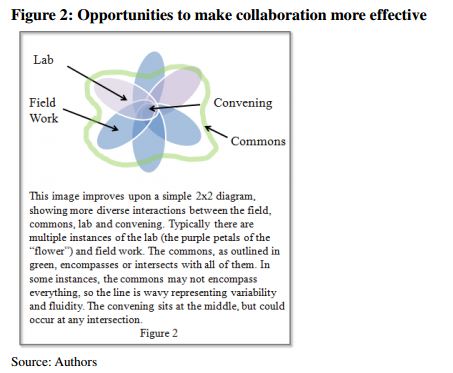
This discussion paper builds on the body of research and practice about technology stewardship originally explored in Digital Habitats, and on the findings from an initial probe into the experiences of five development agencies using collaboration platform technologies. The probe was conducted from September 2013 through February 2014. We propose a framework for looking at productive practices in selecting, configuring and supporting use of collaboration technologies in international development organizations by focusing on the opportunities that exist in the boundaries between different parts of a development organization and different kinds of interactions that lead to learning and development impact. We suggest that there is a very useful opportunity to expand this initial probe using collaboration pattern language and a complexity lens to develop a useful repertoire of technology stewarding practices for collaboration in international development with the goal of supporting greater impact of development work.

via KM4Dev Journal.

This snippet gives a bit of the context for the action learning agenda:

We worked with key staff from the International Fund for Agricultural Development (IFAD), Oxfam International, German Federal Enterprise for International Cooperation (GIZ), the World Bank Institute, the UN Development Programme (UNDP – special thanks to the ever enthusiastic Johannes Schunter!), and the Bill and Melinda Gates Foundation (BMGF). Our objective was to determine if common patterns or dynamics exist across international development organizations that could suggest models, approaches or methods organizations could use to increase value for money when making investment decisions in support of collaboration. We drew on the collective experience of our action research partners, and our own experiences working to establish, advise and manage collaboration technology platforms. Through a series of discussions, we developed an analysis of the contextual factors relevant to the international development sector.

You can find the full text PDF here. I’d love to hear your thoughts and feedback!

A Webinar on Facilitating with Technology With 36 Co-Presenters

NancyAtWorkOver the past few years I have enjoyed being part of the MAFN Webinars. MAFN is the Mid Atlantic Facilitator’s Network. They offer both online and offline professional development gatherings. Last Friday, Amy Lenzo, Nancy Settle-Murphy and I were ostensibly the “presenters.” I think I want to shed that title. May I be done with presenting, please? And by the end, I realized it was a conversation with 36… so they are all presenters too!

We designed the 90 minutes to minimize the presentation and maximize the engagement. I appreciated both Amy, Nancy and the great MAFN team of Michael, Dan, Fran and Meaghan — all ready to try new things and stretch ourselves.

We each had 5 minutes, then we were, as they say, off to the races. (You can see the five questions here in the PDF –> The Edge o fOnline Facilitation MAFN March2015 4 Blog.) In this case, it was a chat race. (At least it felt that way to some folks. I love it. Maybe I was a chat racehorse in my past life?) We then finished this first section with the following question:

HighestAspirationforOnlineEngagement

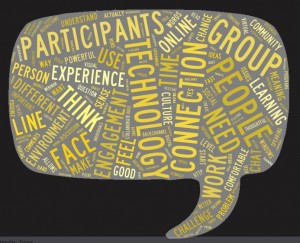
There were 36 participants (maybe a few less with a couple of duplicate log ins, etc.) and there was this amazing chat stream of ideas. So fertile and interesting. I wanted to share the key points.

  • How can we network our intelligence to solve the huge problems facing the world/us?
  • For on-line engagement to be as powerful and impacting as any face-to-face activity.
  • Better connect with people all over the world.
  • . . that it might be superior in some respects to face-to-face engagement
  • People feel like they are in the same room even though they are notaspirations
  • Making deeper (non-trivial) connections with people at a distance
  • For participants to feel energized and that they have had an experience
  • To “level-set” the stakeholders’ understanding of the problem or challenge that all are facing.
  • When the offline culture is not very participatory – using online/virtual to create exchange and relationships and change the culture a little bit.
  • I think work has to meet human social needs.  Online engagement is quite powerful because it can bring  people together socially around quite microspecific topics and concerns
  • People feel a sense of community, leave with  decisions and catalyze action
  • To introduce & discuss the change process in a positive energising atmosphere when some people are resistant to change
  • Participants learn, understand, and feel connected to one another
  • Superior to face-to-face in some ways because many people can “talk at once”.  Appeals to some participants who might be hesitant to speak in a standard classroom
  • Downplay power distances
  • People actually “hearing” the words others were saying; a participant once exclaimed: We were using the same words but we did NOT mean the same thing
  • People who are not technically minded can participate easily and are engaged
  • Human connection across geography with powerful problem-solving
  • Doing strategic planning for a global association on-line (different time zones, cultures, etc., in addition to all the normal human differences)
  • Online engagement feels like in-person engagement
  • Environments that are truly connected – where each of us feel deeply connected to ourselves – our own thoughts and bodies and full selves; to each other; to the natural environment and to the larger world we’re part of. Intimacy and Scale.
  • That it truly engage and lead to the desired outcomes
  • The technology is secondary – the community and results are foremost
  • Create a level playing field so all can contribute to the best of their ability
  • Speed and access to expertise
  • Every voice contributes
  • Making on-line meeting not just a one-off  — so make it a practice that folks will get comfortable with over time (it won’t happen the first time, magically)
  • The fact that the presenters can’t “keep u” means this is more participation than would be possible in person
  • The challenge with online is that the human connection is mediated and distorted by technology. My aspiration is that the technology would feel invisible, or better yet, would be a catalyst for connection.
  • Highest aspiration:  hold onto the social aspect of learning
  • My highest aspiration is connection. Task completion is secondary.
  • Shared meaning … Having folks all proclaim: “I see, hear, & feel and understand.”

These 30+ people aren’t thinking small and I was encouraged and delighted. And from there, the conversation proceeded, mostly in chat and the rest of us with mic access sprinting to keep up became a cauldron of ideas and insights. The group segued from aspirations to questions and how to’s. Within the ideas there were also the meta comments about being challenged being in a text only environment, the pace, the sense of both richness and chaos. It is interesting to read back through the chat and try and pick out some key threads, and to discern where people are “coming” from with their insights. Some are clearly self-defined as trainers, others as facilitators. Some carry the context of the type of organization they work for, and others as consultants range across contexts.

Here are a few examples:

  • What we notice and aspire too is obviously informed by WHAT we do. There were trainers in the group. People embedded in and in the context of organizations and their constraints. Consultants who ranged across contexts. This informs the type of “how-to” people sought or suggested.
  • Everyone is interested in technology, but often in very different ways. Some want to know about the latest technologies. Others are interested in the impact of technology on our interactions. This quote really drew me in after someone talked about the way technology can distort our experiences: ” The presence of technology DOES change and effect the HUMAN experience and connection.” This segued into a conversation about how technology can/might not level the playing field. We are just beginning to really dig into these issues, and move beyond thinking of technology as a tool. I confess I’m getting tired of “what is the best tool for X” conversations and am ready for deeper explorations into the impacts of our technological environments, regardless of what tool is/isn’t available/acceptable/affordable! (Not to diminish those issues.) This is a great topper to this idea that one of my 36 co-presenters shared: “The way the hammer shapes the hand” — Jackson Browne, Casino Nation.
  • We all struggle. Priceless: “My 20th century mind has been struggling to make meaning and order from the chaos of this group chat.” My observation? It is not related so much to age, but I don’t have data to support my hypothesis (says this 56 year old.) The issue for me from the stress of volume is what is lost, as one person wrote, without reflection. (Slow down, Nancy, slow down!) Clearly I’m not the only one with this issue: “I have not been building in enough reflection time in my webinars.  I think it’s because I can’t tell when people have lost interest or when they are thinking.  Could be an insecurity issue for me.  Need to work on that!”

There was a lot more and I’m attaching a file with my semi-Sorted Chat Notes.

But here is the capper:

CAN WE DO THIS AGAIN NEXT WEEK PLEASE AND TALK ABOUT THE NEW QUESTIONS?

I love my 36 co-presenters! Co-creators! Co-labborators! Thank you, one and all. You help me…

thinkmoreradically

Biscuits and Being Better Together

biscuittweetAll it takes is a tweet about grating frozen butter to make better biscuits to get me to click into a web page. And when I arrive, I find this most wonderful quote that can certainly apply to far more than biscuits. (Emphasis mine)

Sitting down to a plate of towering warm biscuits, with butter, sorghum and orange-blossom honey, we get philosophical on details, like placing biscuits so they’re touching.“When you’re touching, you lift each other up and you rise higher,”

Duvick agrees. But if they rise too high and slump over, they still taste good.

via What’s the secret to really tall biscuits? | CharlotteObserver.com.

Continuing My Ecocycle Experimentation

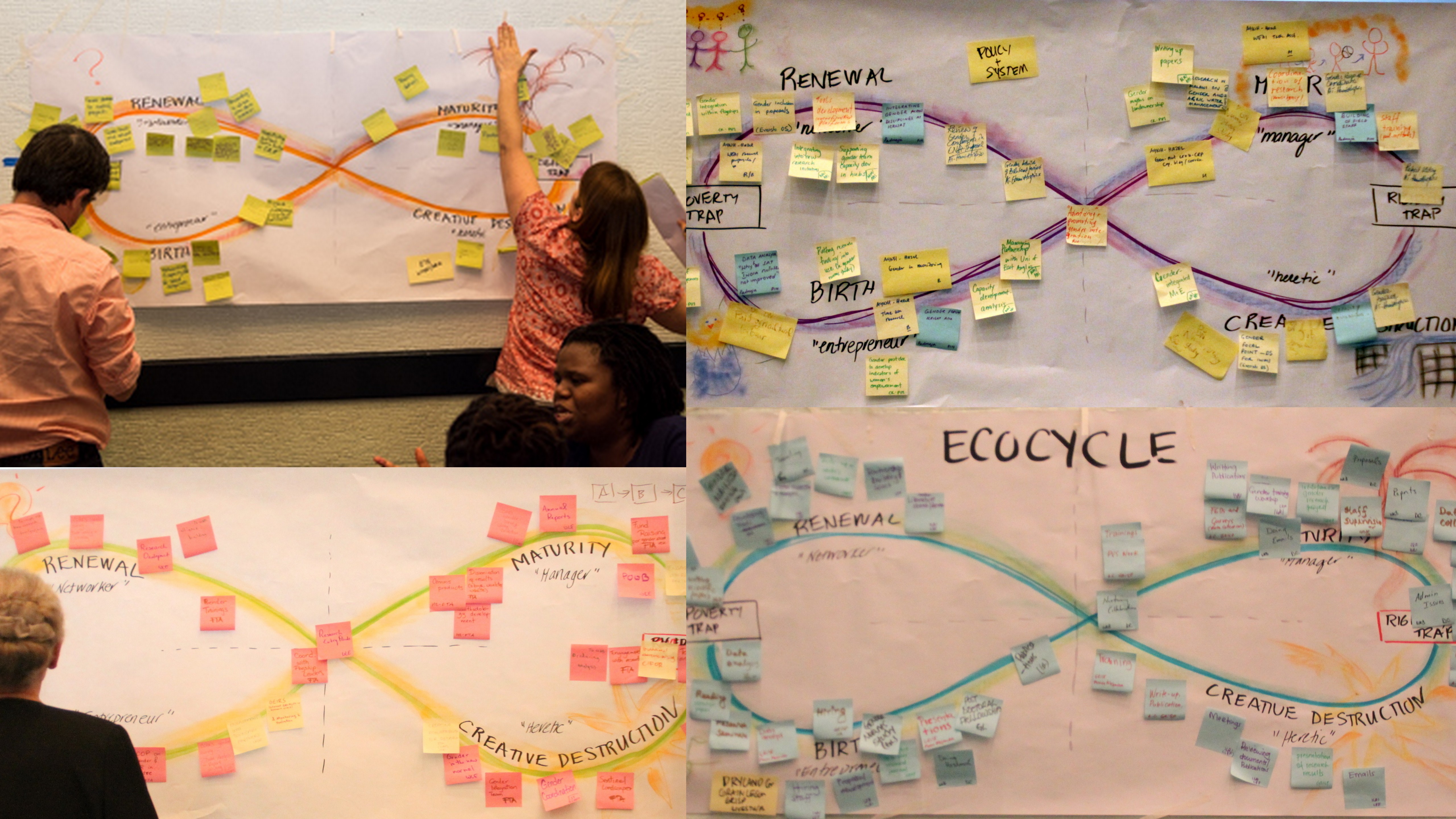
GenderinAgResearchIn January I was working with the CGIAR Gender in Agricultural Research Network during their meeting. My wonderful client, Jacqui Ashby trusted me to use many of the Liberating Structures with the group. We used the Ecocycle Planning structure early on to help think about the network member’s work in a slightly different ways.

This is the third time I’ve used the Ecocycle Planning “full on,” in other words, I hung a meaningful part of an agenda on to it. I am getting more confident in how I launch the process and appreciate the value of practicing and observing others (like Keith McCandless) running the process and learning from them.

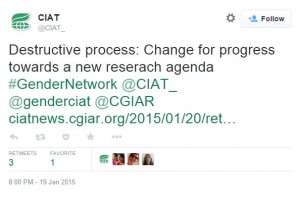
ciattweetSimone Staiger, of CIAT, wrote about the experience on her Knowledge Management blog during the meeting. The tweet was apparently provocative. A few days after Simone tweeted the blog link, she received the most retweets and links than any other post she has tweeted out. Is it the phrase “destructive process” that caught people’s eyes and imaginations?

As it turns out, the conversations around the creative destruction phase of the ecocyle were very interesting to me, and it appears that they were of interest to the participants. Here are the combined notes Simone and I wrote up:

Participants struggled a bit with “Creative destruction.” At first, there was some reluctance to place things in the “creative destruction” area, thinking that this was a negative activity. After some discussion, many groups identified this as a rich area of potential and possibility, the space of innovation and renewal. One participant gave as an example the need to deploy our listening skills to some of their diverse co-workers in order to be able to change mindsets and create and work together.  It was also mentioned that it is important that we involve a larger group of “next users” and partners in the creative destruction and renewal phase. This increases the chances for them to support the birth and implementation of ideas and activities.

Are we both excited and afraid of destruction? Is that the power of this area?

Conversations about the Poverty Traps (now renamed Scarcity Trap) and Rigidity Traps are always useful. It’s like we put a name on something familiar, but often unspoken. Being able to frame and discuss these issues is critical.

The other area that held some useful insights was the area of maturity. Not so surprisingly, what one categorizes as a “mature” practice can vary wildly between individuals depending on their experience, what activities they prioritize in their work and other contextual factors. What is often enlightening is the realization that there may not be a shared understanding of those mature practices and therefore a high potential for misalignment.

From a facilitation standpoint, I was worried that the groupings we created for the maps would not work. We had to group people working on different projects together, and in the past, I’d seen better results when an intact team or group maps their project. But I was surprised how much cross project relevance and resonance emerged. I’m not sure we really mined that as much as we might have.  There was more to harvest and we left it on the table!  Going forward I need to think more deeply about this opportunity. Resonance and dissonance are always rich spaces.