 The word “tinkering” keeps coming up to my radar screen, and it makes me happy. I love the idea of tinkering and find it central to the practice of stewarding technology for ourselves, our communities and networks. Imagine. Create. Reflect. Share. Adjust and go at it again. Experiment. Mash-up and recreate. Build upon the work of others. It is for me a deeply ingrained practice of learning both by myself and with others, particularly in my communities of practice.
Last week, on one of our many, many, many calls in creating the Digital Habitats book, Etienne Wenger noted something about a blog post I had here and on the book blog about experimenting with the community orientations we write about in the book. it was about using the orientations via a spidergraph to explore and understand one’s community. I wrote about how Shawn Callahan had taken the idea in one direction, and I in another. Etienne mentioned on the call that he had been doing this for a long time. I stopped short, feeling embarassed that I had not recognized that I had tinkered upon HIS work, and our work, and then Shawn tinkered upon it in his own way. It made me more aware of recognizing the substrate upon which we tinker. The shoulders upon which we stand. Etienne said something to the effect that despite the hours we spend working on the book together (along with John Smith), we often don’t know what each other is working on. We are tinkering more alone than together.
This made me realize I had been focusing on tinkering as an individual…
John Seely Brown was recently interviewed about education and he focused on this role of tinkering. He says in the video linked below, “Let me take my imagination and build something from it. Does it work? If not, why not. If it does work, can it work better?” Be open to criticism. Brown talks about a networked world as an open source world that facilitates this tinkering. And about how our identities are now bound up in what we have created alone and with others. And how others have built upon what I have built. New social capital.
Take a peek.
www.johnseelybrown.com “I am what I create” says John Seely Brown addressing the Carnegie Foundation for the Advancement of Teaching – Stanford, CA, Oct. 23-25, 2008
So we have the idea of tinkering as a way of creating our identity in the world. Tinkering as a way of learning and creating with and for others.
 Alex Soojung-Kim Pang looks at the origins of tinkering and why it feels on the rise again. (Go see the whole post – it is fabulous.)
Think of the historically contingent forces shaping tinkering first. I see several things influencing it:
- The counterculture. Around here, countercultural attitudes towards technology– explored by John Markoff in What the Dormouse Said (here’s my review of it), Theodore Roszak (his Satori to Silicon Valley is still one of the best essays on the historical relationship between the counterculture and personal computing) are still very strong, and the assumption that technologies should be used by people for personal empowerment. Tinkering bears a family resemblance to the activities embodied in the Whole Earth Catalog.
- Agile software. Mike sees some similarities between agile software development and tinkering; in particular, both are attempts to break out of traditional, hard-to-scale ways of creating things.
- The EULA rebellion. The fact that you’re forbidden from opening a box, that some software companies insist that you’re just renting their products, and that hardware makers intentionally cripple their devices, is a challenge to hackers and tinkerers. Tinkering is defined in part in terms of a resistance to consumer culture and the restrictive policies of corporations.
- Users as Innovators. The fundamental assumption that users can do cool, worthwhile, inspiring, innovative things is a huge driver. Tinkering is partly an answer to the traditional assumption that people who buy things are “consumers”– passive, thoughtless, and reactive, people whose needs are not only served by companies, but are defined by them as well. When you tinker, you don’t just take control of your stuff; you begin to take control of yourself. (John Thackara talks about user innovation wonderfully in his book In the Bubble. As C. K. Prahalad argues, this isn’t a phenomenon restricted to users who are high-tech geeks: companies serving the base of the pyramid see the poor as innovators.)
- Open source. Pretty obvious. This is an ideological inspiration, and a social one: open source software development is a highly collective process that has created some interesting mechanisms for incorporating individual work into a larger system, while still providing credit and social capital for developers.
- The shift from means to meaning. This is a term that my Innovation Lab friends came up with a few years ago. Tinkering is a way of investing new meanings in things, or creating objects that mean something: by putting yourself into a device, or customizing it to better suit your needs, you’re making that thing more meaningful. (Daniel Pink also talks about it in his book A Whole New Mind, on the shift from the Information Age to the Conceptual Age. The geodesic dome is a great example of a technology whose meaning was defined– and redefined– by users.)
- From manual labor to manual leisure. Finally, I wouldn’t discount the fact that you can see breaking open devices as a leisure activity, rather than something you do out of economic necessity, as influencing the movement. Two hundred years ago, tinkering as a social activity– as something that you did as an act of resistance, curiosity, participation in a social movement, expression of a desire to invest things with meaning– just didn’t exist: it’s what you did with stuff in order to survive the winter. Even fifty years ago, there was an assumption that “working with your hands” defined you as lower class: “My son won’t work with his hands” was an aspiration declaration. Today, though, when many of us work in offices or stores, and lift things or run for leisure, manual labor can become a form of entertainment.

Anne Balsamo, who has written quite a bit on tinkering,
reflects…
1) Why is tinkering and “hand-making” important at this historical juncture?
2) What are the key sensibilities of a tinkerer?
3) How is an interest in tinkering stimulated or provoked?
4) What new tinkering practices are emerging in contemporary culture, especially in light of the rise of makers’ culture?
5) What is the relationship between tinkering and knowledge formation?
6) What research has already been done on tinkering as a mode of learning? What research might be needed to understand it better?
7) How should we rethink the notion of tinkering in light of digital media?
Anne’s post has more video’s of people talking about Tinkering that were created with the Seely-Brown video shown above. Again, if you are interested in tinkering, it is worth clicking into Anne’s piece. (As a side note, Anne is also interested in the “corporeal (body-based) dimension of digitally mediated learning ” which pings on my recent note on the kinesthetic!)
So are we in the age of tinkering? Should we be paying more attention to our tinkering practices and patterns? How are YOU tinkering these days?
More recent posts on Tinkering, many inspired by the John Seely Brown video.
- http://www.brandon-hall.com/workplacelearningtoday/?p=3238
- http://askpang.typepad.com/relevant_history/2008/10/reflections-on.html
- http://news.cnet.com/2300-10805_3-10000431.html
- http://www.stevehargadon.com/2007/01/john-seely-brown-on-web-20-and-culture.html
- http://manypossibilities.net/2009/03/tinkerable-technology-equals-green-technology/

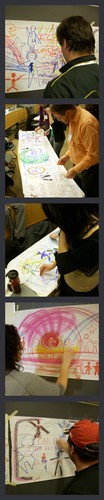
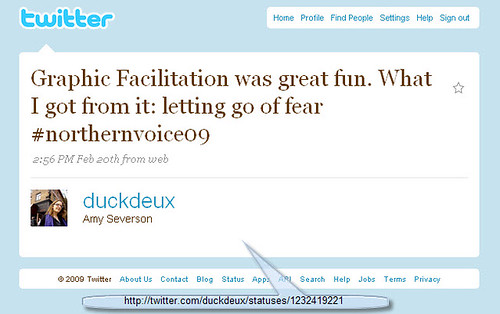 On Friday, as already noted, I ran a lightening fast
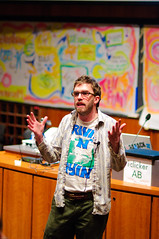
 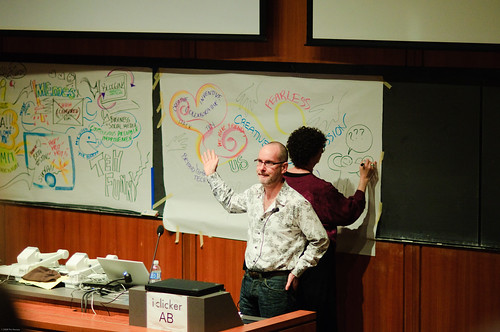 that it was mostly stream of consciousness stand up comedy with some “serious stuff at the end.” I got this information from 5 tweets from Rob, so you know the information was under 700 characters. 😉 I’m glad I just went with the flow. It was risky, but fun. I had thought about some sort of timeline image in advance, but that would not have worked. And because they ended up having me draw from the front of the room right behind Rob and under his slides, this felt a bit more like preformance art than just graphic recording. (Some coverage of the keynote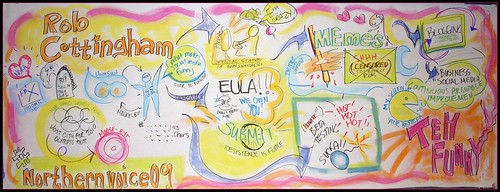

 After it was over, I needed to go outside and lay on the grass and have a quieter conversation with a friend. I felt like I had just run a race, or taken a really hard yoga class. I was physically tired.
 d the
d the 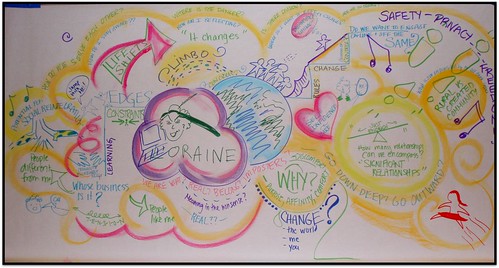
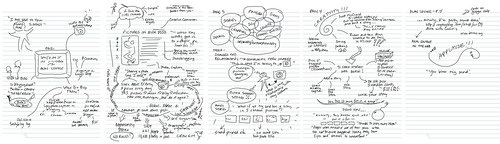 The last experiment of Saturday was with
  If you ever doubt the powerful combination of one motivated person and a large social network, take a look at this Businessweek story about my friend