Audrey Watters’ Amazing Piece: AI Grief Observed

Click here and read this gut-wrenching, inciteful and devastating piece on AI’s impact on education and beyond, by the transcendent Audrey Watters.

Here is a snippet from the end of the piece. But please, don’t read it here, click into the full piece. Slow down. Read every word. If you are not in education, just think about it in your domain. I sure think about it as a person who deeply values community. My take away from Audrey is to pay attention to what gives rise to AI, not AI itself. Read it, please.

We grieve because we love. We grieve because we care. We grieve because we know that the machines do not, and that the community we try to foster — on campus, in the classroom, in our scholarly works — is threatened with erasure. We grieve because we fear forgetting; we worry that people will forget what is beautiful and what is difficult and what is joyous and what is horrible about education. We worry that, if we do not grieve, we give up the struggle to go on, to persevere, to live.

But we do not, we should not grieve alone. We should not be made to feel alone, feel crazed by our grief, feel crazed for grieving. We can, we should grieve together, grieve in public, grieve in protest. Such is comfort – “com” + “fort,” a word that means “with” + “strength.”

Technologies are often wielded in ways meant to imply that humans are weak, messy, slow, stupid, replaceable.

We are strong, messy, awkward, flawed, irreplaceable. All of us.

Our strength comes, in part, from this vulnerability, from our humanity. Together in the flesh. Not isolated, individualized thru some algorithm. We cannot allow systems and practices and machinery to foreclose this humanity, to automate the decisions, the expressions, the explorations that we turn to and that we struggle with in education, in this imperfect but liminal space of learning.

“There is no good way to say this” but to say this: AI is the antithesis of education. It is the antithesis of the future. As such, it is a kind of epistemological death, and I recognize — thanks to capitalism and neoliberalism and imperialism and racism — we have long been surrounded by such efforts; we are grieving already. And yet, we go on.

One final note that I think I’d be remiss not to state, even though there is no good way, or rather no polite way to say this:

Some men (and I do mean mostly men) would rather spend trillions of dollars on an idea that is financially, technologically, morally, and environmentally unsustainable, they’d rather destroy democracy and destroy education and destroy the planet than just get therapy.
Protocol and that which is sacred

https://aperture.org/editorial/a-photographers-unseen-archive-of-the-hawaiian-renaissance/

I am a member of The Well and one of the conversations/conferences I follow is called Hawaii. The above article was shared a while back and I continue to be moved by this article in Aperture magazine. Photographer Franco Salmoiraghi has taken pictures in Hawaii for decades. Not all of those are shared publicly because they are sacred to Hawaiian’s and their culture. There are things that are, by protocol, sacred. Images that are ONLY for native Hawaiians.

I remember working overseas many years ago and heard someone talking about my style and approach as that “casual American disregard of protocol and devaluing the role of the formal.” Guilty as charged and I often perceived that those protocols just slowed things down and did not amount to much. And from one perspective, that felt pretty accurate.

What I did not see nor school myself on was where protocol was, in fact, sacred, and when it was just a way to consolidate and preserve power. Or when it was both. Or neither. So when I read the article above, it opened up a new window through which I am now taking a longer peek. No conclusions here, just appreciation for another view.

Patti Digh’s Op-Ed Writing Course

Now, more than ever, we need to be able to express facts, ideas and opinions clearly and persuasively. Here is your chance to learn from a pro. Patti Digh has made a great offer!

NEW CLASS: Learn to Write an Op-Ed that Creates Change STARTS JULY 11

We need progressive voices to show up in the traditional media, on social media, in water cooler conversations… It is not enough to feel passionately about issues like gun control, reproductive rights, child hunger, voting rights, LGBTQIA+ rights, disability rights, and a myriad of other issues. We must also be able to articulate our point of view, clearly and concisely. I’ve been thinking a lot about this as an inveterate op-ed writer since I was in the sixth grade. So I am offering a four-week intensive on writing op-eds (which can also be used as Letters to the Editor, blog and social media posts, etc). I hope you will join me. Our voices matter. Go here for info.

Connecting Infrastructure and Power

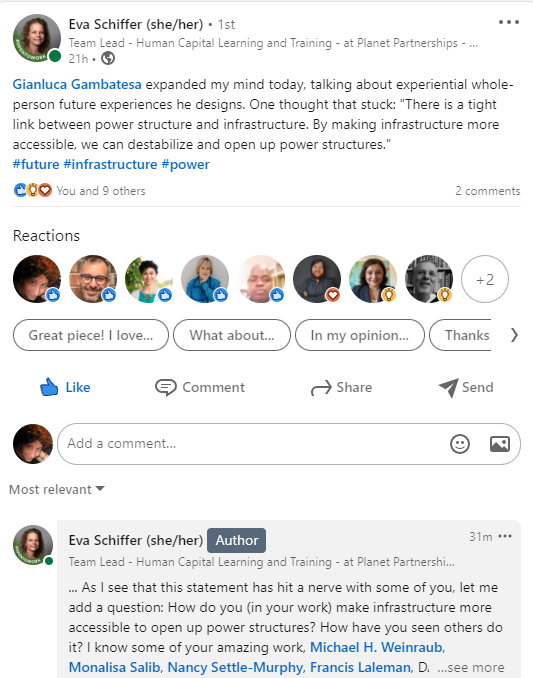
I was intrigued by a post from my wonderful friend and colleague, Eva Schiffer, on LinkedIn a while back. Coming off a conversation with the creative Gianluca Gambatesa, Eva quoted him with something that opened up a lot of questions in my mind about power. Gianluca said “There is a tight link between power structure and infrastructure. By making infrastructure more accessible, we can destabilize and open up power structures. Oh. So. Much. To. Unpack! Then Eva went on to ask for examples.

Before I can mine examples, I want to understand what we mean by infrastructure and power structure. In my group process work most often the aim is to distribute power out to engage everyone and support work that distributes agency and responsibility across a group. It is rarely a goal to destabilize power, but to distribute it. So the idea of “opening up” power structures resonates.

Decision making can be a good place to test ideas. In practice that might look like clarity of decision making (as opposed to fake consultation – I’ll listen to you but I already made up my mind), clarity of how power is exercised and by whom in decision making processes. Power structure is expressed in this case by who makes what decisions, how they are communicated and enacted.

So what is infrastructure in this case? In the LinkedIn thread most references were to collaboration tools: Google drive, Slack, etc. Accessibility to tools requires they are available, properly configured to distribute control of the tools, backed up so useful experiments don’t risk mass destruction of stuff, and skills for people to use those tools. Who can choose and mess with the tools is super important – something we learned in our research for Digital Habitats.

I immediately wondered about the role of transparency of tools, how they are configured and who controls them as one sort of accessibility. There are other layers of accessibility: is a tool friendly for those who cannot hear or see? Is it free of embedded bias? Are the use practices built on shared values and goals or is it a free for all? My bias here is finding the sweet spot between over control and under control. For a diverse group, is the tool accessible ENOUGH to allow access and support diversity? Eva, in a latter comment, noted “Transparency is part of it. But also: Does this structure make it easy for me to fully contribute if I’m not highly privileged?”

That takes us to the less visible side of tools-as-infrastructure – the processes we use with the tools, each other and our shared work. Who has the power (there is that word again) to, as Eva called it, “fully contribute” regardless of one’s priviledge and power.

Process is infrastructure. Lack of process is infrastructure. Workarounds to avoid or change process is part of infrastructure as far as I’m concerned. Yet it is rarely noted in ones “infrastructure plans,” eh? It is the place where power is exercised with little visibility, or perhaps little accountability.

Some other stuff:

https://www.forbes.com/sites/hbsworkingknowledge/2019/08/08/facebook-and-electio
n-influence-will-history-repeat-itself/

Renee Diresta gave a superb talk at Long Now about the difference
about social media which Long Now retweeted about:

"When people say propaganda has always existed, they're absolutely
right. But what has not always existed is inexpensive,
sophisticated, precision targeting."
- Renee DiResta (@noUpside) on how social media algorithms help
spread propaganda on altogether new scales.

https://twitter.com/longnow/status/1518706648730140672

From the Archives: 2008 Hyper Optimism about MOOCS

I found a REALLY old one full of the hope and optimism of 2008. Leaving it as is, with just the addition of cheerful flowers. I want to feel optimism again!

image of 5 colorful imaginary flowers on a light cream background.

I should be doing a hundred other things than blogging at 8:30 at night. No wonder I have weird dreams. But I really wanted to jump into the flow of posts and conversations about Massive, Open, Online Courses or MOOC’s.

I’m referring to Stephan Downes’ and George Siemen’s generous offering, “Connectivism and Connective Knowledge”, a twelve week, open offering they are getting ready to launch. No small feat. For anyone who has ever designed and offered an online collaborative learning event, it is a lot of work. An act of love. (Yes, Stephen, LOVE!) But what happens when 1200 people want to play? This reminds me of the lovely conundrum Leigh Blackall is in with 90 people signing up for his Facilitating Online Communities course. It is raising all kinds of fun questions about how to scale social learning.

So, can a ‘course’ scale to 1200 people as a social, connected learning event? What does that look like? How do we set our expectations? While Stephen and George are creating a course (see this page) I suspect that something wholely different will be experienced by many. It is a delicious set of possibilities and challenges. I’d like to question if it is even a ‘course’ in the way we have come to understand the word. Of course, with academic institution sponsorship, one can understand the name, but what I think this is is a Massive Online Learning Happening (MOLH!). Or a Massive Online Learn Fest (MOLF!). Or maybe a Massive Love-Learn-In. (MILLI!)

Seriously, this is networked learning.  But what a great learning edge to find out what happens when you really OPEN the doors.

Thanks to Stephen and George’s course blog, we’ll have a line of sight in to the action, even if we aren’t able to jump into the actual event. (I confess, the thought of it alone kind of makes me tired!)

So here are my questions:

  • How much will end up being about content delivery, how much about meaning making through individual reflection (especially evidenced in this case by blog posts) and how much will be socially constructed through interaction and meaning making between people (reading and commenting on other blogs, shared creation on the wiki and conversation in whatever conversation spaces crop up).
  • What are the implications of such a large group and the large possibility that they will have wildly different experiences — will what they learn be wildly different? Does that matter?
  • What are the implications of those paying for credit and support? How do they feel about “sharing” the course with 1000 other people?
  • What is the impact on the learning facilitators? Will the size of the group push them back to the traditional role of information providers? Will they only interact with the paid participants? Will they get any sleep for 12 weeks????
  • How does this compare/is this related to what we know about other types of online events?

Associations Should Consider the MOOC | Mission to Learn
I suspect I don’t really even need to spell out how the MOOC model could be of value in the association sector. Or for nonprofits hoping to engage a large group of stakeholders around a cause. Or for businesses seeking greater engagement with their customer base.

Just taking associations as the main example, imagine bringing together a significant slice of your audience online – member and non-member – over a period of days, weeks, or even months to engage on a topic that is central to their day-to-day work. Not just an online conference with a line up of presenters – plenty of that has already been done with widely mixed results. Rather, an event that is truly facilitated, in which key thought leaders help evoke shepherd audience input and participation, taking advantage of social media-driven Learning 2.0 approaches.

The potential seems tremendous. And not just for professional development or continuing education. I sincerely hope this idea will not be relegated to that. This is the stuff of missions.

Perhaps one of the most fascinating aspects of what Siemens and Downes are doing will not even be the course itself – though I have no doubt that will be incredibly valuable, and I plan to participate – but rather observing the thinking and processes by which the course comes about. Siemens and Downes have been documenting their efforts on the Connectivism and Connective Knowledge blog, and have also engaged in at least one podcast interview so far on EduTech Talk.