Every Village Needs a Clown

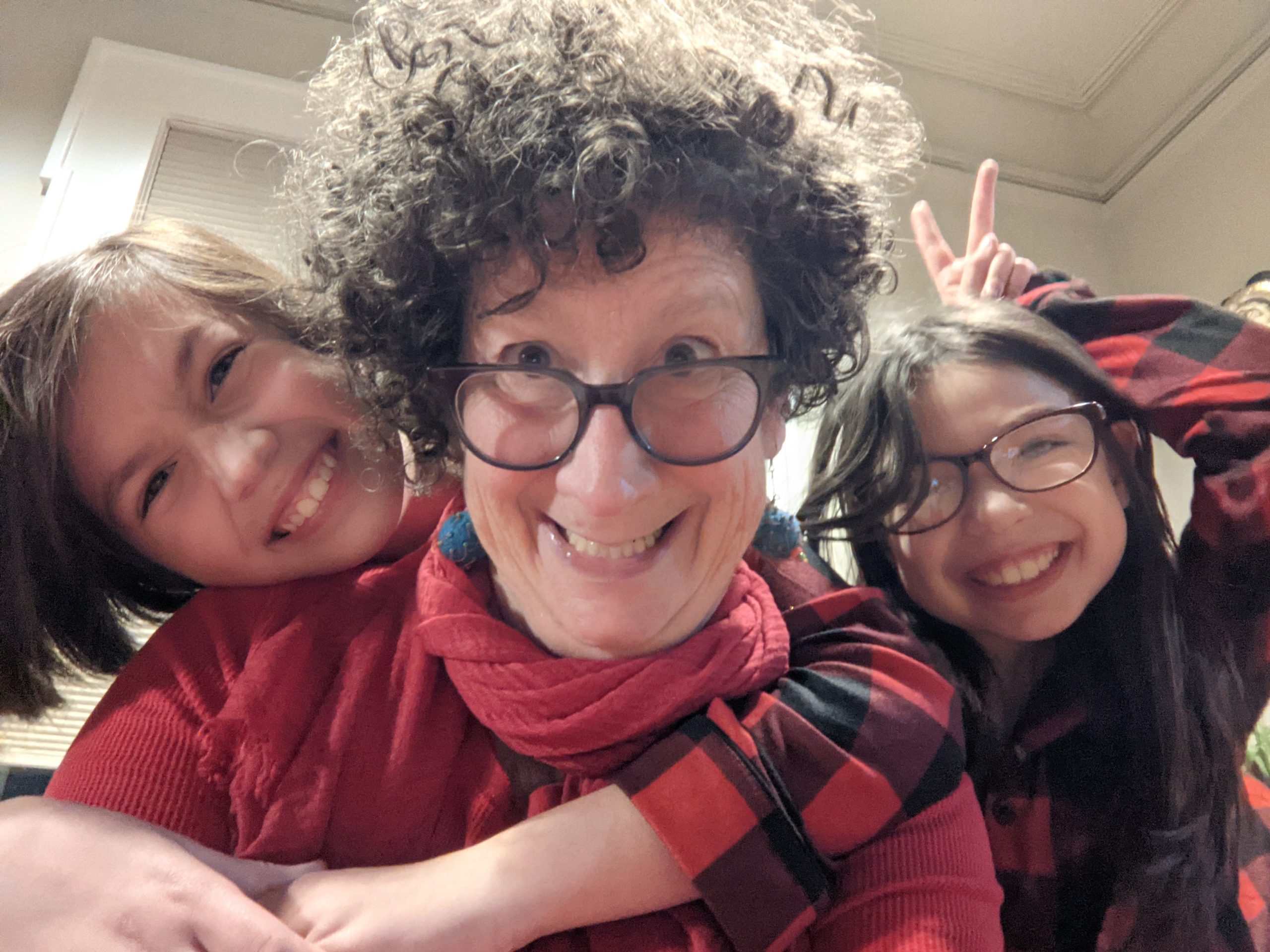
A picture of Nancy White with a goofy face surrounded by her two grandchildren. Picture by Alex White.

(Note: This is a resurrected draft from 2009. The language I used in the draft I now know is wrong… a particular term. So I am trying a new term: clown. Please read this in the voice of Nancy White of 20098. And know I still have a challenge describing both what I used to do, and figuring out what I’m going to do next…)

This  morning I had coffee with two people I met online. I’m always struggling to describe what I do.  At one moment today I started to say I was an clown savant around  online stuff. But really, I’m  more on the clown side than the savant. And proud of it.

You see, I think every village needs its clownt. The person who will ask the dumb question out loud, who will utter something half baked, who is not afraid to fall flat on their face, with enough sense of humor to get up again. Better yet, if they can get up with grace. I aspire to that grace.

Remember, the village clown has permission to say the emperor has no clothes, that the sky is falling or that the strawberries are ripe, right as they have the juice dripping down their chin. The clown is not just for amusement or entertainment, but for sensing things, for voicing the unspoken and trying out the slightly outrageous. They have permission because they are, well, idiots. They can be loved and forgiven, tolerated and cared for.

What a delightful role. I think I have found my niche. Now, however, I have to define what village means when one lives a life both online and offline. Hmmmm…..
Bev Wenger-Trayner Place, Pulse, Party

Beverly Wenger-Trayner’s old Eudaimonia blog post “What makes something a place?” is no longer online but in my archives of draft blog posts, this bit of text was saved. It seems to elegantly follow the words of Gardner Cambell in yesterday’s post, that I’m adding it into the slip stream. What do you think, Bev? Your description still resonates for me

Funny, I have been thinking about “place” related to another line of inquiry, and that is place as a recognizable border when I feel I am shifting between community and network. In my networks, I don’t feel the absence of place, but instead focus more on PULSE. In community, and even moreso in TEAM when I am intricately reliant on my partners, place becomes MUCH more central.

In communities of practices, I think I slip between place and pulse. Hm, I think I need to think about this concept some more and blog about it. After I do more housecleaning. (On a roll. Painting.)

Network. Resonance. Place. Pulse. There is something there….

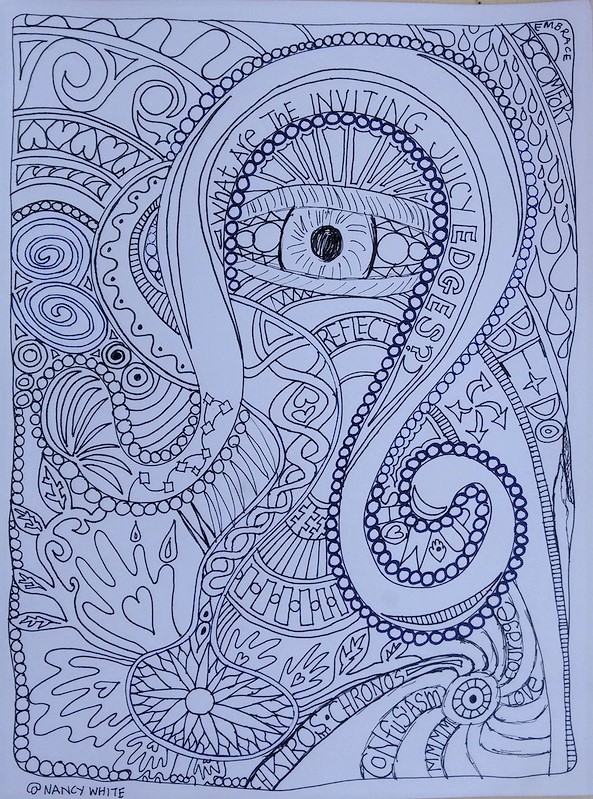
Pen and ink doodle with lines, eyes, hearts, hands, flowers and words.

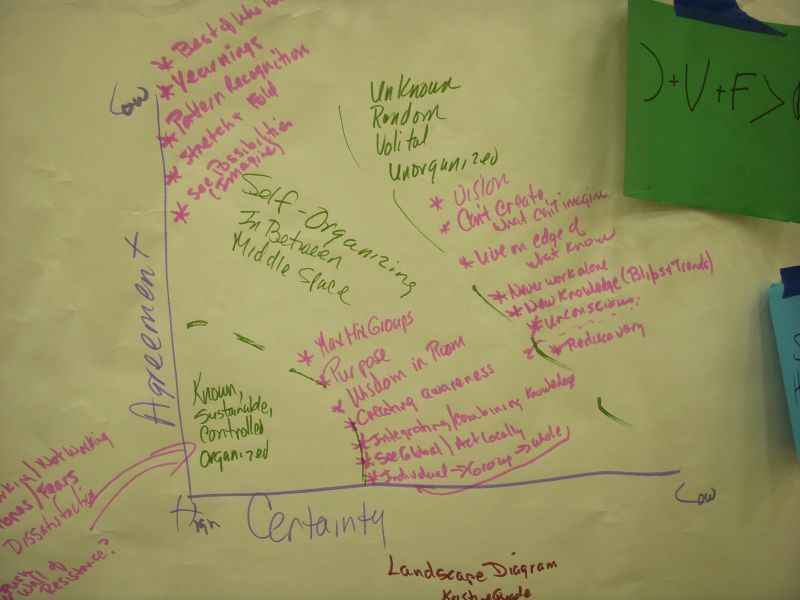
Uncertainty/Agreement Matrix

I have started going through the 419 draft blog posts sitting in my WordPress dashboard. Some are simply links of things I found interesting, and alas, many of those links (2006, 2015) are now dead and those drafts are deleted. There are a few nuggets.

I came upon this little doodle that emerged from/by people at the 2008 gathering of process practitioners, Nexus for Change. (Nexus continues to grow and thrive focusing on the domain of whole systems change. There are three videos which try and tell the story of its evolution.)

The image is of an agreement/certainty matrix based on the work of Ralph Stacey. I continue to use it as part of my Liberating Structures repertoire and it has infused and informed many other process approaches.

What attracted me to resurrect this image and post it is that there is still such resonance for me today. Much of my work of the past five years has been in this area of low certainty and low agreement – the stuff in the upper right hand side of the image. And of course the invitation into each piece of work has often been in the lower left – clients thinking they were working in higher agreement and certainty, only to discover they were not.

This shift of understanding where we place and understand our work (play, relationships, etc.) is both liberating, daunting and, sometimes, frustrating. It calls upon different skills and expertise. The lessons of the COVID era illustrate this. Just when we think we understand what is happening and how we might respond, things change. We have to find that space between “just do something useful today ” and live with the uncertainty and “unknowing.”

Photo of a hand drawing of an Agreement-Certainty matrix in various colors of pen.

From the Principles Chart on Flickr – Photo Sharing!

At the same time, this does not mean we ignore the lower left. There are things we can do with some amount of certainty. One that seems to have been somewhat abandoned is the choice to care about every person around us, and to act with kindness. Our uncertainty seems to have nudged many of us (USA I’m looking at you) towards self-preservation, or even outright selfishness, as if we deserve something. In uncertainty, all bets are off, including our past sense of entitlement.

What does this image tell me today? Keep ahold of the principles of our best selves and practice them together, with certainty and agreement. And let go of things that prevent us from seeing and experimenting with possibility in the areas of high uncertainty and disagreement. A classic wicked question and filled with potential dissonance. And possibility.

Part of a larger photo set from Nexus for Change in 2008 https://www.flickr.com/photos/choconancy/albums/72157604309184882

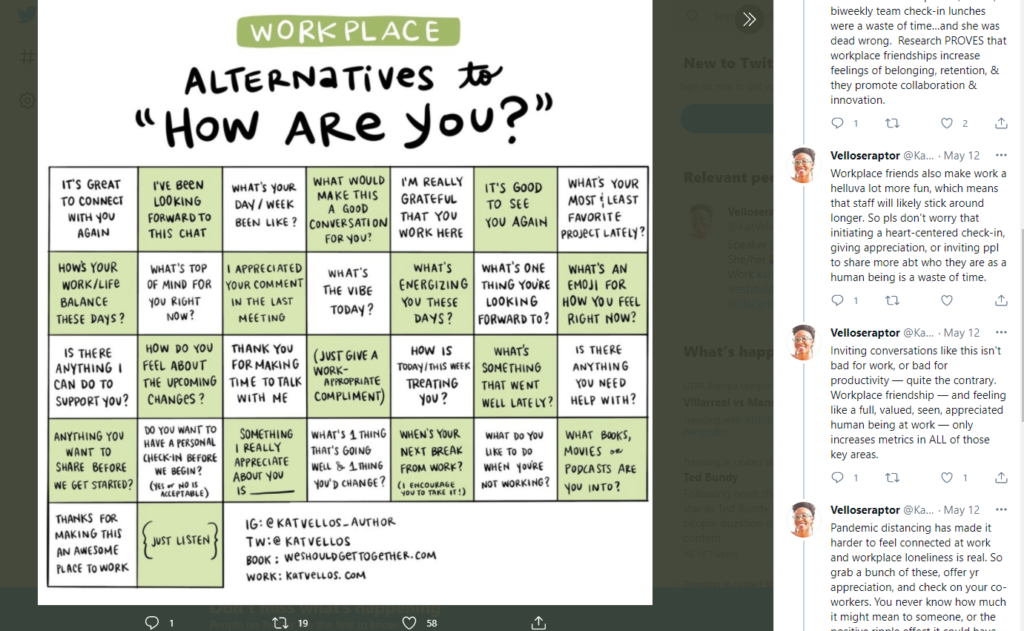
Not another “how are you?” Alternatives from Kat Vellos

Brilliance from Kat Vellos https://www.instagram.com/katvellos_author/ and https://twitter.com/KatVellos/status/1392606023718825986/photo/1 (Her blog post about it here.)

I think I now sleepwalk through someone asking/answering “how are you.” That said, sometimes I’d love a meeting where I can skip ALL check-ins, check-outs and just get the work done and the meeting OVER WITH. This is a unique kind of pandemic-induced fatigue for me. I seek not the gathering place on some days, but the cave.

Interesting…

What does consent look like to you as a facilitator?

“Consent is key. Relatedly, whatever you do, get consent from the local government and the local community. Involve them in the decision-making and processes. For example, in a humanitarian crisis (outbreak, environmental, or manmade), development organizations and INGOs (e.g., UN, Save the Children, IRC, MSF) aren’t allowed to enter a country to provide support until the country has invited them or accepted their offer. This is one example of tapping into existing structures, which are in place for a reason, as well as the importance of consent.” https://www.fsg.org/blog/covid-19-seven-things-philanthropy-can-do

I’ve been thinking more and more about how I have controlled and oppressed others through my well-meaning facilitation. I jokingly call it “facipulation,” and seek to be very transparent about how I approach facilitation. But that is no excuse to ignore my filtered and often biased approach.

I have been working to understand how better to work with the Tribes in my state as it relates to my work with an integrated floodplains management network. Informal conversations between the consultants and the leadership team have opened up many new and nuanced vistas about what consent means.

As I begin to glimpse the complexities of sovereign nation relationships (thank you Bobby), the relationships within and between tribes, and practices of who can or does speak for whom, it is clearer that I based most of my sense of “inviting people in” on my white, American, female and other identities, without having a clue how they were received by others different than me. More importantly, WHY they are perceived the way they are. My personal value was to ensure that “everyone speaks.” Does that, in fact, equal egalitarian engagement? Not necessarily.

In my belief in networked and multi-nodal approaches, I often dismissed existing power structures as oppressive, without even understanding HOW they worked. I lumped them into the buck of obstruction and sought to work around them.

But what happens when working around them makes matters worse? While you might not agree with me and I with you, dismissing the way we each wish to engage does nothing for moving forward together. So what does the path “between” look like? How do we flock together and hold our uniqueness and diversity intact? How does that inform consent and group process?