Community Indicators from the Seattle Farm Coop

People often ask me, “how do you know if a community is healthy and thriving, particularly through online cues?”  As some of you know, I lump these into a category I call “community indicators.”

Two harder to quantify indicators are love and a sense of humor. Today I’d like to observe a bit about the power of humor.

This morning as I was reading the daily email digest of the Seattle Farm Coop, humor was abundant. The warm kind, not the sharp point of a stick (funny to some…) Here are a few snippets:

One response to a classic Q&A (which yielded some great suggestions beyond the one I’m sharing):

Date: Mon Apr 30, 2012 11:32 am ((PDT))

Fellow urban farmers,

Bindweed is slowly overtaking my garden.  Has anyone successfully eliminated it their garden and how did you do it?

I’ve tried hand-weeding and (reluctantly) roundup, though neither with obsession, and my efforts did not even stop its spread.

Please send me your advice if you’ve been able to get rid of it!

The conversation evolved to include horsetail weed… My favorite response:

Date: Mon Apr 30, 2012 5:35 pm ((PDT))

I use psychological intimidation with my horsetail, and it’s worked! Every time I see a horsetail, I pick it, and I tell the plant that it has become a great delicacy and that every single one of its children will get picked and eaten. I make loud “nom”ing sounds. My garden, which used to be so rife with horsetail that I called the place Equisetum Acres, is almost horsetail free now.

Passing along information from other sources, in this cases the West Seattle Tool Library (network weaving!)

 *Power Tool Drag Races*

You really haven’t lived a full life until you’ve witnessed The Power Tool Drag
Races
 that take place in Georgetown every year, hosted by The
Hazard Factory
.  It’s even better when you participate!

This year’s races will take place on June 9th so we definitely need to get started “refurbishing” some of our otherwise inoperative tools in time for the competition.  If you’d like to help out and just stop to see the process, please either drop us a line (library@wstools.org) or stay tuned to the Tool Library Website or our Meetup Page for more details.

And…

 Date: Mon Apr 30, 2012 2:00 pm ((PDT))

Anyone lose a goat?

News flash from the City of Seattle: On April 20, the Seattle Animal Shelter received a call about a goat that had wandered into a woman’s house when she left her door open in the warm weather.  She went into her house to find the goat lying on her bed.  Animal Control Officers picked up the stray goat and brought him to the Shelter. The Shelter held the goat as a stray but no owner showed up to claim it, so it will be adopted by a farm outside Seattle.

I have pics but they didn’t paste in–email me directly if you’d like to see.  The goat is white/gray with dark grey splotches and horns 6″ or longer.

While us Seattlites would like to say “only in Seattle,” what I observe are community indicators of a healthy community with both a thriving online and offline life. In this example, humor peppers the posts, and after a while, I can almost feel the smiles as I read. Now don’t mistake this for fluff. This community is very domain/content oriented. They are serious about raising food in an urban environment and taking care about how it is done. The humor is the warm part of this ‘electronic” communications.

Offline the community is also very rich. There is of course, the warehouse where people buy their urban farming supplies where we get our chicken feed. There are the potlucks (almost always with homegrown, really great music) and swapmeets. There are volunteer opportunities (I’m manning a Coop booth this Sunday at a local plant sale.)

What I sense is that  the “daily rhythm” of the community’s life is online on the email list. Lots of questions are answered — I have learned more about chicken health than I would ever have imagined! People are HELPFUL… ideas, borrowing tools, reusing materials that would have otherwise been thrown out but for that bit of electronic text communication.

Sometimes there are dustups — usually around political or contentious issues. But they pass.

What does it take? No mistake, there is an amazing volunteer leadership that carries the coop forward, because it is NOT a community that is all talk. There is a physical warehouse to be responsible for. There is stock. There are cash transactions. I bow down to that small but amazingly productive and passionate core — yes, another community indicator.  AND the vibrant voice of the wider community and periphery.

I love communities and I enjoy observing and participating in their indicators. What are some of the indicators you are enjoying in your communities?
Bringing Home Beauty and Wondonga Friends

Thanks to Geoff Young (@gsyoung), the vibrant and ever perapatetic host a few weeks ago at Wondonga TAFE, my Christmas presents will soon be moving from Australia to the US.

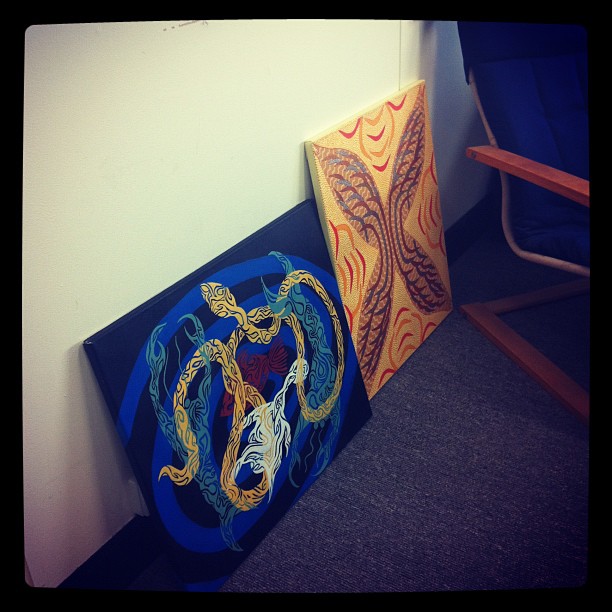
What I love about these two paintings, beyond their beauty, is that we found them in the student gallery at Wondonga TAFE as part of an Aboriginal show. So not only will our home be blessed by their beauty, but we have the pleasure of directly showing our gratitude to the students by buying them. I can think of no finer way to spend my travel money, and more important, ongoing time and attention than to the beauty of their art. Thank you Geoff for getting them to us and send our deep gratitude to the artists.

Our two new paintings from Wondonga TAFE students.

Instagram.

I might add a word about Geoff. Not only is he a Tweet-Meister, but he clearly is working social media and open education magic at his TAFE. Way to go, Geoff!

Noodling on my fOSSa presentation

October is a month on the road… and one stop is Lyon, France, where I’ll be presenting at the third edition of the fOSSa Conference taking place from October 26 to 28, 2011.

What is fOSSa? From the organizers:

The aim of the fOSSa (Free Open Source Academia Conference) is to reaffirm the underlying values of Open Source software: innovation & research in software development.

While the first edition aimed at providing valuable information on the Open Source model at large, the second edition focused specific key-aspects of FOSS such as development, innovation & research, community management & promotion, public sector, and education. The third edition will address in an open-minded style about
– what tech people are actually doing and innovating?
– which are the upcoming issues & challenges in the open development context?
– how open activities, collaboration and knowledge sharing is beneficial to academia, education & industry?

fOSSa 2011 program includes talks about Education, Online Community Management, New Innovating Development & Contribution Paradigm, Openness and OSS trends.

fOSSa days are open to everyone and registration is free !
more information @ http://fossa.inria.fr

So what am I going to offer? Here is my first draft: Twittering: Frittering or Connecting?  The role of transversal connections in online communities and networks.

As humans, we have a long history of working in groups: families, local geographic communities, work teams. Today online technologies allow us to connect broadly using networks of all kinds. We might think of these as deep (groups) and broad (networks). The question is, how do we keep these two forms usefully knitted together? How do the emerging technologies work together as a useful habitat, and when do they actually make things harder? What are the online and offline implications? Lets explore the place of the “transversal!”

I picked up the word “transversal” from Etienne Wenger’s talk a few weeks ago at the Rome Share Fair. It resonated with my observations about the disconnect we seem to experience between high level conversations in a domain and practice, between the breadth of networks and the intimacy of smaller groups. So I grabbed the word and I’m running with it, along with his term “social artist!” Yum. Plus I’ll weave in technology stewardship. So maybe this is about roles, eh?

This week I also have a fabulous case to illustrate many of the ideas I’m thinking of sharing, the #Canlis4Free treasure hunt in Seattle. I took a ton of screen shots and uploaded them today.  But does one dare talk about one of the more exclusive Seattle restaurants when in the home of some of France’s finest cooking? Mmmm….
Message From Meetup/Community Thoughts

KM4Dev members

I thought this was worth sharing as I know many of you, dear readers, are as passionate about community as I am. Plus I’m preparing for a round of gatherings of communities that are very significant in my life in the coming weeks. In that spirit considers what triggers us to connect. What has catalyzed significant community engagement for you?

To: nancyw at fullcirc dot com
Subject: 9/11 & us

Fellow Meetuppers,

I don’t write to our whole community often, but this week is special because it’s the 10th anniversary of 9/11 and many people don’t know that Meetup is a 9/11 baby.

Let me tell you the Meetup story. I was living a couple miles from the Twin Towers, and I was the kind of person who thought local community doesn’t matter much if we’ve got the internet
and tv. The only time I thought about my neighbors was when I hoped they wouldn’t bother me.

When the towers fell, I found myself talking to more neighbors in the days after 9/11 than ever before. People said hello to neighbors (next-door and across the city) who they’d normally ignore. People were looking after each other, helping each other, and meeting up with each other. You know, being neighborly.

A lot of people were thinking that maybe 9/11 could bring people together in a lasting way. So the idea for Meetup was born: Could we use the internet to get off the internet — and grow local communities?

We didn’t know if it would work. Most people thought it was a crazy idea — especially because terrorism is designed to make people distrust one another.

A small team came together, and we launched Meetup 9 months after 9/11.

Today, almost 10 years and 10 million Meetuppers later, it’s working. Every day, thousands of Meetups happen. Moms Meetups,Small Business Meetups, Fitness Meetups… a wild variety of 100,000 Meetup Groups with not much in common — except one thing.

Every Meetup starts with people simply saying hello to neighbors. And what often happens next is still amazing to me. They grow businesses and bands together, they teach and motivate each other, they babysit each other’s kids and find other ways to work together. They have fun and find solace together. They make friends and form powerful community. It’s powerful stuff.

It’s a wonderful revolution in local community, and it’s thanks to everyone who shows up.

Meetups aren’t about 9/11, but they may not be happening if it weren’t for 9/11.

9/11 didn’t make us too scared to go outside or talk to strangers. 9/11 didn’t rip us apart. No, we’re building new community together!!!!

The towers fell, but we rise up. And we’re just getting started with these Meetups.

Scott Heiferman (on behalf of 80 people at Meetup HQ)Co-Founder & CEO, Meetup New York CitySeptember 2011

Do something, Learn something, Share something, Change something – Meetup.

Living Example of Community Q&A Power

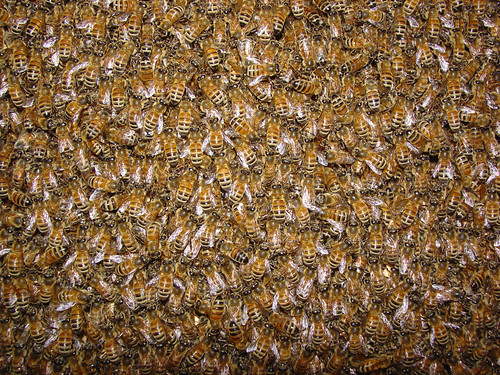
Bees, by kokogiak on Flickr, CC some rights reserved

From the wonderful and amazing Seattlefarmcoop : Seattle Farm Co-op comes evidence of the power of online communities and networks. Look at the time stamps.

8a. bee swarm
Posted by: “heatherleagr” (email revmoved)
Date: Thu Aug 18, 2011 10:37 pm ((PDT))

My bees just swarmed!  I caught them and they have successfully moved into their new hive.  I wonder if it is too late for them to build up enough to make it through the winter, or should I combine them with their old colony.  Any beekeepers out there with suggestions?  thanks, Heather

________________________________________________________________________
8b. Re: bee swarm
Posted by: “Andres Salomon” (email removed)
Date: Thu Aug 18, 2011 10:51 pm ((PDT))

Personally, I’d combine them with the old colony.  There *are* still drones flying (at least outside of my hives), but they’re dwindling.
It would take a lot of luck (and heavy flows) for the old colony’s queen to mate, and the new swarm to build up quickly enough to put away 40lbs of honey for the winter.

However, if the old hive has a huge amount of capped honey and you’d like 2 colonies, you could transfer food stores to the swarm hive. Recombine or purchase a new queen if the virgin queen fails to mate.

Oh, and keep an eye out for afterswarms!

When the domain — what people care about — is clear, the repetoire of a community can be nimble and powerful.