 Having been involved in online facilitation since 1997, I’m often asked for examples of “successful online communities.” People want to see them, tour them, and understand what they can learn from them as they embark upon or support their own communities. Sometimes they are interested in technology. Sometimes they want to know about how things are structured and organized, both content and activities. But mostly they want to see examples where people really DO interact. This is always a challenge for three main reasons:
- How do we qualify “success?”
- How do we extrapolate lessons across diverse needs and contexts?
- How do we account for “success” as underlying technologies reshape the very nature of communities into less bounded, often larger networks?
I’m preparing for another of these tours so I wanted to do some renewed reflective homework before I started building the tour. (I’ll say more about the actual tour process in a subsequent post.) Plus, by sharing this post today, maybe you, dear readers, will have some insights, comments or pointers I can include. And as always, you are welcome to use anything here if you are giving someone else a tour!
Here are four areas I’m reflecting on to help me conceptualize, frame and plan the tour.
Community Indicators of All Sorts
 What do we mean when we say “successful” for an online community? What are the parameters Are we talking about the success of a community’s online interactions, or the whole life of the community which is often a blend of online and offline? What are the boundaries? For some time I have been collecting examples of what I called “community indicators” the gave us some clue about the life of a community. (You can read more musings about community indicators here and some bookmarked examples here.)
What are the indicators of community activity? In other words, as we observe a community, and (ideally) interview some of its members, what signs of life are we specifically looking for? There are the process indicators, both quantitative and qualitative that are most easily seen.
- Evidence of mechanisms and opportunities for community member participation (availability/opportunity). These are often predicated on the underlying technology and intentions of those stewarding the site. Sometimes community members bring in additional opportunities, something that is becoming more common in open networks and ad-hoc configurations.
- Types of interaction options: discussions, blogs, commenting, rating, personal/instant messaging, other synchronous and asynchronous interaction mechanisms, linkages to F2F or offline events, etc. What is useful? Appropriate?
- Evidence of appropriate choices about what is public/open and what is private as it relates to community purpose.
- Clarity on how members find out and learn how to use these mechanisms. (Communications and technology stewardship)
- Evidence of participation
- Quantified activity – number of posts, page views, ratings (thumbs up/down, likes), comments, and contributed content.
- Quality – what interaction patterns demonstrate that people are interacting with each other (vs simply publishing or broadcasting?) This could be looking for conversational threads, evidence of reading/responding to what others post instead of simply posting one’s views, how conflict is used either generatively or as a deterrent to further interaction.
- Recency (i.e when was the last substantial set of interactions?) So often we see the telltale signs of a dead community…
- Number of members – this gets a bit subjective as some communities are intended as small, others larger. Sometimes it is hard to find this data and the number of registered members rarely corresponds with number of active members.
 That said, most organizations want to implement an online community for a reason. The purpose should be the driver. So how do we relate those success indicators to the mission or goal of the community? In other words, how do we look beyond process to impact?
- What connection can we see between the activity indicators and community goals/purpose?
- How do we discern this connection in contexts of open-ended or very diffuse purpose? What happens when purpose shifts (as it often does)?
- What sorts of monitoring and evaluation strategies are in place (visible, or more often, invisible and we need to ask the community leaders!)?
- Taking a communities of practice perspective, what is the interplay between the DOMAIN of the community (what it is interested in), it’s COMMUNITY (who is involved and engaged, how they play out in relationships, etc.) and PRACTICE (what they do together and how they use what they do together back out in their own work/lives, etc.)?
Tapping My Network for Examples
We each may have an example or two of “successful communities,” but the fact is, we need a broader scan than what is available in our personal realm, so my first step was to tap my network and see if I could surface any new examples. Some of my known examples are great, but old. Really old. Tweeting requests on December 23rd, however, is not so smart. But here is what I received on first query about vibrant online communities (with a special interest in Drupal based sites for this instance):
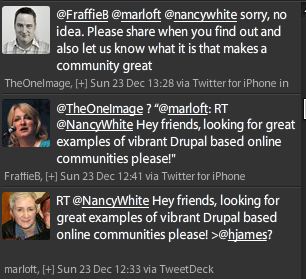
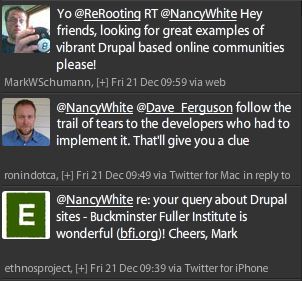
The first concrete suggestion was the Buckminster Fuller Institute (http://bfi.org/). And that was the ONLY concrete suggestion. Cameron Cambell’s (@ronindotca) comment about following a Drupal Developer’s trail of tears may give you a sense of the challenge at hand! Looking at the BFI site, there is little evidence of online community interaction (see http://bfi.org/news-events/community-content). I don’t think Cameron’s observation is far off base!
 So back to my own set of examples, I compiled the following options.
- Share Your Story (http://www.shareyourstory.org) – a long time, well established community. (Technology:Webcrossing. Disclaimer: I was deeply involved w/ this site early on!) This is a great example of when an online community really fills a needed function that is not easily found elsewhere. And of loving community management!
- CPSquare (http://www.cpsquare.org) – private, must be member, but I’m a member! (Technology: WebCrossing and Disclaimer, I’m a member!) This is a private community so no easy peeking, but a good example of some deep learning events.
- BetterEvaluation (http://www.betterevaluation.org) – an example of a new, emerging community based on Drupal (Disclaimer: I’m involved w/ this site!) It is useful to see a site before it really launches its interactive features. (Beta)
- Knowledge Management for Development (http://www.km4dev.org) as both a long lived and multi-platformed global community which uses DGroups, an email centric tool, NING and mediawiki. (I had been on the Core group from its beginning until late last year.)
- The KSToolkit Wiki (http://www.kstoolkit.org) which is about the artifact more than the community.
- A couple of Facebook communities
- RosViz – a community of interest on Facebook (I’m one of the community moderators) – open hearted resource sharing. A good example of focused domain in a very open, outward facing context.
- Network Weaving (just a member!) – Vibrant due to some passionate leadership and blending of synch and asynchronous interaction.
- SCoPE is another good one. This is their FB home https://www.facebook.com/SCoPEcommunity while their main home is a Moodle site.
- I asked for some other Drupal examples and here are a couple:
- A fairly new Trout Unlimited site http://www.troutunlimited.com/ with highly customized Organic Groups module for interactive elements. The interactive elements appear to still be fairly broadcast with little interaction.
- GratefulWeb http://www.gratefulweb.com/ a music fan site. There is some event activity, but little in the way of active discussions or groups http://gratefulweb.com/community/groups They seem active on Facebook and Twitter, raising the cross platform issue. On a guess, I’d say that one or a few people keep this community alive…
Extrapolating Lessons
 It is great to see a successful community and think what they did will automatically create conditions for success for a completely different community. We know this is rarely true. So we need some sort of mechanism to extrapolate the lessons. Perhaps a heuristic that says if X is your goal, patterns 1, 7 and 12 might be useful. This is much harder than it looks due to the lovely complexity of human behavior. Here is what I’m thinking so far, but I’d love your suggestions:
- What visual elements drew you into a site? What “turned you off?” Why?
- In terms of figuring out how to get involved, what was easy? What was challenging? What are the technical and communications aspects of getting people involved?
- What community activities could inspire your community? Which would you avoid?
- What community leadership/management functions did you note as important? Do you have time and skills (or someone else does) to fulfill these roles?
- What surprised you? How can you use that insight in your community?
Reflecting on the Learning Journey
The final bit is thinking about how we apply what we learn on a field trip to our own work. The questions above are one trigger, but the final part of the tour will ask each person to consider the following “next steps.”
- What will be the first/next thing you will do to steward your community based on today’s tour? Why?
- Review your community plan draft and see if there is anything you want to change based on what you learned today.
- Pick one community (from the tour or one of your choosing) and explore it on your own. What else can you learn by digging in a bit deeper? Consider contacting and interviewing the community facilitator/leader/manager. What would you ask them?
Resources for Virtual Online Community Field Trips
- Building a Virtual Tour of Online Communities http://fullcirc.com/wp/2013/01/07/building-a-virtual-tour-of-online-communities/
- CPSquare’s Virtual Field Trip wiki page http://cpsquare.org/wiki/CPsquare_field_trips_project and examples of their field trips http://cpsquare.org/category/quarterly-field-trips/.
- A particularly nice field trip report from a visit to KM4Dev.org http://cpsquare.org/wp-content/uploads/2008/07/KM4Dev-field-trip-report-may2011.pdf
- Relating community activities to technologies http://fullcirc.com/wp/2012/02/14/relating-community-activities-to-technologies/
- Communities, Networks and Engagement http://fullcirc.com/wp/2011/10/17/follow-up-from-the-leadership-learning-community-webinar/