Chris Corrigan – 3 Lessons on Leadership

spiralsChris Corrigan  shares three lessons he learned about leadership while doing work this week with Aboriginal leaders in Canada. This is good stuff. I rarely quote this much, but I sense this is stuff that has value far and wide for all of us. It resonates with the groundswell I hear, feel and read about concerning our need for each other, for community, in turbulent times. And how we take responsibility matters, regardless of label of “leader.” Thanks, Chris.

Teaching one came from Nancy Jones one of the Elders who gave us small blankets with a medicine wheel design based on a vision that she had about unity, leadership and healing.  One of the great teachings in this medicine wheel was about the north, the direction from which winter weather and wind comes.  We laboured here through a blizzard today, waiting for an hour until whoever was coming was going to show up, and working small processes with diminished numbers.  But the Elder gave the teaching that essentially the weather teaches us that “whatever happens is the only thing that could have” and that the chaordic path is an inherent part of leadership: you can never really be in control.

The second teaching was from Ralph Johnson.  I asked him about the Ojibway word “ogiimaw” which is often translated as “chief” or “boss.”  I asked Ralph what he thought the word must have meant before contact, when the concept of “chief” was basically unknown.  He said that word relates to the word ogiimatik which is the poplar tree, the tree that is considered the kindest of trees.  Poplars are gentle, flexible, quiet and kind and are also good medicine.  He said this idea of kindness is what is under the word “ogiimaw” and that influencing people through kindness is the kind of leadership that the word implies.  This is very different from the kinds of leadership implied by the word “chief” which is a  title now won by competition in a band election, a process that seems to engineer kindness right out of the equation.  This is a great legacy of colonization – the lowering of kindness from a high leadership art to a naive sentimentality.

Ralph also gave me one more little teaching that rocked me.  He told me that the word I had always understood as “all my relations” – dineamaaganik – actually means “belonging to everything.”  Seems like a small change in translation, until another Elder, Marie Allen chimed in and said that the problem with leadership these days was the way ideas like “all my relations” activated the ego.  The difference between “all my relations” and “belonging to everything” is the difference between the ego and the egoless I think.  This is what Ralph was trying to tell me.  That the centre of the universe is not me, and things are not all related to me, rather I belong to everything.  Marie and I took a moment to express amazement at the way the earth used us to channel life in a particular shape for a short period of time.  We come from her, we return to her, and in the interim we do our work upon her.

Remembering our bodies when working online

While I blather on about visual thinking, it is important to remember we have bodies. I saw this great quote from Gabriela a while back and have been meaning to share it out. photo by pablosanz on Flickr CCGabriela on Coniecto

How is distributed collaboration affected by the lack of movement and space awareness? People tend to assume that their counterpart works in a similar place, in similar conditions- and this is most of the times false! People tend to guess each other’s reactions in call conferences. People in the same room express through gestures unknown to their counterparts. Is a video channel a solution to this? I don’t think so, although it is very useful in some circumstances.

Twitter as Search Engine or Community Seed

Photo by choconancyThe folks over at BrandonHall, the learning folks who blog lots of interesting links, pointed out a value of Twitter that not all of us may have seen yet. Twitter as a search engine. This was interesting to me because I’m co-leading a short online workshop introducing social media in a global international development network. The question always comes up “why would we be interested in something like Twitter. One application I try to show is Twitter as social listening. But I never really conceptualized it as search.   So I thought I’d put it to the test.
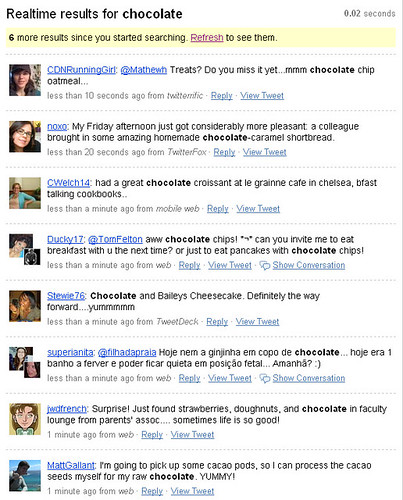
First, I searched for something for me. Chocolate, of course. But you have to have a question in mind to make the search meaningful beyond curiosity. I wanted to get a sense of how many people were tweeting about chocolate, and if their tweets were about their obsession, or if there was valuable information about chocolate flying around the tweetosphere. (Is that a word?)

Well, the answer is yes and yes. The first page of results were from tweets that happened within a two minute time frame. LOTS of volume. For example, flamingo_punk Wrote: “Mmmm! Chocolate mini-wheats rock my socks.” There were lots of passionate chocolate tweets like this. On the information side I found:

  • SavingEverydayOff to work! I leave you with this: An ounce of chocolate contains about 20 mg of caffeine…
  • recr@MortgageChick They say it takes 21 days for a ‘change’ to become a habit. try subing coffee or lattes with hot chocolate. worked for me.
  • 2chaosNYSE commentator: “If the last depression brought innovation, like thechocolate chip cookie, I hope this gives us more than the snuggie” Ha 
That last one bolstered my outlook of the current economic situation. Ha! is right! But chocolate is a wide ranging topic so using Twitter to search and listen would give you many results and you could aggregate that information to watch trends on a topic quickly.
So what happens when I search for a narrower topic that might be of interest to my workshop colleagues, such as “climate change” or “agricultural research?”
Climate change gave me on the first page a lot of links and serious tweets about the issue. Clearly, climate change advocates have taken up tweeting. Note the twitter names — they are using their twitter IDs as a part of the communication issues strategy. It is like a breaking news ticker. The volume of tweets on this topic (the first page of returns were all posts within 15 minutes) indicates this may be a very useful “social listening” resource for organizations working on climate change.
I thought agricultural research might be a bit thinner. I was wrong.  But the timing is much different. The links on the first search page were between 1 and 20 days ago, but they were far more focused than the wide ranging chocolate tag. Interestingly, I knew about 20% of the tweeters on the first two pages — it is a much smaller network. There were also tweet replies @ users within the first two pages, showing connections between those tweeters.  So I start to wonder, is there an audience for agricultural research tweets yet? Is it in the growth phase while chocolate may be overwhelming in the amount of ongoing tweets?
All in all, this 25 minute exercise told me a lot about Twitter as a social listening tool. For me, watching a twitter search stream over time is a form of scanning one subset of the world and what it is thinking about that topic. I am not quite as clear about how searching Twitter as a one-off search can pay off. The time frame is so short, or if you want to go longer, you have to awkwardly search back through page after page of tweets. It is not yet easy. If you captured the stream via an RSS feed and than analyzed it later as a search, that might be easier.
Still, I’m fascinated by the listening site. Watching tweets can tell me about both what people are tweeting, but more interesting to me from a work perspective, is who is tweeting about a topic and how connected tweeters are around a topic.  Is a Twitter topic a seed for a new community?   Can a community or a network emerge around a shared tweeting topic like it can around a social bookmarking tag? Is a trend of tweets a community  indicator? It certainly is when people use a hashtag to tweet event or topic related tweets.
How would a community technology steward use Twitter? Would they want to encourage some sort of community usage of keywords or tags? Would they want to go more focused with a hashtag? Ah, but now I’m roaming far outside of my initial “twitter as search” question. See how tantalizing this is?
Do you use Twitter as a search engine? If yes, how is it working out for you?

P.S. Edited in later — some additional Twitter Search resources, thanks to all you fab commentors. I’ll keep coming back and editing them in.

CoP Series #4: Practice Makes Perfect

CC Flickr picture by matthijsThis is the fourth in a series of blog posts I wrote for Darren Sidnick. I posted three last fall, then sort of forgot about the rest of the series. I’ll get the rest of them up over the next few weeks. Part 1part 2part 3, part 4, part 5part 6,  part 7 ,  part 8 , part 9 and  part 1o  are all here on the blog.

The is the fourth post exploring more about Community, Domain and Practice aspects of CoPs mentioned in the first post of this series on communities of practice (CoPs). This is the “where the rubber meets the road” leg of the stool, Practice.

CoPs are not about learning things in the abstract. They are about learning and putting that learning to practice, and learning from that practice in an ongoing cycle of learn/do/learn. This is why businesses and organizations have been so interested in CoPs — they see them as a way to improve practices in the context of work. While a “to do list” gets you to “done,” it does not surface or share the learning of that task for the next time around. But by linking practice to learning, improvement and innovation is more likely. Here is Etienne Wenger’s description of Practice:

The practice: from http://www.ewenger.com/theory/
A community of practice is not merely a community of interest–people who like certain kinds of movies, for instance. Members of a community of practice are practitioners. They develop a shared repertoire of resources: experiences, stories, tools, ways of addressing recurring problems—in short a shared practice. This takes time and sustained interaction. A good conversation with a stranger on an airplane may give you all sorts of interesting insights, but it does not in itself make for a community of practice. The development of a shared practice may be more or less self-conscious. The “windshield wipers” engineers at an auto manufacturer make a concerted effort to collect and document the tricks and lessons they have learned into a knowledge base. By contrast, nurses who meet regularly for lunch in a hospital cafeteria may not realize that their lunch discussions are one of their main sources of knowledge about how to care for patients. Still, in the course of all these conversations, they have developed a set of stories and cases that have become a shared repertoire for their practice.

Implications of practice

The practice of communities  that are not colocated and whose members are not around and available to each other, can be invisible unless we find ways to talk/show it to our fellow members. So in thinking about practice in CoPs related to distributed communities, what do we need to consider? We each can’t “know it all” about our domain, but by tapping into our community members, we as a whole know and learn a whole lot. The trick is to start to make that knowledge and learning available and encourage the practice of sharing our practice! Here are a few possibilities:

  • Telling stories of our practice – is there both a compelling invitation and a place to tell stories of applying learning out in the world? Oddly, people often think their story is not “important enough” to share, so it is not enough to put up a forum and say “share stories.” Role modeling, acknowledging and encouraging — all forms of facilitation, are critical to nurturing storytelling.
  • Sharing “stuff” – tools, resources, links to other people. Is it easy to post resources to a community website, or to share a “tag” that identfies useful materials on the internet? See http://en.wikipedia.org/wiki/Tag_(metadata) for a definition of tagging.
  • Asking and answering questions – again, both the invitation and the process for this matters. Sometimes it is the “senior” or “expert” members we need to hear from, but it is important to make space and value contributions for all members. Newbies know a lot as well, and bring in fresh perspectives into our communities.
  • Mentoring – is there a mechanism to pair or create small groups of people to mentor and closely follow each others’ practice? This can be REALLY important in large communities where it may be harder for this closer and more intimate form of learning to occur. It also builds the community side of the “three legged stool!” Events – people lead busy lives, so time-limited events (online or offline) can focus attention on the community’s practice and learning.Ongoing conversations – little streams of conversation that connect and keep the community heartbeat going in slower times. This may be the conversations of a small subset.

The exciting thing about Practice in CoP is there are so many things we can do. That is also the problem. So focus on a few things and then grow from there. Don’t overwhelm at first and let the community lead with the practice activities that mean most to them.

If you are a member of or are a CoP leader, share a story about successful practice activities in your community in the comments section.

just to be in the presence of others who understand

image by 2-dog-farm on Flickr ccA few weeks ago I had the great pleasure to jam in an impromptu telecon with Jessica Lipnak, Luis Suarez, Jenny Ambrozek, Lilly Evans, and June Holley about all things online. It was a sort of a net-worker’s jam. Thursday Feb. 26th, at 10am PST we are doing it again. Leave a comment if you want to join us.

Today at 3pm PST, we are doing something similar with a handful of visual practitioners and those interested in the role of visuals in our work.  You can find the details here.

These ad hoc gatherings came out of connections on Twitter. Wondering out loud, finding each other and then moving to action. Pretty cool.

More importantly, they fill a hole that Jessica articulated beautifully with this comment “just to be in the presence of others who understand.” This may mean with people who know us deeply. Or with people who care about something we care about – deeply. These are two kinds of “knowing” – one relational and one domain related. But there is a deep pleasure in basking in conversation with people you “know.”  A joy. A happy dance. 😉

So if you want to join us, let me know. Find your way and connect!

Photo credit:

view photostream
by 2-Dog-Farm