 Now that we are a couple of months into the “signal sharing” of the Communities and Networks Connection, I wanted to share the top posts people have clicked into on the site (courtesy of the magic of Tony Karrer). I find that sometimes I am paying attention to the site, and other times it is off my radar. But when I look at the top hit list below, I recognize many of the posts as ones I have read, so for me, personally, there is resonance with what other people are finding interesting. And I find THAT interesting.
The following are the top posts in March from featured sources based on social signals, with a few annotations from posts that I found useful. Notice how many are about Twitter!
- Twitter Compared to IM, Email and Forums– Collaborative Thinking, March 2, 2009
- Social Media ROI: Measuring the unmeasurable?– FreshNetworks, March 22, 2009
- How to use Twitter for PR– FreshNetworks, March 15, 2009
- Tom Vander Wall Nails My Sharepoint Experience– Full Circle, March 23, 2009
- Circling Around To Enterprise 2.0 Again– Collaborative Thinking, March 12, 2009
- Understanding Communities of Practice– Collaborative Thinking, March 6, 2009
- Crowdsource as a way to create a community– Library Clips, March 15, 2009
- Team-based CoPs compared to cross-functional CoPs– Library Clips, March 11, 2009 (John and I have been having fun in the comments and writing on many related things lately. I like this kind of “juice!”)
- CoP Series #6: Community Leadership in Learning– Full Circle, March 10, 2009
- Twitter as Search Engine or Community Seed– Full Circle, March 6, 2009
- Twitter 3 years on, and why it’s the killer app!– Library Clips, March 4, 2009
- Twitter: Measuring clickthrus Social Media Metrics– Laurel Papworth- Social Network Strategy, March 16, 2009
- CoP Series #5: Is my community a community of practice?– Full Circle, March 5, 2009
- CoP Series #4: Practice Makes Perfect– Full Circle, March 3, 2009
- Examples of online communities in the financial services industry– FreshNetworks, March 17, 2009 (I deeply appreciate examples and cases)
- Why do people write reviews?– FreshNetworks, March 12, 2009
- Enterprise 2.0 for an Enterprise of One – Part Two – Content Monitoring– Portals and KM, March 10, 2009
- The ten commandments of managing online communities– FreshNetworks, March 7, 2009
- Future of Social Networks by Charlene Li– Elsua, March 20, 2009
- CoP Series #9: Community Heartbeats– Full Circle, March 19, 2009
- CoP Series #8: Content and Community– Full Circle, March 17, 2009
- Social media ROI – a calculator for not for profit campaigns– FreshNetworks, March 25, 2009
- Response to “SharePoint 2007: Gateway Drug to Enterprise Social Tools”– Michael Sampson – Currents, March 15, 2009
- Red-Tails in Love: Birdwatchers as a community of practice– Digital Habitats, March 28, 2009 (interesting that my post on our book blog did better than the same post on my blog!)
- Best Buy & Enterprise Social Networking– Collaborative Thinking, March 19, 2009 (This post also showed up as a shared link a lot in my Twitter stream.)
- McKinsey on Making Enterprise 2.0 Work is Reminder of Process Centric KM in Early 90s. – Portals and KM, March 18, 2009
- Enterprise 2.0 for an Enterprise of One – Part Four – Content Collecting, Assembling, and Creation – Potential New Approaches – Portals and KM, March 12, 2009
- Enterprise 2.0 for an Enterprise of One – Introduction– Portals and KM, March 9, 2009
- Team-based communities are about change, commitment and tasks– Library Clips, March 8, 2009
- Tinkering and Playing with Knowledge– Full Circle, March 8, 2009
- Turning Instant Messaging and Presence Upside-Down & Inside-Out– Collaborative Thinking, March 7, 2009 (I had not seen this one, but the title is so intriguing, I’m going to look at it next!)
- Twitter: Skittles does a twitter bomb– Laurel Papworth- Social Network Strategy, March 2, 2009
- The lies behind online ratings and reviews– FreshNetworks, March 27, 2009
- Examples of online communities in the not-for-profit sector– FreshNetworks, March 5, 2009
- Twitter for Business and Government and number of Australians– Laurel Papworth- Social Network Strategy, March 30, 2009
- How to tell a story about yourself without sounding like an ego-maniac– Anecdote, March 26, 2009
- Red-Tails in Love: Birdwatchers as a community of practice– Full Circle, March 26, 2009
- CoP Series #10: Stewarding Technology for Community– Full Circle, March 24, 2009
- Workflow 2.0– Library Clips, March 23, 2009
- Burton Group Field Research Study: Social Networking Within the Enterprise– Collaborative Thinking, March 18, 2009
- Enterprise 2.0 for an Enterprise of One – Part Five – Content Publishing and Archiving– Portals and KM, March 13, 2009 (OK, you guys, look at how many times “Enterprise 2.0” shows up. And also see how multipart blog series – mine and others – are showing up on this list. Coincidence?)
- CoP Series #7: Roles and Scalability– Full Circle, March 12, 2009
- Does your story have impact?– Anecdote, March 11, 2009
- Enterprise 2.0 for an Enterprise of One – Part Three – Content Collecting, Assembling, and Creation – Current Approach– Portals and KM, March 11, 2009
- Impact of Social Software Within the Enterprise by Jon Iwata– Elsua, March 9, 2009
- Twitter in the Workplace– Collaborative Thinking, March 6, 2009
- Business Blogs Trump Social Networking Sites as New Business Drivers – Portals and KM, March 4, 2009
Here are the top from April so far:
- A simple explanation of the Cynefin Framework– Anecdote, April 2, 2009
- Social search, Help engines, and Sense-making– Library Clips, April 1, 2009
- Examples of online communities in healthcare– FreshNetworks, April 8, 2009
- 45 provocative propositions about using social technology– Social Reporter, April 6, 2009
- Is cassette culture to thank for web2.0?– FreshNetworks, April 4, 2009
- Helping councils learn to share with social media– Social Reporter, April 5, 2009
- Extending the customer experience – the Zappos story– FreshNetworks, April 10, 2009
- Using Twitter for the wrong reasons– FreshNetworks, April 9, 2009
- Big brands in social media: Ford and Southwest Airlines– FreshNetworks, April 2, 2009
- Sources for social technology propositions – please mix your own– Social Reporter, April 10, 2009
- The Semantic Web is Now AKA Web 3.0 But is It Really?– Portals and KM, April 8, 2009
- netWorked Learning:connecting formal learning to the world– Full Circle, April 3, 2009
- Social networks: acquisition or retention tools for marketers?– FreshNetworks, April 5, 2009
- Are online communities all a game?– FreshNetworks, April 3, 2009
- Blog networking study: choosing channels– Mathemagenic, April 9, 2009
- Can you shift your organisational culture by introducing social media?– Joitske Hulsebosch, April 5, 2009
- IBM Lotusphere 2009 Highlights – Social Softwre in the Enterprise by Chris Reckling & Sandra Kogan– Elsua, April 3, 2009
- Using experts to get real engagement in online communities– FreshNetworks, April 3, 2009
- Hybrid ecosystem of narratives– Taming the spaces, April 12, 2009
- The Company as Wiki by Best Buy– Elsua, April 11, 2009
- The cultures of collaboration – Inside Knowledge– Full Circle, April 11, 2009
- Technology Stewardship and Unexpected Uses– Digital Habitats, April 9, 2009
- Spidergram to visualise community orientation, adoption, and requests– Library Clips, April 8, 2009
- Behavior Guidelines: Unblocking Social Media at the Firewall– Laurel Papworth- Social Network Strategy, April 6, 2009 (I enjoyed this one a lot)
- The Social Media Experiment Is Over by Adam Christensen– Elsua, April 3, 2009
- Grass roots inspiration from graduating social entrepreneurs– Social Reporter, April 3, 2009
- Winemakers’ Communities of Practice– Full Circle, April 1, 2009
- Blog networking study: establishing and maintaining relations via blogging– Mathemagenic, April 9, 2009
- User Adoption Strategies for Lotus Connections– Michael Sampson – Currents, April 8, 2009
- Why is word-of-mouth for brands so important?– FreshNetworks, April 4, 2009
- The Net Promoter Score and the value of Promoters– FreshNetworks, April 1, 2009
- Challenge: SharePoint and NGOs/NonProfits -go or no go?– Full Circle, April 10, 2009
- Technology Stewardship and Unexpected Uses– Full Circle, April 9, 2009
- Communities, e-participation, crowdsourcing, innovation, selling content: variegated links– eme ka eme, April 7, 2009
- The Many Meanings of Our Words– Full Circle, April 7, 2009
- Monday Video: Share– Full Circle, April 6, 2009
- Comments on Jeff McKenna’s Agile Development Blog– Portals and KM, April 6, 2009
- UC And Web 2.0 / Enterprise 2.0– Collaborative Thinking, April 3, 2009
- Digital Habitats Community Orientation Spidergram Activity– Digital Habitats, April 2, 2009
- Travel Budget Slashes, Meeting Crunch and Going Virtual– Full Circle, April 2, 2009
- Successful Social Networking for Business Collaboration by Ed Brill– Elsua, April 1, 2009
- Nancy Dixon’s Conversations Matters Blog– Portals and KM, April 1, 2009
- The Ultimate Question: The Interview– Community Guy, April 8, 2009
- Our top five posts in March– FreshNetworks, April 7, 2009
- Slides from SharePoint Master Class in Europe– Michael Sampson – Currents, April 6, 2009
- Have a disagreement? Resolve it virtually– Endless Knots, April 2, 2009
I can also sort out the top keywords, but I have to mess a bit with how they display, so I’ll save that for a separate time.
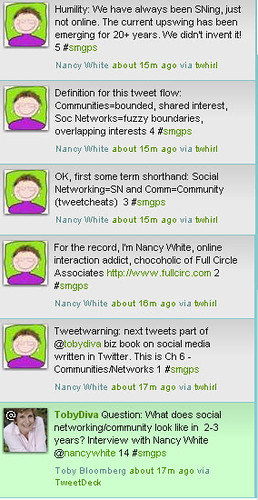 Toby Bloomberg is not the type to let the dust gather. She is always looking at things, asking “what can we do with that” and, rather than just asking, she starts trying and doing. She is a force to be reckoned with!
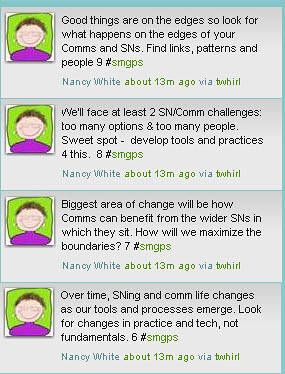 Now that Toby is on chapter six, she has sussed out the process a bit and suggested earlier in the week that preparation is worth it, and that trying to not get carried away with too many tweets is also useful. That asks the writer to be both succinct per post (140 characters) and overall. With the size of the question Toby asked me, that was challenging. How to be brief but substantive, eh? It is harder than it looks.
 Are we pushing a medium too far or is this a useful, creative application? Or something all together different?
 Throughout the year I’m involved in quite a few conferences and meetings. This year, the ground is shifting. Travel budgets are being slashed (faster here than in Europe as far as I can tell) and people are starting to think more seriously about the non financial costs such as carbon emissions of the travel and the plain old wear and tear on our bodies traveling across time zones and geography.
 It seems every conversation I have with someone here or overseas starts with some comment about “these times we are in.” Moreso for my US colleagues, but the change in economic times is on everyone’s mind. I’m doing more work online and less on the road. Budgets for current projects are sticking pretty steady, but no one seems to know what tomorrow will bring. For us independents, this uncertainty is nothing new, but clearly the playing field has changed.