Corporate Learning Trends and Innovations Nov 17-21

Most of you know me in the non profit world, but Tony Karrer of Tech Empower convinced me I could contribute to a corporate learning event. So take a look at what he, Jay Cross and George Siemens have put together for Corporate Learning Trends and Innovations » Corporate Learning Trends and Innovations 2008
November 17-21, 2008 | Online | Free

Join us to explore new developments, track emerging opportunities, network with other learning pioneers, and deal with topics you don’t find at the conferences you have to travel to. Come online the week of November 17 for a different kind of conference experience. Mark your calendar now. The event is free. Events are live and online.

Hook up with fellow innovative thinkers and international visionaries to gain insight into what’s going on, swap opinions, and shape the future of learning. Share your suggestions with the organizers at learntrends.com

My contribution will be on Online Social Architectures – Networks and Communities. And her is my disclaimer. I have more questions than answers, but I’m pretty darned convinced that the relationship between networks and communities – the fuzzy boundaries between them – is where important stuff is happening. Learning. Innovation. Work.

A huge sigh of relief – a title

Warning – this is a venting blog post!

For nearly four years my dear friends and colleagues John Smith and Etienne Wenger and I have been writing this thing that became a book. You’ve heard me periodically obsessing about it here in my blog. Writing communally is one of the hardest and most rewarding practices I’ve ever done, especially when done with smart, diverse people. It is both heaven and hell. It is almost unending. But the end is in site.

We finally picked a title. FINALLY. FINAL-FRICKEN-TASTICALLY. What started out as Stewarding Technology for Communities, (site to be renamed today!), then veering around many ideas, including the recent “Digital Nests” theme, we landed today on something that both brought the warmth and natural world and a metaphor that works with the topic of the book.

So drum roll pleasssseeeee!

“Digital Habitats: stewarding technology for communities”

Now, I dare ask, what do you think?

I could not resist searching for a few Flickr creative commons images for the post … not intended as book images, but just … just… because I CAN!

Haworthia viscosa in habitat
Linda Lanes Habitat
Linda Lane's Habitat

Flickr Creative Commons Photo Credits:

CoP Series #3: Community – without people?

Here is the third in a series of guest blogs I did for Darren Sidnick, reblogged here with his blessing!) focused on CoPs in a learning context –> From: Darren Sidnick’s Learning & Technology: Community – because without people, you just have a pile of content. Or worse… nothing!  Part 1part 2part 3, part 4, part 5part 6,  part 7 ,  part 8 , part 9 and  part 1o  are all here on the blog.

Community – because without people, you just have a pile of content. Or worse… nothing!

This is the third post surfacing a bit more about Community, Domain and Practice mentioned in the series on communities of practice (CoPs). This time we’ll “go social” and talk about the community aspect. From the “no duh” perspective, there is no community without people. Here is Wenger’s explanation of Community in the context of CoPs.

The community: from http://www.ewenger.com/theory/
In pursuing their interest in their domain, members engage in joint activities and discussions, help each other, and share information. They build relationships that enable them to learn from each other. A website in itself is not a community of practice. Having the same job or the same title does not make for a community of practice unless members interact and learn together. The claims processors in a large insurance company or students in American high schools may have much in common, yet unless they interact and learn together, they do not form a community of practice. But members of a community of practice do not necessarily work together on a daily basis. The Impressionists, for instance, used to meet in cafes and studios to discuss the style of painting they were inventing together. These interactions were essential to making them a community of practice even though they often painted alone.

Right off there are the practical implications of Community in the context of elearning.

  • You have to find the people and, if they aren’t already connected or convened, make that happen. Is there an existing community you can tap into, or do you have to actually set one up? Are you ready for that?
  • Members have to have some sort of relationship with each other – so there needs to be conditions for not just information exchange, but social interaction. How does that fit with your mission and role?
  • Social interaction is neither linear, nor is it always neat and within the confines of structured things like “courses.” Are you ready for a little unorder?
  • Relationships develop over time. Courses end? What are the boundaries you need to set and what can be open ended? How will that be supported?

These questions might give you pause – and for good reason, but lets also look at the benefits of community. From a learning theory perspective, a lot of learning is social, meaning it happens between us, not always as a solo activity. In fact some of us seem to need social learning more than others. When Etienne Wenger and Jean Lave coined the term communities of practice, it was part of their work on understanding learning and the importance of social learning. Again, from Wenger:

Social scientists have used versions of the concept of community of practice for a variety of analytical purposes, but the origin and primary use of the concept has been in learning theory. Anthropologist Jean Lave and I coined the term while studying apprenticeship as a learning model. People usually think of apprenticeship as a relationship between a student and a master, but studies of apprenticeship reveal a more complex set of social relationships through which learning takes place mostly with journeymen and more advanced apprentices. The term community of practice was coined to refer to the community that acts as a living curriculum for the apprentice. Once the concept was articulated, we started to see these communities everywhere, even when no formal apprenticeship system existed. And of course, learning in a community of practice is not limited to novices. The practice of a community is dynamic and involves learning on the part of everyone.
From http://www.ewenger.com/theory/

Community as curriculum — for me, that is a pretty juicy concept. So let’s just end this blog post at the edge of the cliff. What does that mean to you? How might you imagine your learners as community and thus as a way to extend and deepen your curriculum?

CoP Series #2: What the heck is a Domain and why should I care?

This is a reblog of a guest blog post I did on Darren Sidnick’s Learning & Technology Blog: What the heck is a Domain and why should I care? (CoP with Nancy White). I’m republishing them here with Darren’s blessing! Part 1part 2part 3, part 4, part 5part 6,  part 7 ,  part 8 , part 9 and  part 1o  are all here on the blog.

What the heck is a Domain and why should I care?

Flickr photo by IdeaideiaIn the first in our series on communities of practice, (CoPs) I briefly mentioned Community, Domain and Practice. In this blog post I want to dive a little deeper into Domain. Because Etienne Wenger does such a great job of defining domain (and he really helped me understand it) I’ll start with his definition, and use his definitions later for Community and Practice as well:
The domain: from http://www.ewenger.com/theory/

A community of practice is not merely a club of friends or a network of connections between people. It has an identity defined by a shared domain of interest. Membership therefore implies a commitment to the domain, and therefore a shared competence that distinguishes members from other people. (You could belong to the same network as someone and never know it.) The domain is not necessarily something recognized as “expertise” outside the community. A youth gang may have developed all sorts of ways of dealing with their domain: surviving on the street and maintaining some kind of identity they can live with. They value their collective competence and learn from each other, even though few people outside the group may value or even recognize their expertise.

So Domain is what we care about together. It is what is important enough for us to make time to participate, to learn these crazy online tools if that’s how our community connects, and makes us prioritize it over the many other things we have in our busy lives. So it has to matter! So if a learner is taking a course because they “have to”, we need to think carefully about if a community is the right approach.

Domain is not static
Domain is also one of those things that seems obvious at first — we are interested in learning about how to become entrepreneurs — but ends up being a bit more subtle. In large communities, there may be a big, overarching domain, with smaller, more specialized subgroups. In some communities, the domain may be relevant for only a short period of time and then the community naturally comes to the end of it’s life. The domain may shift when new people join or initial core members leave. Not all domain’s are “eternal!” So the first lesson about Domain is that it is not static and it has to reflect and respond to the interests and needs of the member. So we might start a CoP on entrepreneurs coming out of a business course offering, but it may turn out that the core of the group is really interested in marketing for small businesses, or developing a horticulture business. Then you get to that “ignition” point where the interest and passion is sufficient to get the community going. That “commitment” that Etienne describes in his definition. Over time, the domain focus might shift again — and responding to that shift is critical for community sustainability.

Community and personal identity
Domain also has to do with something else important in communities of practice: identity. The domain gives the community as a whole an identity, and it also is part of the identity of individual “members.” Shawn Callahan from Anecdote often says a useful test of a domain is to be able to identify with it personally. So in a community of entrepreneurs, you would say, yes, I’m an entrepreneur. But it may have a lot more personal meaning if it was “yes, I’m own a small horticultural business” and thus the more specific domain has more meaning.

So if you are thinking about a communities of practice approach with your e-learners, ask yourself, what might be the domain of my community? Try it out on some of your learners. See what they tell you. If it resonates… keep going. If they look at you like you are crazy, keep refining your ideas about domain WITH them. Because after all, it will be THEIR community. If you do this little experiment, leave a comment here and share a story of what you learned!

Here is another story about domain: http://joitskehulsebosch.blogspot.com/2008/07/communities-of-practice-and-bulldozers.html

Flickr Photo Credit:

view photostream Uploaded on July 10, 2008
by ideaideai

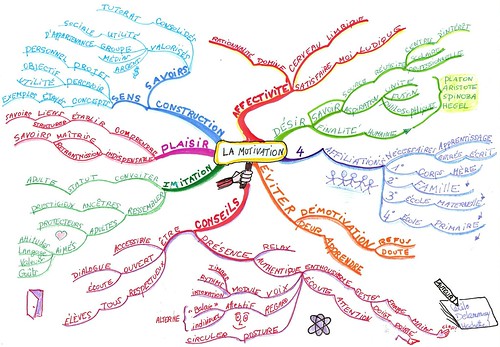
Engagement and motivation in collaborative action

Flickr photo by Philippe Boukobza
Tony Burgess, one of the founders of the CommpanyCommand community (and author) made a great post on Com-Prac this week around engagement in communities of practice. It was so terrific, I want to point to it and share a snippet from his post.

com-prac : Message: Re: [cp] CoPs and unpaid volunteers
The question I have asked myself is, “What is the experience of becoming an
especially active member of a community of practice?” In the process of
searching out this question, what emerged for me was a sense for what makes
members’ experience meaningful. It is the depth of meaning that they make from
the experience of being an active member that seems to propel them forward in
their journey. In a nutshell, here are three factors that stood out to me:

The experience is meaningful to me (an active member) along three dimensions:

(1) Connection: As a result of this experience I am becoming connected to
like-hearted leaders who I value. This is about relationship.

(2) Contribution: I am able to give back and make a difference–to contribute
my unique experience and talent to something greater than self. I am making a
positive difference for people and a collective that I value.

(3) Personal Development: As a result of this experience, I am personally
developing and becoming more effective as a leader and a person than I would
otherwise be. I am being exposed to people and experiences that change me. I’m
learning.

Given this understanding, a follow-up question follows:? “What can we as a
community of practice do to be a catalyst for the meaningful experience of
members?”

These three dimensions are terrific. They are also pretty general. A good starting place, but I think in practice, we need to go deeper. How do we understand these motivations? Both in CoPs and in other collaborative settings.

In yesterday’s telecons in our Knowledge Sharing Workshop, we asked what people thought motivated others to share knowledge. We talked about “gaining visibility for work” and “getting useful information.” They were all “true” answers, but very general. Easy to say yes to on first blush, but often prioritized at the bottom of giant to-do lists and thus engagement rarely happens.

Then we asked them personally, what motivated them to share their knowledge in the workshop and the answers were much more specific and actionable. People had a task they needed to do involving knowledge sharing. They wanted to expand their network of colleagues working in KS because they didn’t have enough of those people in their daily work life. And yes, some of them wanted to share because they believed in sharing. Those seem to be the people we can count on, but make up a fairly small percentage of any group we are working with.

When we are trying to design, support, create conditions for collaboration, how do we best suss out motivation to increase the chance of actual engagement? What are your “sussing” strategies?

Photo Credit:

view photos Uploaded in Flickr on February 4, 2008
by Philippe Boukobza