Relating Community Activities to Technologies

[Edit Feb 23: The notes and recording link of this event can be found here: http://faciliteeronline.nl/2012/02/the-spidergram-for-getting-started-with-and-evaluating-communities/comment-page-1/#comment-7704]

Next week I have the great pleasure of facilitating a webinar for some Dutch colleagues of mine. In preparation, they asked me to put together a bit of background to prepare folks for our conversation. I decided to share it on my blog as well, in case any of you, dear readers, had additional insights to add. In other words, walking the “network talk!” [Edit Feb 20 – see the great pre-event comment stream here: http://faciliteeronline.nl/2012/02/digital-habitats-technologies-for-communities-webinar-with-nancy-white/]

The group I’ll be conversing with is a group of 12 people who are involved in learning and change processes in their organizations or with their clients. (This reminds me of Beth Kanter’s Peeragogy.) They are on an 8 month learning journey and have been exploring things like social media  (which reminded me of this post on how I use social media – albeit a bit dated), communities of practice, online communities and the like. Now is the time to start weaving across those technological and process areas. So a perfect time for community technology stewardship!

As we prepared for the webinar, some of the random potential bits for discussion included the practice of tech stewardship, the pros and cons of  “hopping across technologies,” the tension between thinking about the platform AS the community instead of the people — especially distributed communities, what it means to ‘be together” as a distributed group, more on online facilitation, and how to identify community activities and tools useful in supporting those activities. The webinar will focus mostly on the latter and we’ll use the Activities Spidergram from “Digital Habitats: stewarding technology for communities,” as a learning tool. But to set the stage, I wanted to write a bit about the other topics. Sort of a  lead in to the activities conversation. At the bottom of this post, I’ll link to all the artifacts we’ll use next week. And if someone prompts me, I’ll return after the webinar to post an update in the comments! (That means — show me you are interested/care!)

What it means to be together using technology

Groups, communities, pairs, networks are all about people connecting, being together in some way. In the “olden days” this meant being together face to face augmented by these artifacts which carried documentation of our being together called books, and letters that we slowly exchanged with each other via land based transport. Today we spend time with each other online — not just face to face. That may look like reading, replying to or retweeting messages via Twitter, interactions on Facebook, email, blogs, Skype, YouTube, Pinterest or any of hundreds of web based platforms. These platforms convey and hold the artifacts of our interactions. They are the digital traces of being together. But the EXPERIENCE of being together is something we create in our own minds as we navigate these artifacts. Without conversation with others, we may find our individual experiences of “being together” are, in fact, not at all similar. So the first key here is that being together, even technologically mediated,  implies that we have to reflect – at least a little bit – about shared or different experiences. Otherwise we may not be “being together.”  Sense-making is critical. So if I’m designing or facilitating a social strategy using online tools, I had better darn well design in process to facilitate reflection, sense-making and other similar types of conversations. Yes, conversations, which implies active listening — something you can’t always see or have in pure social media actions.

One of the tough things about all this is how to understand what is working. Is there really connection? We tend to compartmentalize the tech into things like page views. But does that tell us about our quality of being together? Of learning? Of getting things done? Not really. So in thinking about being together in this age, we need new frameworks for assessment. A nice intro to thinking about communities and how to evaluate them comes from a short video from the USAID KM Impact Challenge

Hopping across technologies

If you accept my first proposition that being together requires some sort of sense-making/reflective aspect, lets add on a layer of complication: hopping across different tools and technologies. So not only are we not face to face, but we don’t necessarily interact as a full group, nor on a single communications tool and this may (and usually does) vary over time.  Community’s technological configurations change over time. Let’s pick this apart a bit.

1. There is rarely just one tool. From Digital Habitats we framed the idea of configuration this way: “By configuration we mean the overall set of technologies that serve as a substrate for acommunity’s habitat at a given point in time—whether tools belong to a single platform,to multiple platforms, or are free-standing.”  For example, we may have a NING site, but we talk to each other on the telephone and no one every identified the telephone as an official community tool. 😉 Look around. Our configurations are rarely as simple as they look. Observe and notice what people are using. Explore if there is a shift from the official platform to others and use that usefully, rather than as a distraction.

2. Togetherness does not imply only full group interactions. Side conversations and “back channel” are an intrinsic and important part of a community’s communication ecosystem.  We talk about “capturing” knowledge and having everything in one place, but the reality is that communities have all types of conversations and interactions. Some should stay small and private. Some should be captured and shared. And some will just happen. The key is that people are connected enough so that they DO happen. The interaction has primacy over the container or the captured artifacts … even if this seems counter-intuitive at times.

3. People start where they are technologically comfortable, and move to what serves them over time. Now this may seem like a repetition of #1, but what I’m getting at here is change in technologies is actually part of the life-cycle of many communities rather than an aberration or fatal disruption. (Though, yeah, it can be fatal, but less often than we might expect!) The key lesson here is start where people are “now” and let the needs of the community, its appetite (or not) for experimentation and change drive the platform evolution.

4. A change in technology may intrinsically change the interaction.  In our research for “Digital Habitats” we noticed that not only did technology change communities, but communities changed technologies. When members wanted or needed something, they invented new ways of using tools or scrounged for new ones.  When the motivation to do something together becomes more urgent and compelling than the platform, it’s affordances or constraints, you know something good is going on. So attention to the community’s domain, community and practice (see that video above!) should be front and center. Technology supports.

 Technology stewardship

So if technology changes what it means to be together, if technology choices change over time, it is logical that stewarding that technology becomes part of the life of the community and there is an association between the people who do this and a role — a role we call technology steward. Technology stewards are people who know enough about technology to help scan for, select and implement tools and enough about their community to know what they need and what they want/can tolerate. This is not the traditional IT person or pure geek, but someone who straddles these two domains of knowledge and practice. They are bridgers. (You might enjoy this 6 minute audio from Etienne Wenger, John Smith and I on tech stewardship. ) For example, consider the person who can observe how others use a tool (even if it is different than how they themselves do), notice how it can be valuable to the community and share that practice with others. (An ethnographer!) You have to know the tool, but to observe and understand the practice — that is the magical sweet spot. (For an example, see John Smith’s post on Skype.)  Most of us who find ourselves in this role are in it accidentally. I think that is significant!

Community activities and their technological support

So this leads me to the bridge to our webinar next week. Flowing directly out of this idea of technology stewardship is the need for ways to identify important community activities as a precursor to selecting and deploying tools. In the work writing Digital Habitats we identified 9 community orientations which comprise sets of activities that we found happening pretty commonly across different kinds of communities. This slide deck gives a brief overview.

A couple of key things the spidergram exercise has taught me are: 1) observe your community with an open mind rather than through your own preferences. I, for example, love asynchronous conversations, yet in many of my communities, they would not thrive without telephone calls. 2) You can’t prioritize all 9 orientations all at once, but they may shift over time. This impacts community leadership, facilitation, and technology. So as always, this is not primarily about the tech, but about the community. That seems like a “no brainer” yet time and time again we fall into the technology seduction trap! That leads us to community facilitation, but we’ll have to save that for another day!


I’ll be asking the group to read Chapter 6 of Digital Habitats and then begin to fill out a spidergram for a group or community they belong to or work with. I’m also inviting them to post questions here or over at their group blog. But for the rest of you, what sort of advice would you offer for those trying to steward technology for their community? Post in the comments, please!

Resources


Updates from Communities and Networks Connection

I’m continuing cleaning up and adapting my  technology configuration this week. Here is part 2!

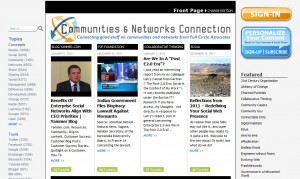
I confess, I don’t pay nearly enough attention to all the good things flying past me, including things on my own Communities and Networks Connection. In case this is new to you, this is an aggregation project led by Tony Karrer. He set up a system that lets me curate content from a wide variety of bloggers interested in communities and networks (If you aren’t on the list and want to be, drop me a line!). Tony just let me know that Aggregage, the platform that powers has some new features that are now on the  Communities and Networks Connection.  Announcing the PERSONALIZATION ENGINE! That means that Communities and Networks Connection now allows you to sign-up and have your content personalized based on their interests. You can sign-up via the “Personalize Your Content” button on the right side of the interface shown on the right side of the picture on the right (right, right?).

Tony has explained it well on his site, so I’m quoting the master. He refers to his own aggregation site, eLearning Learning 

Now with personalization it’s even better. The picture below gives a sense of what’s happening:

Aggregage-Personalization

Curators handle finding the best sources of content.  The system then uses social signals such as those coming from Facebook, twitter, LinkedIn, delicious as well as clicks and views.  These are compared to averages for the source and also looks at who is providing the signal, how often they signal things, how often they signal for that particular source, etc.  Those aspects existed before and it does a good job of finding great content.  You can read a bit more about these aspects in eLearning Learning Launches New Features.

What’s new now is that the site allows you to sign up and provide your Twitter and LinkedIn information.   The site will look at your activity on these sites and the content of what you share.  It will use that to find interests as well as to cluster you with other users who are like you based on interests and sharing.  You can partially control your interests via the Subscription page as shown below:

eLearning-Learning-Subscription

This will change over time based on your LinkedIn and twitter activity.  You can always visit and manually select interests as well.  You can read a bit more here: Personalization Explained.

The system then can combine three pieces of information to figure out what will be most interesting to you:

  • Social signal score – are people in the audience finding it interesting
  • Topic match – does it match up with your interests
  • Like sharing – are individuals who are like you sharing this

The system uses these to both rank things on the site and to generate Daily and Weekly newsletters.

The reason that I’m most exited about this is that I partly use eLearning Learning to make sure I don’t miss things that is good content that is relevant to me.  Now with personalization, it is even less likely that something will sneak by.

I also personally like the format of the new newsletter.

Give it a try and let me know what you think.

So I’ll add my pitch – give it a try and let me  know what you think. In the mean time, here is the best of Communities and Networks Connection 2011


Hot Topics for 2011
2011 (4593)
People (2501)
Social (2225)
Share (1603)
Sharing (1603)
World (1555)
Change (1546)
Networks (1534)
Community (1515)
Difference (1467)
Business (1431)
Development (1425)
Management (1349)
May (1324)
Media (1298)
Information (1296)
Open (1240)
P2P (1220)
Learning (1191)
Groups (1181)

Digital Habitats Editable version of Chapter 10 – Action Notebook

John Smith likes to work on his vacation, it seems. 😉 Thanks to him, we now have an editable version of Chapter 10 of Digital Habitats… which in essence is a collection of all the worksheets from the book. I’ll let him explain! This is from the book blog.

We wrote Chapter 10 of Digital Habitats as a combination summary of the whole book and as a workbook that organizes the content in a roughly chronological / process order (instead of the logical, expository order we use in the book itself).  We imagined that people would copy pages of the book and write their responses on paper.  And we published a PDF version that you could print out and write on as well.  But we’ve found that it’s useful when people complete it together, discuss it, and share it at several different stages of “completeness.”

Anybody can vew the Google Doc version of Chapter 10

Step 1: View the Google Doc version using this URL: http://bit.ly/DH-chapter10

Recently a group of students in the Foundations of Communities of Practice workshop completed a Word-Doc version of Chapter 10.  It turned out that the process of responding to the questions was very useful to them and the results were very interesting to compare, even thought the communities represented seemed quite different one from another.

Being able to write in the Word Doc was more useful than the PDF version because the boxes could expand according to how much there was to say about a particular topic for a particular community.  (And in one community that was at a very early stage of development, it was useful to complete just the front end and skip the rest of it.)

Here’s how to make a copy so you can work through the questions that are relevant to your community using Google Docs:

  1. Step 2: Save your own copy of the document

    Point your browser to the original:http://bit.ly/DH-chapter10 .  You can’t edit the original version, but anybody can view it.  Log in to Google Docs. (See Step 1.)

  2. Save your own copy of the document by selecting “Make a copy” on the drop-down menu under “file”.  (See Step 2.)

  3. Find your new copy in your list of Google Docs and begin the hard / fun part: thinking through all the issues discussed in Chapter 10!  (See Step 3.)

Step 3: Edit your copy, discuss, and share.

We are considering having some systematic group discussions in CPsquare, comparing completed responses for many different communities.  I anticipate that the issues raised in Chapter 10 will be challenging and difficult for some communities, obvious for others, and irrelevant for some.  Understanding more about those differences should be very useful to all of us.

If you have a completed workbook that you would like to present, please let me know.  Either way, stay in touch!

via Digital Habitats: stewarding technology for communities » Editable version of Chapter 10 – Action Notebook.

Thanks, John!

Planning and Evaluating Your CoP (amplifying and other good stuff)

Today JeffJackson tweeted an embedded link to this YouTube video from the USAID KM Impact Challenge video I did with them earlier this year.  I know – I posted this already, but Jeff’s note gave it a twist. And having hung out recently with Alan (aka cogdog) Levine in Tasmania last week, I am attending to his principle that in social media, we ADD value. We don’t just retweet, rebroadcast, etc. Jeff added value.

Here’s his note: “Check out @nancywhite ‘s Full Circle Associates on Communities of Practice (CoPs). Great way to review and consider how you develop your #PLN and #AltProDev.” Wow, I had not thought about this from the perspective of a PLN (personal learning network) but it sure does work. Thanks Jeff, for helping me see another perspective.  I used the same communities of practice framework the last three weeks in my workshops in Australia about teaching and learning online. We weren’t talking about CoPs, but the framework is useful. (More on that in a subsequent post, currently in edit stage!)

For a refresher, here is the video.

Nancy White discusses various aspects of strengthening CoPs, mechanisms to measure their effectiveness and improve our understanding of how people are participating in CoPs.

To access the two items referred to in the video, please visit:

Promoting and Assessing Value Creation in Communities and Networks: a Conceptual Framework:
http://wenger-trayner.com/resources/publications/evaluation-framework/

The Activity Spidergram
http://fullcirc.com/wp/wp-content/uploads/2011/06/SpidergramWorksheet2011.pdf

Reflecting on #socialartists and #change11

My week facilitating #change11, a very massive MOOC, flew by too fast for me to blink. (See these previous posts for more background.) Between being on the road so much and the distributed nature of the conversations, my head was spinning by Friday and it has taken until today to slow down, reflect and write. I’d like to reflect on both the content and process of “week 8” where we focused mostly on the idea of “social artists” in learning and technology. Well, honestly, mostly just on the social artist bit. As always, I was too ambitious in my planned scope. I am happy it narrowed down to social artists. That was enough!

First, the process. #Change11 is structured around whatever theme or idea the facilitator of the week offers. Up until now that has been kicked off by a piece of writing, a recording or some structured artifact where the facilitator shares his or her big ideas around change, technology and learning. There is at least one synchronous event per week (more often two) hosted on the platform formerly known as Elluminate (now BB Collaborate, and I think worse for the transition). There is the #Change11 daily which aggregates posts from the lead facilitators (George Siemens, Stephen Downes and Dave Cormier), posts and tweets tagged with #Change11. There are some quasi-centralized discussion outposts on Facebook, Google+ (see this tool to find Change11 circles on G+)  and Moodle, but most of the action seems to be on blog posts/comments and Twitter. In other words, the landscape one might traverse for learning and sensemaking is broad and diverse. I’m not the only one trying to make sense of this. See “We are always catching up” http://squiremorley.wordpress.com/2011/11/04/change11-playing-catchup-part-3/#comment-190 and https://jennymackness.wordpress.com/2011/10/26/the-selfish-blogger-syndrome/#comment-1666

Of course, I didn’t structure my week around a piece of writing. I was interested in explore the experience of change and how the social artist plays a role in that experience. Instead of content slides, I ginned up a deck full of questions and whiteboard templates inviting people to express themselves together visually, textually and if so moved, to grab the mic. (The before and after slides are here, but don’t expect them to make much sense as a stand alone presentation, and more like digital traces of what we did together. ) I ended with a challenge to find stories of social artists in their learning lives and to blog and or tag them #socialartist. And of course I scheduled both session late in the game, giving few time to get it on their calendar. Did I mention I have been busy? Can you read my sense of guilt between the lines? Yup. Giulia Forsythe then invited me to a follow up session later on Monday, and we had a final hour on Friday where George and Stephen interviewed me which was both interesting and weird. I think I got a little verclempt. Ahem! Judge for yourselves!

I then tracked tags to try and read and comment on most of the blogs that either blogged in general on the #socialartist idea or took up my challenge. Here are a few of the links (and yes, I’m still catching up commenting on some of them! DO look at the comments in these posts! Lots to think about)

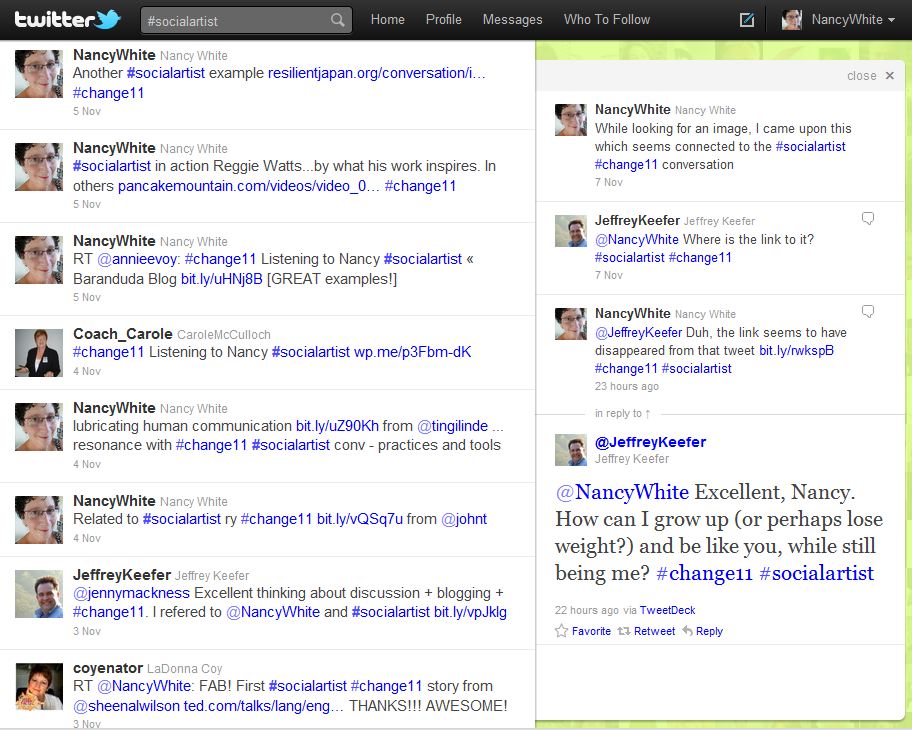
Here are some of the tweets archived into a Tweetdoc.

So now the content. The alleged synthesis and sense making. NOT! I don’t think I can do it, but here are the things that have been emerging for me through all these distributed conversations.

What IS a social artist?

So, what is a social artist and why did I think it might be relevant to #Change11? I’m not sure we landed on a clear definition. I started with the concept I borrowed from Etienne Wenger-Trayner, who has talked about the social artist as a person who makes the space for the social aspect of learning. Here is a quote from him from 2008 on David Wilcox’s blog which really resonates for me:

“The key success factor we’ve found is learning citizenship where learning citizenship is a personal commitment to seeing how we are as citizens in this world. Let me give you an example: I know an oncological surgeon in Ontario, Canada who asks himself how to provide the social infrastructure for patients to learn about cancer. An act of learning citizenship is to be able to use who you are to open this space for learning. I’ve come to call these people social artists, people who can create a space where people can find their own sense of learning citizenship.

“I love social artists. In fact I worship them. First because social artists know how to do what I only know how to talk about; and second because I care about the learning of this planet. I think we are in a race between learning and survival. We live in a knowledge economy where any expertise is too complex for any one person. One person can’t be an expert so anyone who can give voice to that need to work together is a social artist.

“I do a lot of consultancy work for training community leaders, but in my heart of hearts I know the real secret of those social artists is not something I can teach. The real secret of those people is knowing how to use who you are as a vehicle for opening spaces for learning.  I don’t really have the words – but I just know when I see it. It is a way of tapping into who you are and of making that a gift to the world … it’s about being able to use who I am to take my community to a new level of learning and performance.

“I want to leave you with three questions…

  • How can you act as a learning citizen in this world?
  • How can we as a group help , sustain, celebrate that capability among ourselves? If EQUAL has done a bit of that – how do we capture it, nurture it cherish it?
  • For those of you who are movers and shakers – how can you build an institutional structure that enables people to find their voice in the interests of the people they want to serve? Social artists need to fight … How can we enable a structure that enables those people to do the work that they do?

“These are urgent questions. Social innovation is a matter of the heart, not just projects. We need you to do that for the world, not just Europe”.

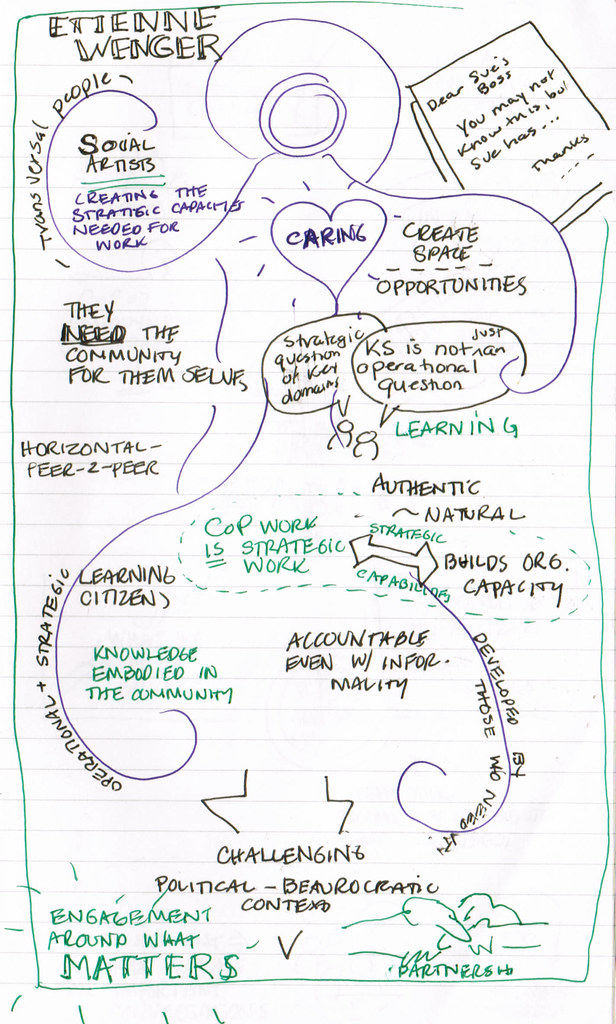
You can also hear Etienne talk about social artists (as well as other community issues) in this keynote from September’s ShareFair in Rome. The sketchnote above is from that session.

Jean Houston defines social artistry as:

Social Artistry is the art of enhancing human capacities in the light of social complexity. It seeks to bring new ways of thinking, being and doing to social challenges in the world.

…Social Artists are leaders in many fields who bring the same order of passion and skill that an artist brings to his or her art form, to the canvas of our social reality. (See also the Jean Houston Foundation page)

As I juxtapose Etienne and Jean’s meanings of the concept, I am finding out how to link  the roles to learning. From Etienne’s questions “How can you act as a learning citizen in this world? How can we as a group help , sustain, celebrate that capability among ourselves?” I hear the call to recognize the social acts of learning more explicitly and to attend to the people with social artistry skills. Nurture and recognize them. At the least, remove barriers to their participation. From Jean, I glean the parallels of passion and skill from art forms, to the social canvas.

The other thread was the juxtaposition of “social” and “artist” — where some had the concept of the solo artist, working alone to create a product of their work, while here the canvas is not only ephemeral through the interaction of people, but the role is inherently WITH people and social, not solitary. One person also noted the tension between the idea of a scientist and an artist which is to me one of the artificial constructs we create by dividing art and science. They have roots which intermingle.

Here are some links where people really picked up on the art part, which thrilled me.

In case you want more on visual practices, check out https://onlinefacilitation.wikispaces.com/Visual+Work+and+Thinking

Why is social artistry useful?

As the week went on and we sought out examples of social artists, and as we did this, I also realized it was useful to tease apart the social artist as a person (their role, skills, talents, way of being in the world) and the practices of social artistry which are often named as process arts, facilitation, network weaving, etc. People pointed a lot to specific practices, like the power of engaging people in using the white board in the online webinar space, how to use both silence and music instead of talking all the time, commenting on others’ blogs, helping them feel heard, designing connecting out into the world into her classroom, asking great questions, and such. I think people really resonated with these familiar practices, but we struggled with the less tangible ones. Like the kinds of people who just open up and hold space for people to be together and learn. The people who do that lightly and without manipulation. The people with big ears, big hearts and generosity of spirit. How do you tie that tangibly to education when we haven’t a clue how to measure it and I think many of us wonder if it can be learned, or it is something some of us just carry with us. The “fluffy bunny” stuff which I know, in my heart, is not fluffy at all, but very profound. I have seen the difference “being seen, heard and loved” means to people. But I can’t call it out in clear, intellectual terms that some people sought. I could not answer them. At the same time, I felt a quick kinship to those who recognized it. Are we finding our tribe? I don’t know.

Finally, it was very interesting to note that both the experiences of the synchronous gatherings (particularly the first one) and the concept of social artistry really seemed to resonate with some people, baffle some people and find no relevance for others. This was VERY interesting to me. In The Queen Has No Clothes, George wrote about feel-good commentating:

This week’s MOOC #change11 has not held my interest. Without doubt, Nancy White is a charismatic facilitator, using graphical tools to have participants express themselves and develop a particular view. I think this approach (using such graphical tools) is excellent for the participants.
I learned long ago that my wonderfully produced mathematical notes were excellent – for me. The iterrative process of producing these and improving them was valuable to me, the writer. My students needed to produce their own versions (yes, to construct their own knowledge), for this to be valuable for them. So the outcome of the process did not mean much without being a participant.
Also, there seemed to be an inordinate amount of “feel-good” commentating. Why? Could there be a cultural difference?
Hence my Tweet: the Queen has got no clothes on. There, I said it.

Tonight I responded:

I’m still chewing on what I understand to be underneath – the lack of resonance for you (and others!) about social artistry in the context of change, learning and technology.

When we moved into “interview Nancy” mode during the Friday session and George started asking me questions which felt more academic to me, I started to get some insight into the fact that while I know “inside” what social artistry is because I believe I practice it, I still can’t clearly articulate it in a way that fits in with learning theories and the deeper, intellectual grounding that many of you have. I’m a simple practitioner. So making that leap is .. well, hard.

As I listened to today’s session w/ Dave and rhizomatic learning, I kept being troubled by his reference of the rhizomatic learner as a nomad. The metaphor of the nomad — at least the romanticized notion of a nomad is a solitary being, forging off on her or his own.

This has a disconnect for the social aspect of learning for me. I’m not saying all learning must be in a social context, but a heck of a lot of it is. Those who pay attention to making that space where this learning happens play and important role. Thus the social artist.

We ran out of time and never got to the transversalist. That’s another interesting kettle of fish!

I need to go back and dig into what George meant about “feel good comments” — what makes a comment feel-good? What other qualities of comments might we use or name? A whole ‘nuther interesting thread.

The loose ends…Onward

You know what they say. Once you start looking for something you had not noticed before, you start to see it everywhere. Like when I became pregnant with my first child, I saw pregnant women everywhere where before they didn’t even show as a blip on my radar screen. So as the week went by, I kept Tweeting related #socialartist  links. For example, not change11 directly, but related social artist practices from Barbara Ganley http://community-expressions.com/2011/11/04/lessons-learned-part-one-listening/ and from the  Facebook Convo, an link to  http://en.wikipedia.org/wiki/Habitus_(sociology) from Vanessa Vaile who wrote “PS I see strong traces of habitus in Digital Habitats” which of course tickled me! I can even see glimpses of social artistry in this more general reflection on Change11 https://bigreturns.posterous.com/change11-looking-forward-and-looking-back

Habitus is the set of socially learnt dispositions, skills and ways of acting, that are often taken for granted, and which are acquired through the activities and experiences of everyday life. Habitus is a complex concept, but in its simplest usage could be understood as a structure of the mind characterized by a set of acquired schemata, sensibilities, dispositions and taste.[1] The particular contents of the habitus are the result of the objectification of social structure at the level of individual subjectivity. Hence, the habitus is, by definition, isomorphic with the structural conditions in which it emerged.
The concept of habitus has been used as early as Aristotle but in contemporary usage was introduced by Marcel Mauss and later re-elaborated by Pierre Bourdieu. Bourdieu elaborates on the notion of Habitus by explaining its dependency on history and human memory. For instance, a certain behaviour or belief becomes part of a society’s structure when the original purpose of that behaviour or belief can no longer be recalled and becomes socialized into individuals of that culture.

Habitus is the set of socially learnt dispositions, skills and ways of acting, that are often taken for granted, and which are acquired through the activities and experiences of everyday life.Habitus is a complex concept, but in its simplest usage could be understood as a structure of the mind characterized by a set of acquired schemata, sensibilities, dispositions and taste.[1] The particular contents of the habitus are the result of the objectification of social structure at the level of individual subjectivity. Hence, the habitus is, by definition, isomorphic with the structural conditions in which it emerged.The concept of habitus has been used as early as Aristotle but in contemporary usage was introduced by Marcel Mauss and later re-elaborated by Pierre Bourdieu. Bourdieu elaborates on the notion of Habitus by explaining its dependency on history and human memory. For instance, a certain behaviour or belief becomes part of a society’s structure when the original purpose of that behaviour or belief can no longer be recalled and becomes socialized into individuals of that culture.

Here are some other places where Social artistry appeared in front of me this week

Want more #Change11? The schedule is here.

The beauty of a MOOC is the way you can sail into ideas, people, memes, and streams. Here are some people and their streams I want to read more of: