Communities in Classrooms at UBATIC+

[Edited Nov10 to note that at the bottom of the post, I’ve uploaded a PDF of the Google Translated version of the web discussion. I so appreciated the spirit of this conversation, even though we were working across languages with machine translation.]

This week there is what looks to be (using Google Translate) a great online conference called UBATIC+, a virtual gathering about ICTs and teaching in higher education hosted by the University of Buenos Aires, Argentina. It was great to be asked to offer a short (14 minute) contribution which Silvia Andreoli has captioned in Spanish. I’m impressed — I’m not always so easy to follow!


via NANCY WHITE – YouTube.

I’m trying to follow along as best I can — my video and discussion launches Friday and I wanted to have some context for the conversation. And to get used to Google translate’s view of ICTs in higher ed! 🙂 Language always presents such an interesting barrier. I don’t speak Spanish, but because of my Portuguese, I can decode some things. But I still find it incredibly tiring. It is important to remember this feeling — at a gut level — because so often I’m the one talking a mile a minute in English to people who are trying to think through two or three languages!

Updated: Here is a quick PDF of the web conversation. UBATICDiscussions

KM Singapore Recap

Last week I had my first trip to Singapore and was a keynote speaker and workshop presenter at KM Singapore. My talk was entitled “The Heaven and Hell of Communities!” If you want the short version, a 2 minute recap can be found here. (I just blogged about the Graphic Facilitation workshop as well.) I want to thank the fabulous Edgar Tan, Wai Kong and Patrick Lambe of Strait’s Knowledge for hosting me. You guys ROCK!

I spent quite a bit of time thinking about this presentation, so I thought I’d share some of that process, acknowledge and thank those who helped me, and then share the slide set.

Process

My first instict was to use my communities and networks to “think out loud” about the tensions that are mounting in the productive and strategic use of communities and networks. Little did I realize that I was actually setting myself up for the very challenges I was trying to talk about. Filter failure. Lack of discrimination and strategy in how I tapped my networks. Too much on my plate. Mama mia. It was all in front of me, and I wasn’t even seeing it.
My first round was asking on Twitter for “radical ideas” about knowledge collaboration. Then I set up a Google Doc to start sharing my ideas and solicit comments. THEN I added one more mechanism, Google Moderator (which it turns out, I’m not so fond of) which gave me more diverse input. Then I started scanning more generally on my network and the “kismet” factor kept turning up more and more interesting and relevant links. These are still a disorganized mish mash on the Google doc. I think I’m not such a great Curator! (Robin, now you know why I was massively inarticulate on this topic when we last talked in Rome!) Thanks Jennifer, Dave, Eugene and Christopher and the rest of my network!

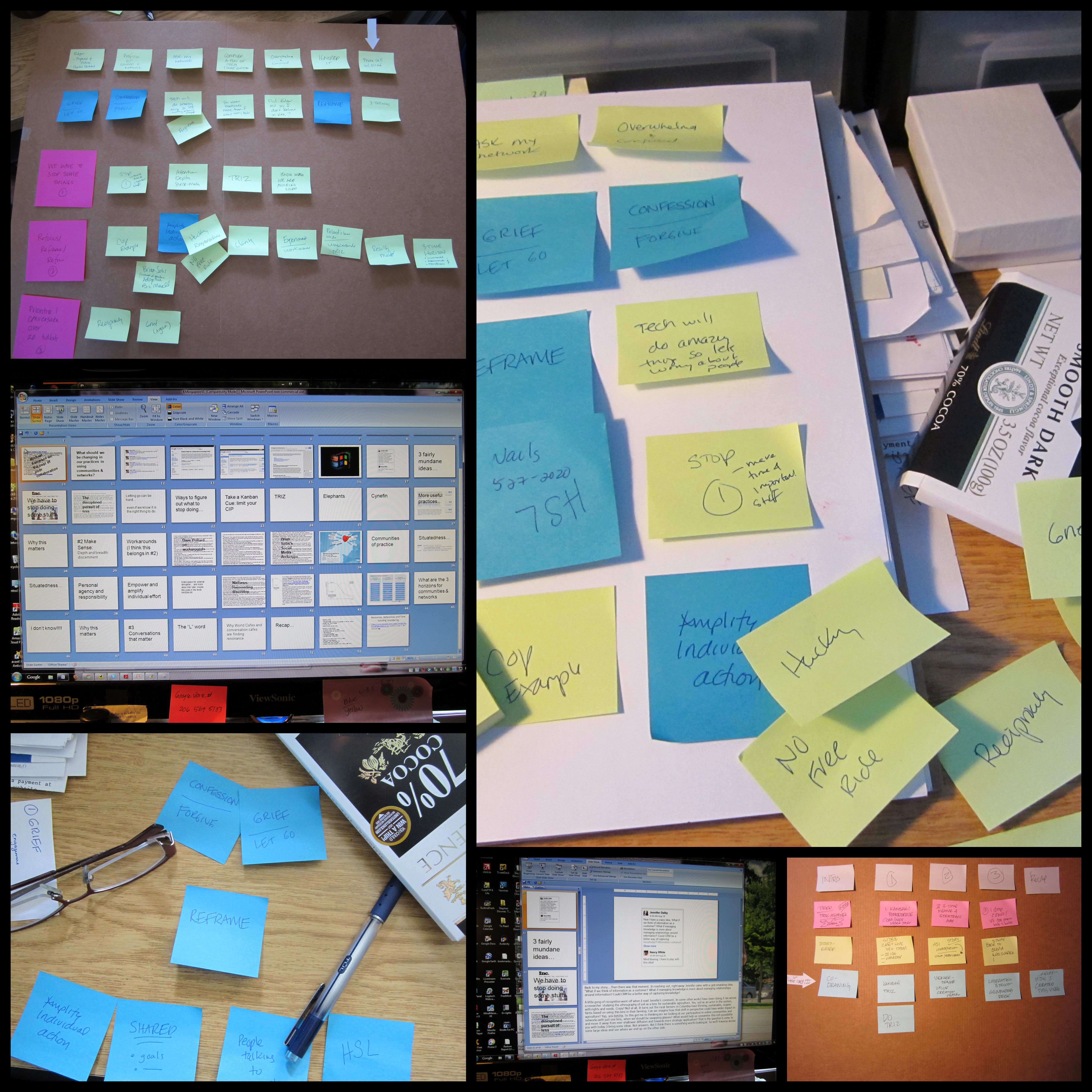
I was pretty darn well overwhelmed, so I let it all sit. Then a week before I was due to travel, I started with my “post it note” presentation planning, pulling out three main thoughts, supporting information, key anecdotes and at least 2 actionable suggestions for each main point. I begin to feel urgent, so I started dumping things into PowerPoint, with the intention of drawing the visuals for the slides once I had them set. But they just would NOT SETTLE in my mind or on the screen. So I decided to travel with things “unfinished.” Sometimes at the event, in the PLACE things fall into place. But I could not chase away some niggling worries.

I got a bit nervous as things had not fallen into place. Then the night before the keynote they did. David Weinberger’s keynote on day one totally resonated with what I wanted to talk about. Patrick Lambe’s talk analyzing the incident review of a major breakdown in Singapore’s public transit system told the perfect story validating the three points. In fact, almost every talk had a resonate point or reference. And somehow the language around the points got clearer as I reread some of my favorite work of friends. The idea of resilience instead of mitigation, of creative destruction to make room for strategic participation in communities and networks, and of conversations that matter all  felt right.

As an aside, here are my Sketchnotes from some of the other presenters!

[slideshare id=14227608&doc=kmsingapore2012sketchnotes-120909221148-phpapp02]

Slides

The room at the Swissotel was pretty bright and images on previous slide sets were washing out. I usually use visually oriented slides – either photos or my own drawings. I realized a simple, bold text strategy might be better in this room, so that actually saved me some prep time. I rarely use text, but I think this worked out OK.

I was surprised how popular the slides were on Slideshare, even without any notes or narration. I was featured on Slideshare one day! Now I need to get the  audio/video so there can be a bit more sense making.

[slideshare id=14196396&doc=heavenhellofcommsnetsfinalkmsg12-120906192628-phpapp02]

Feedback

The room seemed to feel some resonance with the messages.  The group was fairly quiet through the whole two days of the event, so one would not expect whooping and shouting, but the follow up questions were very thoughtful and we continued some of these in the afternoon “Knowledge Market.” The three time horizons from Steve Waddell, the ideas I borrowed from the sustainability field around resilience instead of just mitigation and the chance to STOP doing something resonated. Patrick and I now want to work more on practices for creative destruction! Stay tuned for a workshop series.

All in all it was great fun.

Related Links and Event Artifacts
“This isn’t what I thought it was: community in the network age”

Earlier this year some of my online friends (Val Cortes, Lisa Endersby and Ian Simmie) invited me to be part of a panel they were preparing for  Canadian Association of Colleges and Universities Student Services Conference: Engaging Digital Citizens <http://www.cacuss2012.ca> in Vancouver BC, Canada.  The topic was on communities and learning, building off of some lessons learned from the project the three of them had been doign.

 Abstract
What does it mean to be a member of a community in the digital age? In this session you will begin to explore how student affairs professionals can use available technologies to create vibrant and engaging online communities. Through discussing the SASA Leadership Educators Resource Network (LEARN) online community as a case study and the lessons from the LEARN membership survey, we will explore the creation and facilitation of this and other distributed work, learning, and community groups.

Summary
Developing and maintaining a vibrant and meaningful online community requires purposeful care and nurturing. Many of the tools that student affairs professionals use in their daily practice can be applied to the digital world. In this session, we will review the theory of online community facilitation and we will provide specific group facilitation tools, strategic-planning models and engagement strategies that participants can implement in their own contexts. Finally, we will share the lessons that we have learned as LEARN facilitators and creators. The session will feature a remote presentation with a colleague in Victoria and, potentially, with a Seattle-based consultant and international online group facilitator of distributed work, learning and community groups.

To warm things up, Lisa Endersby wrote this blog post. My job was to add something about this ecosystem of group forms that address the diversity of small groups, individuals, bounded communities and networks. I’m particularly interested in the interplay between communities and the broader networks they live in and “by.”

This was all well and good, except due to my not paying close attention to dates, I was not available to do something live online with them as I was going to be, ironically, driving to Vancouver for Northern Voice and the Online Community Enthusiasts gathering.  So we decided that I’d record a short piece for them to weave into their presentation. This makes life easy for me in terms of preparation, but dang, I sure missed the interaction!

Then the F2F team was going to ask the participants some questions. I’m reposting them here because they continue to be useful questions. Every time I engage in a conversation about communities, communities of practice, networks, groups — whatever form — we run into a lack of clarity of what we are talking about.

  • What is your definition of community?
  • How do you know when/if you are a part of a community? How do you know when/if you aren’t part of one?
  • Can you join an online community (‘obtain a membership’)? What does this look like?
  • What is your first reason/goal for entering an online community?
  • Are there any risks to being part of an online community?
  • What are the benefits of online communities? Which one(s) resonate(s) most with you?

As I prep for some presentations and workshops at KMSingapore next week, these questions remain alive, along with the question “how do we useful work with profusion of networks, groups and communities we MIGHT belong to?” What are the strategic choices and practices? Stay tuned for more…

CPsquare’s NING Stackathon – Tech Stewarding Learning Opportunity!

Are you stewarding technology for your community? Did you or are you considering a NING site? You may want to join in with CPSquare’s NING Stackathon. It will last for a year, but I suggest you get in on the ground floor now. John notes at the bottom that if you are willing to contribute a case, he will waive the (VERY MODEST) entry fee. Plus you get a six month CPSquare membership. Folks, JUMP on this!

Here are the deets, via http://cpsquare.org/.

Launching our Ning Stackathon

By: John David Smith

playful stackHackathons are the current equivalent of a barn-raising, where people get together and work really hard for a short period of time on a fun project that somehow contributes to the common good.  We’ve used barn-raising as examples of the kind of personal, skin-in-the-game generosity that’s involved in communities of practice.

We’re inventing a new portmanteau.  A Stackathon is working party that’s slower-paced than a hackathon and more reflective.  It gathers useful examples of something with a lot of sense-making built into the process.  Therefore a stackathon is not like the current craze for content curation.  Read on for details about CPsquare’s first Stackathon.

During this stackathon we’ll gather profiles and portraits of as many living Ning-based or Ning-supported communities as possible.  We’ve started developing a list of interesting examples.  As we stack these communities one on top of another, we expect to discover new hacks that could make any of them more effective, sustainable, and fun. (And those hacks are probably relevant to simpler or more elaborate platforms than Ning, too!)

We will try to be somewhat systematic in describing how Ning is configured for each community and how it fits in the community’s digital habitat. We’ll pay attention to the ongoing role of leadership, facilitation, and technology stewardship. That means understanding what the community is about, what kinds of activities are typical, and what other tools a community uses in each community. Understanding that would give us a better idea of how and when to recommend Ning. Our stack will also suggest many possible methods that one community could borrow from another (including the use of auxiliary tools, plug-ins, themes, membership restrictions, etc., etc.).

During the stackathon (which will run for a whole year, from March 2012 to April 2013) we’ll have discussions in CPsquare’s Web Crossing site (password required: it’s for CPsquare members and people registered for the Stackathon), we’ll collect ideas in various Google Docs, we may have teleconferences, and we will collect some of our insights on CPsquare’s Media Wiki site. It all depends on what people want to do and are willing to do.

You can participate in the stackathon by joining CPsquare or by registering for the Stackathon here (costs $10). Any Stackathon registrant who contributes a full community portrait gets their registration fee refunded and they receive a CPsquare membership during the last 6-months of the Ning Stackathon.

(Thanks to Amboo Who for the photo!)