And so recently, we’ve prototyped an exercise at various workshops and events called ’2 degrees of separation’ that has worked so remarkably well that a) I wanted to share it and b) see if anybody can help prove exactly how it works. The way we have run it to date is as follows:
In a room of at least 30 people, ask everybody to think of a project or problem they are working on right now where what would really help them is to be introduced to a specific person or organisation.
Invite people to then take it in turns to shout out the name of who they are trying to reach, and also to briefly introduce themselves (if necessary) and why they want this introduction.
Ask the whole group if anybody knows that person or organisation directly, or might know how to reach them, and if so to raise their hands.
If so, just point them out to each other so they can chat afterwards and repeat the process a few times.
We’ve now done this exercise 3 or 4 times with group sizes varying from about 30 to nearly 100 and every single time we’ve been able to make a productive connection. And whilst I thought it would probably work I am struck how well it has worked so far.
According to Stanford University’s Carol Dweck, the psychologist behind the much-praised book Mindset: The New Psychology for Success, the attitude that we bring to our creative work—and to mentoring our juniors—can play a huge role in shaping just how much of our inborn talents we realize.
One of the most important things that I think I offer the individuals and groups I work with is to notice their contribution, their creativity, passion, persistence –> whatever the quality. The article calls this people’s “inborn talents.” I think it is more than inborn, but I won’t quibble…
I call my role or function “holding up a mirror.” Helping people see for themselves their power and agency. But that is an oversimplification. So it seems useful to consider how we give feedback — it matters. Take a look at some wise words from Stanford University’s Carol Dweck.
Could you give me an example of how that language would actually play out if I were giving someone feedback?
A fixed mindset approach would be saying something like: “This project turned out amazing. You’re a genius. I knew you had the talent. This is proof of it.” As opposed to a growth mindset approach of, “Wow, this project turned out fantastically well. I loved the way you mobilized the team, the way you kept everyone focused, the way you brought it to fruition, the way you made everybody feel the ownership.” These are things you can replicate and that you should replicate the next time. Whereas, when I say, “You’re a genius!”…how do you reproduce that over and over?
And what about when you need to give someone criticism? Or point out an area that needs work?
As I mentioned, when you are giving criticism, you need to carefully critique the process someone engaged in and discuss what skills they need to learn and improve.
But I’ve also fallen in love with a new word—“yet.” You can say to someone who fell short: “You don’t seem to have this,” but then add the word “yet.” As in, “You don’t seem to have these skills…yet.” By doing that, we give people a time perspective. It creates the idea of learning over time. It puts the other person on that learning curve and says, “Well, maybe you’re not at the finish line but you’re on that learning curve and let’s go further.” It’s such a growth mindset word.
The “yet” thing is interesting and it reminds me of the power of “Yes, And,” from improv. Interesting that searching for a link took me back to the 99U site! Look at this. It both cases, I don’t think the feedback is limited ONLY to specific feedback — I really liked what Dweck said in response to the first question. But also having some lack of clarity also leads to possibility. Thus Roland’s fuzzy mirror photo inspired my thinking a bit more. Clarity on feedback, and possibility going forward. How’s that? How do you give feedback?
Click on the link and read the whole post — it is short.
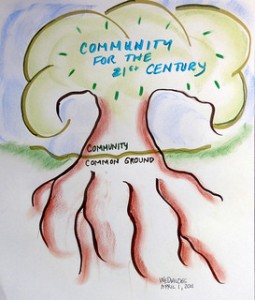
My friend Tim Merry has taken to saying that we can’t do community engagement we can only do community. Or not. I think this is a compelling idea. Engagement is meaningless now as a term. We are seeking real community, a genuine sense of being in this together. Whether it is public policy or building infrastructure you have the choice to do it to people or do it with people. Just using the word “engagement” is not enough.
Time to put real power behind the idea of community.
I have a little inkling that the practice of deciding what not to do is related to Chris and Tim’s insight. But I haven’t quite chased down the thought yet. Ideas?
This past weekend I’ve been hanging out at the National Coalition for Dialog and Deliberation‘s national confab, NCDD2012. Synopsis? Amazing people. Also it was great to connect with folks I’ve met/known online and demoralizing to NOT connect with others who were there in the flesh. Not enough time or energy. 🙁
Thursday I took part in pre-conference workshop using the fabulous Group Works Deck to map out the elements of a variety of group methods and processes. (I wrote about the deck a while back here. )
As we did the exercise, I realized that I needed the narrative with the map, so took these off the cuff videos, now debuting as this week’s Monday Video.
What I noticed about the mapping was the more we did it, the more discerning we became at identifying the essential “spine” of a method AND,through reflecting on the other possibilities offered by the patterns in the cards, observed new ways of “fleshing out” the method depending on context. In other words, the cards enabled us to have great learning conversations about the methods. Very cool. I plan to use the cards a lot in the coming weeks of crazy work and travel! I also deeply appreciated all the knowledge in the room. As I learned about Participatory Budgeting from John Kelly, I was getting all kinds of ideas about how to reapply the basic idea to Knowledge Sharing/Budgeting (in terms of time and attention — which seems to be a big problem in my world these days!)
At the meeting, I also was part of a fabulous team of visual practitioners who volunteered to do a visual capture of the plenaries of all three days as a unified product. Tim Corey helped us envision a 24 x 8 foot image and then we all figured out a) how to work together to b) make a coherent capture. I’ll write more about this later after our debrief, including links to all the fab people I got to work with. But it was great fun and a lovely learning laboratory.
Other NCDD Materials:
NCDD 2012 Tweets (I hope someone Storify’s them or harvests them before they are gone. It was not a huge tweeting crowd, but there are some good captures!)
My photos, including some not-so-great images of the giant collaborative graphic capture 8 of us worked on (better images to come)
We use cookies on our website to give you the most relevant experience by remembering your preferences and repeat visits. By clicking “Accept”, you consent to the use of ALL the cookies.
This website uses cookies to improve your experience while you navigate through the website. Out of these, the cookies that are categorized as necessary are stored on your browser as they are essential for the working of basic functionalities of the website. We also use third-party cookies that help us analyze and understand how you use this website. These cookies will be stored in your browser only with your consent. You also have the option to opt-out of these cookies. But opting out of some of these cookies may affect your browsing experience.
Necessary cookies are absolutely essential for the website to function properly. These cookies ensure basic functionalities and security features of the website, anonymously.
Cookie
Duration
Description
cookielawinfo-checkbox-analytics
11 months
This cookie is set by GDPR Cookie Consent plugin. The cookie is used to store the user consent for the cookies in the category "Analytics".
cookielawinfo-checkbox-functional
11 months
The cookie is set by GDPR cookie consent to record the user consent for the cookies in the category "Functional".
cookielawinfo-checkbox-necessary
11 months
This cookie is set by GDPR Cookie Consent plugin. The cookies is used to store the user consent for the cookies in the category "Necessary".
cookielawinfo-checkbox-others
11 months
This cookie is set by GDPR Cookie Consent plugin. The cookie is used to store the user consent for the cookies in the category "Other.
cookielawinfo-checkbox-performance
11 months
This cookie is set by GDPR Cookie Consent plugin. The cookie is used to store the user consent for the cookies in the category "Performance".
viewed_cookie_policy
11 months
The cookie is set by the GDPR Cookie Consent plugin and is used to store whether or not user has consented to the use of cookies. It does not store any personal data.
Functional cookies help to perform certain functionalities like sharing the content of the website on social media platforms, collect feedbacks, and other third-party features.
Performance cookies are used to understand and analyze the key performance indexes of the website which helps in delivering a better user experience for the visitors.
Analytical cookies are used to understand how visitors interact with the website. These cookies help provide information on metrics the number of visitors, bounce rate, traffic source, etc.
Advertisement cookies are used to provide visitors with relevant ads and marketing campaigns. These cookies track visitors across websites and collect information to provide customized ads.
 Ah Seth, we know the troll of which you speaketh in your blog post, Seth’s Blog: A field guide to the Meeting Troll.

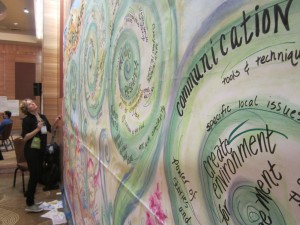 At the meeting, I also was part of a fabulous team of visual practitioners who volunteered to do a visual capture of the plenaries of all three days as a unified product.