Facilitating Strategic Planning in Complex Contexts

My clients have been asking for more support in planning for the future. In almost every case there have been internal or external factors that suggest significant inflection or turning points. Policy changes due to political shifts. Growth in networks. Shifting priorities. Emerging possibilities. New combinations of partners.

They usually ask for traditional strategic planning. I have realized I don’t do this anymore. Won’t. Forget your SWOT analysis. I’m fully into the “liberating planning” space. A liberated facilitation space. This work has been deeply enhanced by my collaboration with folks like Keith McCandless and Fisher Qua, fellow “struturalistas!” Many of the words below came from or were inspired by them and others from the Liberating Structures community.

Context
Why do we need complexity informed planning? Three big reasons.

  • Portfolios, not just projects: Very few organizations have just one element, yet planning is often linear and isolated at the project level. Strategically we need to take a portfolio perspective on planning which is quite different than “planning a project.”  When you work at the portfolio level, you are looking not for a single success (or failure), but for signals that can show how to move the whole field forward. A portfolio approach can help buffer against the typical three-year grant funding cycles and keep focused on strategy. Tactics should include “safe fail” probes (http://cognitive-edge.com/methods/safe-to-fail-probes/) and experimentation in areas of uncertainty, and then, once some clarity has emerged, scale up or adapt to more mature results.  Among many useful things, the Liberating Structure Ecocycle Planning (http://www.liberatingstructures.com/31-ecocycle-planning/ ) supports a complexity informed portfolio approach.  Interestingly it also allows simultaneous work on strategy and tactics.
  • Complexity requires complexity informed facilitation practices. A portfolio approach is complex, with many unknowns, variables and dependencies. Even within a project, the challenges people are facing are rarely simple cause/effect problems. They are complex. It does NOT mean that things are SO complex, we simply can’t address the complexity.The facilitation implication is that people need a handle on complexity, to recognize it, work with it, and not get overwhelmed by it. If we are to tackle system level problems, we need a repertoire suited for complex contexts. Look at the work of Cognitive Edge (http://cognitive-edge.com/ )  , Harold Jarche and many others. (http://jarche.com/2010/10/organizations-and-complexity/, https://jarche.com/2016/04/complexity-in-the-workplace/ , http://www.ontheagilepath.net/2015/10/complexity-and-methods-to-succeed-thanks-for-the-books-organize-for-complexity-and-komplexithoden.html and https://www.odi.org/sites/odi.org.uk/files/resource-documents/10604.pdf )

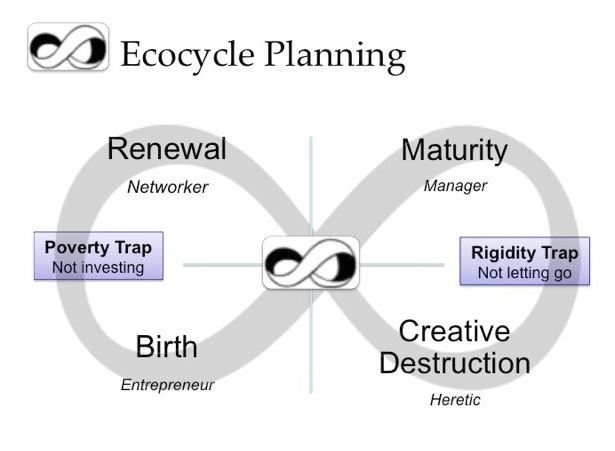
  • Planning itself becomes an Ecocycle. My recent work with the Ecocycle Planning tool has opened a new repertoire of facilitating in complex contexts by helping us recognize that our work does, and should, span the four spaces of maturity, creative destruction, networking and birth. The Ecocycle recognizes that we operate across a range of contexts and projects that are, from a Cynefin framework perspective, simple (rules based), complicated (expertise driven),  complex (not predictable) and chaotic (we will never fully know!) A manager may feel most accountable for the maturity space, where tested approaches can be scaled up. But without an eye to the pipeline in, simply managing the mature space is self-delusion. It may require making space through creative destruction. Opening up to wider networks to identify new possibilities and steward them through the innovation process. Yet maturity is the manager’s area of comfort. To embrace the other areas, they must see the action of the continuum of the Ecocycle. (EDIT: For some great background on Ecocycle see https://www.taesch.com/references-cards/ecocycle by Luc Taesch!)
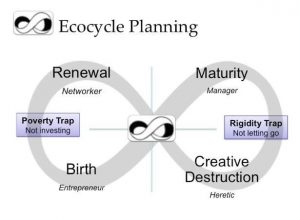
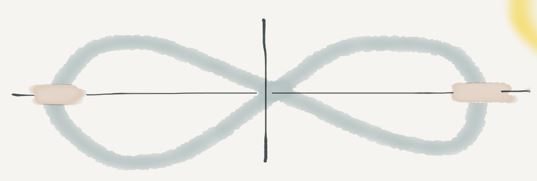
The patterns I notice across the Ecocycle and other useful facilitation processes for working in a complex context are that:

  • they ask us to shift our perspective about how past experiences inform our present analysis,
  • they support the emergent (often unpredictable), and,
  • they are iterative.

Another thing I notice is that this practice embraces a different mindset for planning which also attracts REALLY INTERESTING people. That, of course, attracts me.

The Adaptive Strategy Landscape for Project Design & Development

We have been struggling about what to call this and how to describe it. My newest experiment is “Adaptive Strategy Landscape.” I’m currently designing a workshop for practitioners in international development to use Liberating Structures in project design – thus my need to blog about this and think out loud with you. I am drawn to the term “landscape” because it is visually strong, and implies an ecosystem of inter-relating elements. I am very open to other name suggestions. 😉
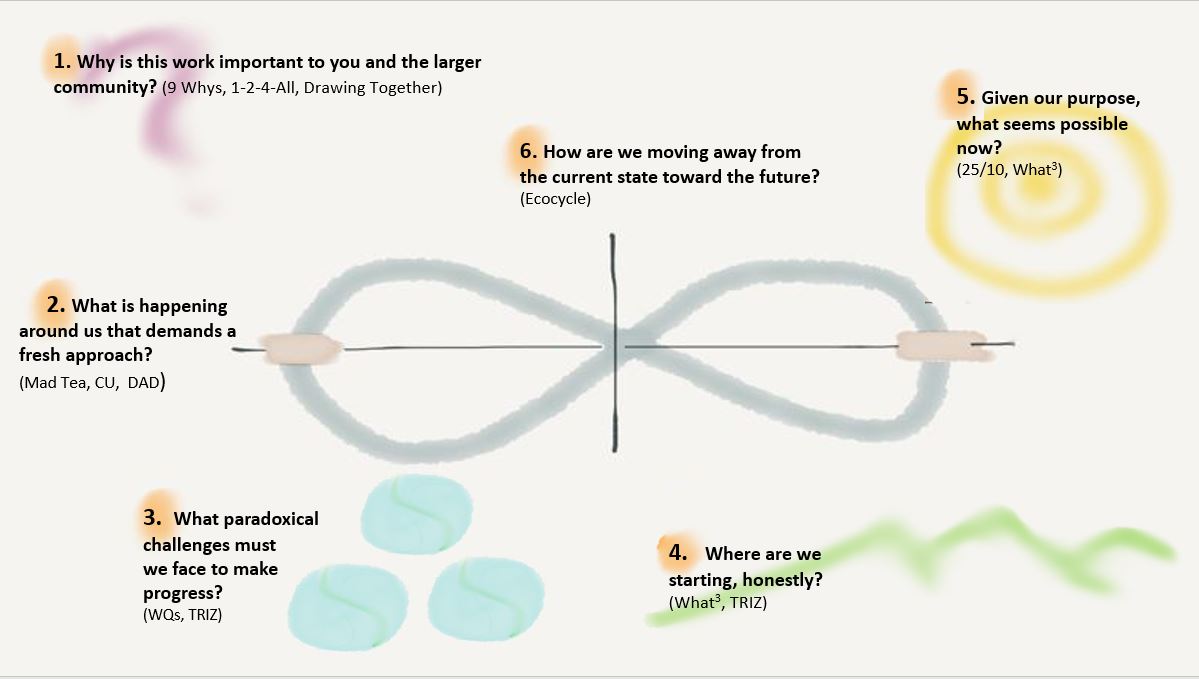
So what does this Landscape, this “emergent, complexity-friendly strategic planning” actually look like? Right now we are framing it around six questions I learned from Keith. Typically I tinker and modify them to the domain in question. This is their generic form.

  1. PURPOSE: Why is this work important to us and the wider community?  How do we justify our work to others? What makes this important?
  2. CONTEXT: What is happening around us that demands change? This question is particularly energizing to help identify and sharpen purpose. It shocks me how often this is ignored or left muddy and far from strategic. A good idea out of context is often a blind alley.
  3. BASELINE: Where are we starting, honestly? This question has many layers and process options, from identification of strengths (things in our “Maturity area” of the ecocycle), positive deviance (http://www.liberatingstructures.com/10-discovery-action-dialogue/ ) , identification of challenges, or the things we have resisted or feared discussing, the light and the dark. It surfaces the things we must work with. AND the things we need to creatively destroy to make space for innovation. The creative destruction is ESSENTIAL to this process!
  4. CHALLENGE: What paradoxical challenges must we face to make progress? This invites the ground shifting conversation to enable working in a complex environment. It is not “if we do X, Y will happen.” It is not X or Y.  It examines competing priorities, uncertain futures, and antagonizing circumstances. It explores multiple perspectives and truths. Paradoxes are not things to defeat us, but tools to change how we view a problem. To shift our mindsets.  A useful sub-question if things get stuck is What happens if we don’t change? How do we keep moving forward in this land of “wicked questions?” ( http://www.liberatingstructures.com/4-wicked-questions/ )
  5. AMBITION: Given our purpose, what big ideas seem possible now for our purpose? What big opportunities do we see? What is ready to be imagined and then stewarded into birth? This frames our shared impetus forward. It is the genesis of our monitoring and evaluation framework as well, informed by the other five questions. This is super-important and includes a developmental evaluation perspective right from the start. This is useful to engage project funders in dialog, both in the proposal, planning and discussion of outputs and outcomes from a complexity perspective.
  6. ACTION: How are we moving away from the current state to our desired future state? This is the practical piece. What are the next steps? Things we can decide and do. Start now, no matter how small the step. Do something. Don’t wait to plan for perfection. ACT! Build iterative learning into the design. Monitor and evaluate as a way of working, not an afterthought or a tick on the checklist.

While these each have a number attached to them that informs sequence, this is not by any means always a linear process. A discovery around “where are we starting, honestly,” may lead us to rethink our purpose. Learning loops abound.

Process

A portfolio approach, complexity and the Ecocycle, informed by the six questions, has lead to the construction of a set or “string” of processes (many from Liberating Structures) that inform design of the process.Here are some example structures for each question.

  1. PURPOSE: Why, why, why is this work important to us and the wider community? 
    1. 9 Whys
    2. 1-2-4-All
    3. Drawing Together
  2. CONTEXT: What is happening around us that demands a fresh/new/novel approach ?
    1. Mad Tea
    2. Critical Uncertainties
    3. Discovery and Action Dialog
    4. Users Experience Fishbowl
  3. BASELINE: Where are we starting, really?
    1. What, So What, Now What?
    2. TRIZ
    3. Critical Uncertainties
  4. CHALLENGE: What paradoxical challenges must we face to make progress?
    1. TRIZ
    2. Wicked Questions
  5. AMBITION: Given our purpose, what seems possible now?
    1. 25/10 Crowd Sourcing
    2. What, So What, Now What?
    3. Troika Consulting
  6. ACTION: How are we breaking away from the present and moving toward the future?
    1. 15% Solutions
    2. Ecocycle
    3. WINFY
    4. Purpose to Practice

I pay close attention to turning points, where something shifts in the group, and adjust my string to respond to these emergent factors. I use large visuals to anchor and capture salient information, ideally identified by the participants and NOT me. (This helps avoid one of my pitfalls, over-harvesting!) Post its, paper, pens are all in everyone’s hands. Fisher has started adding a timeline to the bottom to build off of question 3 with more detail.

We iteratively stop and take turns telling the story of the emerging visual to get clear on what we understand and what we need to process further. Often, this is the moment when we go back and sharpen the purpose, and find the right level of granularity around each question. Sometimes we capture these on videos. There are moments when you see new clarity emerge right on the spot.

From this a smaller team usually transforms this into a written plan, conforming (ahem!) to the needs of the organization and or funders. There is still a gap between the very learning intensive process of complexity-based planning and the formats we use to write, manage and evaluate projects. More work to do!

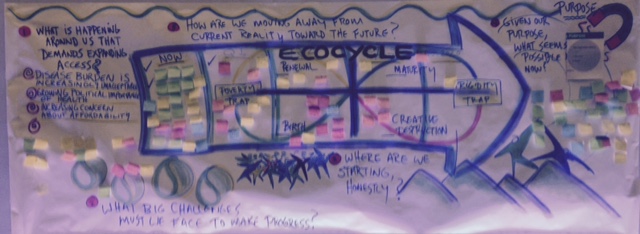
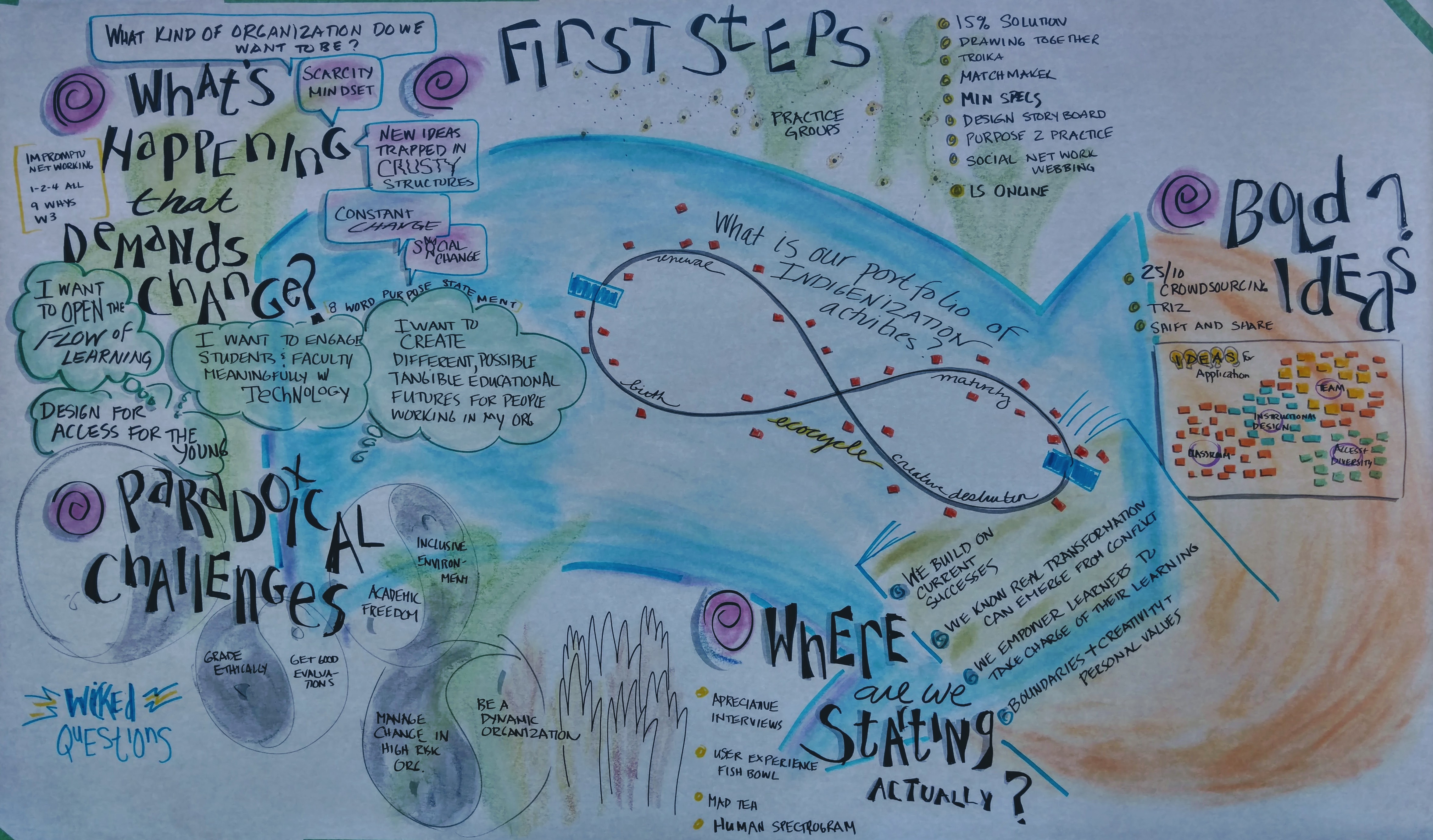
Here are a few examples of the visual after a planning session.
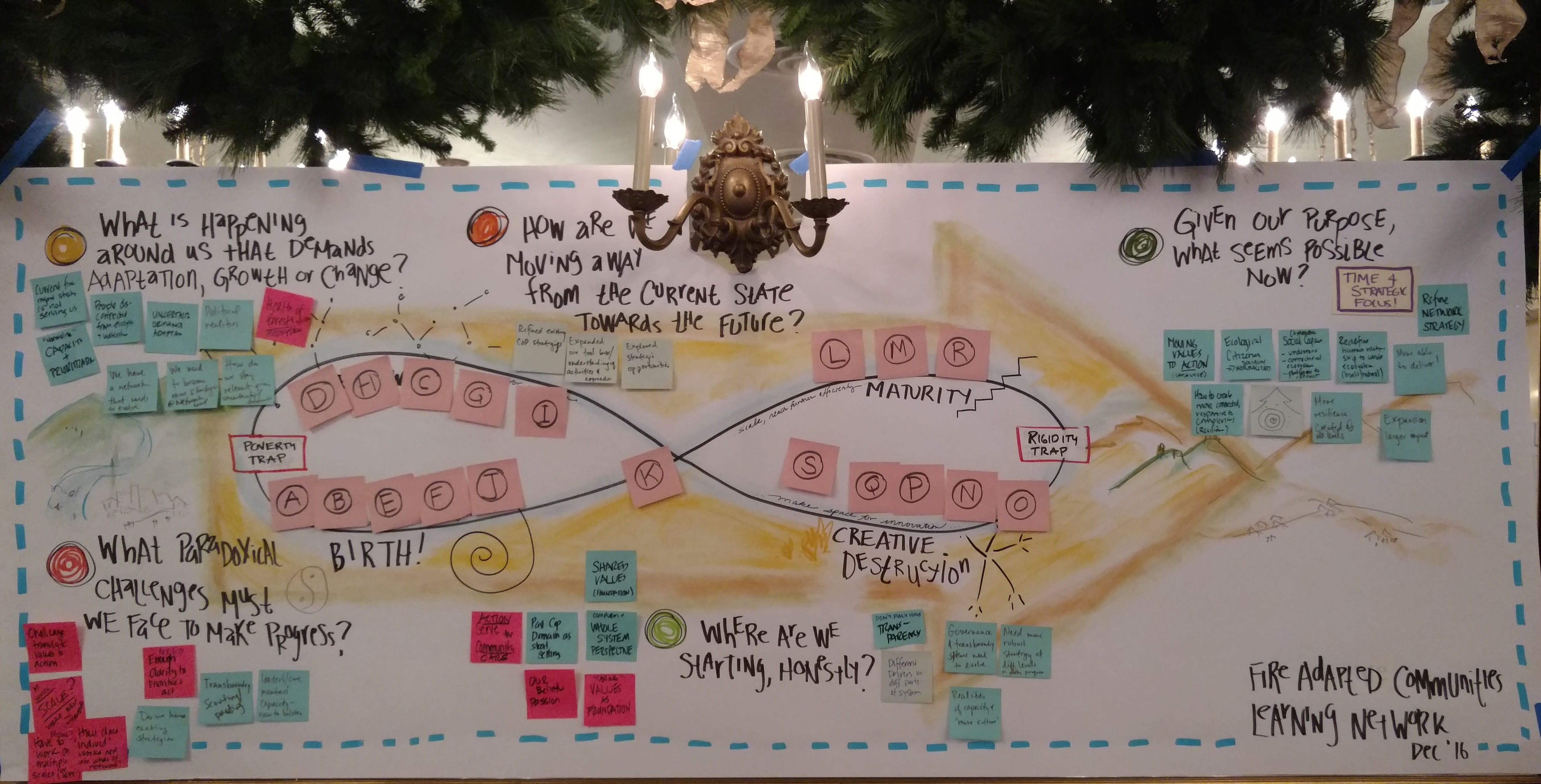
From the Fire Adaptive Communities retreat
From Keith McCandless


So what do you think?

Please add, comment, critique, rename in the comments! Thank you in advance for thinking WITH me!

Resources/Inspirations:

Innovation Barrier #2: Your Network Is Embedded In An Older Model

At this point, most people are aware of the power of network effects.  Everybody uses Microsoft Office because everyone else uses it.  If you want to sell something, you put it on eBay because that’s where the buyers are (and they’re there because that’s where the sellers are).  Apple’s iOS is popular, in part, because everyone wants to develop for it.

via 3 Things That Can Stall Innovation (And How To Overcome Them) | The Creativity Post.
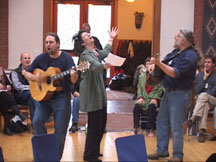
Singing our way in…

Back in 2006 I was a participant in a remarkable gathering called the Evolutionary Salon. It was  an intense soup of ideas, feelings and energy. In these contexts a lot of that can overwhelm me. Luckily, I was not alone. Chris Corrigan and Kenoli Oleari and I were doing a little music jamming and a response to all that energy was born. We called it Euphoric Bullshit, a gentle jab at our own sense of self importance. Originally it was just for us, but our four fearless hosts decided it might help shift the  energy on the third and final day.

Ashley Cooper (who, by the way has restarted her coaching practice if you are thinking about getting a coach), reminded me of all this with a link back to  the debrief the PoP facilitators did.  All of a sudden I vividly remember the moment (and almost the tune!)

I have always found that gentle humor, music, visual arts and dance can open up different channels of connection, communication and meaning making. So literally we can sing our way into better work together. (Speaking of singing, if you haven’t seen this, take a peek.) I need to make sure I keep weaving them in.

Digging around in an old thread in the Open Space email list, I found the lyrics. Um, impolite language warning… but know this was joyously and lovingly sung.

Euphoric Bullshit  by Nancy White, Kenoli Oleari and Chris Corrigan and 90 amused muses

We come into the circle with our passions and resolve
We each have a lot of issues that we really want to solve
But we all start a talkin’, and things get out of hand
So take a little breath (breath) and settle down and we’ll ease into the plan

CHORUS:
Euphoric bullshit is the name of the game
We take the sacred and we make it profane
You can’t come in, unless you bear your pain
Euphoric bullshit is the name of the game

We’re calling a lot of sessions, with various intents
Some get a little bit impatient as we sit upon the fence
But emergence growing edges will carry us all along
We are but one great voice in the universal song

Chorus
Instrumental break

Now the time has come for us to go out into the world
And throw our great intentions into the cosmic swirl
Hey you don’t need to worry that these things will come to pass
Because evolution’s arrow will kick you in the ass

Source: Re: open space poetry

Matthew May Swats the SWOT (Amen!)

This is an older quote from Matthew May from 2015. Ironically, he has stopped blogging and participates through social media networks,
a topic for another of my “still in draft” blog posts. But I wanted to get this quote up here as it is related to a longer piece I am writing about Facilitating in Complex Contexts. So here it is, food for thought today.

I used to be agnostic on SWOT. No longer. I’m violently against it as the starting point for strategy.

I now think it’s far better to think through various strategic choices, ask what would have to be true for those choices to be good ones, and explore those hypotheses through valid experiments, before ever locking and loading on a strategy. It’s creative and divergent thinking, which is the polar opposite of the convergent thinking that fuels planning and analysis.

The difference between divergent and convergent thinking is the difference between chess and checkers. Both games are played on the same board, both games have the same number of players. With checkers, though, you really don’t have much to think about, the players are all the same, and the moves are single, linear steps. Chess has far more kinds of players, far more possibilities and options to consider, including the competitive response to a single move. That’s why when you watch the chess masters play (not sure why you’d want to do that), the “action” is mostly invisible…they’re thinking about their choices and and the possible reactions to those choices.

If you want and need a new strategy, swat your SWOT. Forever.

via MATTHEW E. MAY | creative facilitation » Swat Your SWOT…Forever.

Can I Recover My Asynchronous Practice?

Calm, asynchronous communication isn’t the norm. It’s going to take a major shift in thinking to recognize that focus and balance are vital assets that companies need to protect in order to be successful.

Source: My Company Tried Slack For Two Years. This Is Why We Quit.

Quite a while back this quote floated by my eyes and I grabbed it for “blogging later.” Beyond the reference to the use of Slack, I’m deeply interested in asynchronous text communication. That “grab” was early July. It is now September. The irony does not escape me…

Still, I was drawn back to this draft after participating in a Facebook thread with Bryan Alexander. Bryan is always asking thoughtful questions, rather than throwing out statements, as so many of us do on Facebook. As the conversation asynchronously continued, Bryan asked what would get me back participating in the conversations he hosted on Facebook. My honest reply was I needed someone to get all my family work done for me!

Time and fractured attention practices have made my less willing and capable of meaningfully participating in asynchronous conversations online. It used to be a central part of my practice and learning. I was a passionate advocate for asynchronous online conversation. I LOVED it! I shocked myself, because I believe in the power of asynch.

Family obligations aside, I relate to Katie Hafner’s description of “squirrel-chasing-dog.” I’ve lost the motivation to focus deeply on any online thread. I bookmark. I take a note to “come back.” I don’t. I used to have laser focus and could read long threads, synthesize, respond with questions or comments, nurture the engagement of others. I’m currently designing a new online course for a fabulous refugee educator initiatives on supporting distributed communities of practice and I’m asking myself, what modality is best for the participants and me. I used to position asynchronous threads front and center.

Is this just me getting old? As an adviser for Trusted Sharing, a platform and practices for asynchronous or “flex time” interaction, I should (STILL!!) have this down pat. I’ve lost it. How about you?

My question is this:  is calm, asynchronous conversation valuable to you? Is it worth the (re)focus? If yes, what are your practices to do this well in a time of fractured attention. (Personally, I think there is something important about “doing less” and creating space for focus, but I struggle to practice this!)  What is your current stance and practice in asynchronous conversation?

Transitions, Plumbers and Poets

In this season of immense natural disasters around the world (fires, floods, earthquakes, hurricanes, war, famine, drought…) and here in the northern hemisphere, with a shift in the seasons themselves, I woke up thinking about transitions, and how we use them as plumbers and poets.

As a group process facilitator and change agent (or as Keith McCandless says, a “structured improvisationalist!), transitions are where real progress or failure happens. They are the moments when more is possible – often much more than we ever imagined. Disasters are transitions at a grand scale. Moments in a meeting are often at a subtle and even unnoticed scale. Both can and do change our future trajectories.

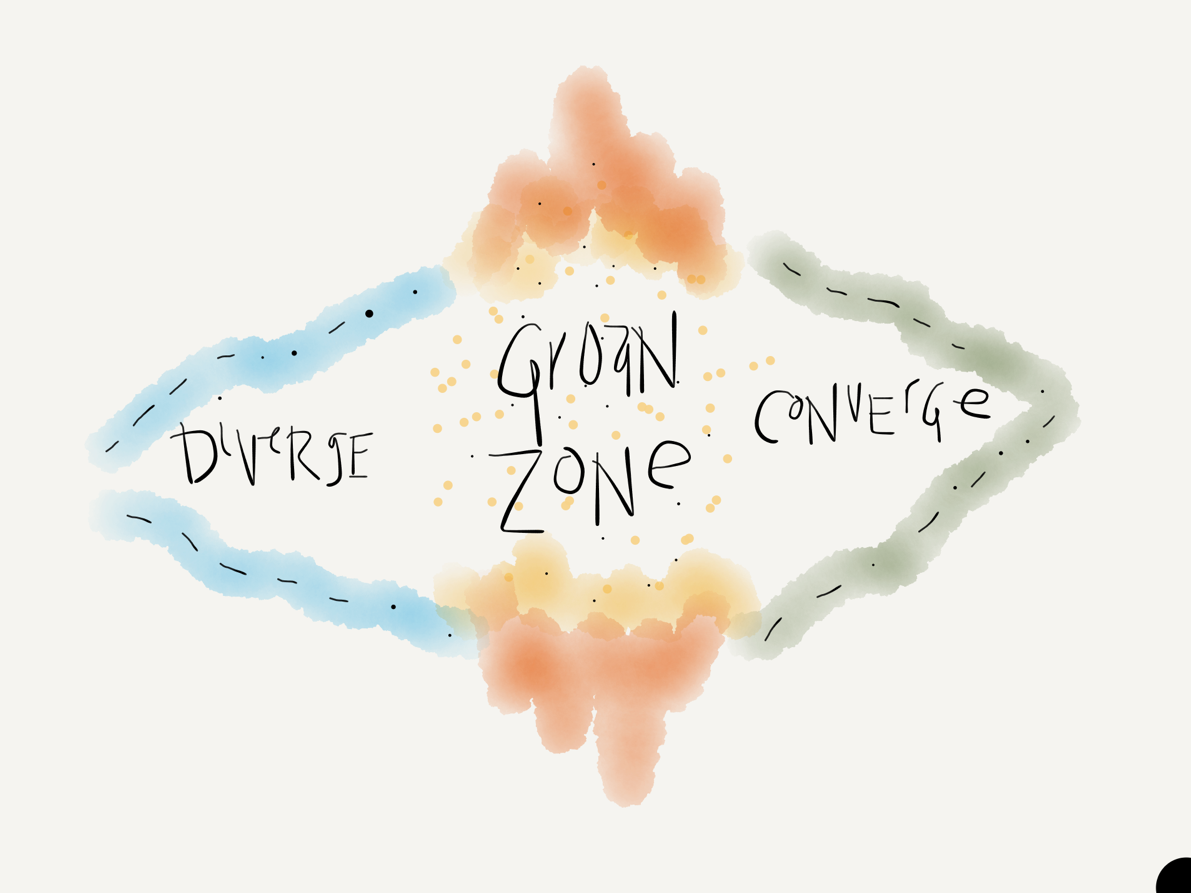
Transitions are often messy. Sam Kaner and his colleagues coined the term, “the groan zone” to describe a critical transition in group process. It is part of his larger “diamond of participation” from the “Facilitators Guide to Participatory Decision Makers,” an essential facilitation tome.

The groan zone is the transition from the opening, divergent part of group process to the convergent, decision making and acting part of the process. Think about the energy of ideation at the start of a project where people are flourishing in possibility (or not!). Then reality comes —  we move into decision making and, hopefully, action. In this liminal space we are often uncertain, confused, and lack confidence or momentum.  Intellectually and  viscerally the groan zone concept and its expression in my work  has always resonated for me. It named a transition that is critical for groups to move forward.

The wisest piece of advice from Kaner’s book was to name this discomfort and use it. I use that advice daily. But there is more to the practice than acknowledging discomfort. I want to reflect on both the intellectual and visceral, or intuitive aspects of this practice of working with transitions, especially groan zones.

This is where the plumbers and poets reference in the title comes in. Stephanie West Allen is a colleague who is constantly spotting and sharing resources. when the poets and plumbers link passed across my screen I paused. YES. Here is the quote from James March that Dale Biron shared in his blog post:

There are two essential dimensions of leadership: “plumbing,” i.e., the capacity to apply known techniques effectively, and “poetry,” which draws on a leader’s great actions and identity and pushes him or her to explore unexpected avenues, discover interesting meanings, and approach life with enthusiasm.  ––James March, Stanford Professor Emeritus

(I am looking for the original source. I think it is from “On Leadership” by James March and Theirry Weil)

The metaphor applies far beyond leadership roles. Here I explore it from the facilitator process, but think about it for leaders, for followers, for disruptors and peace makers.

The facilitator as “plumber” comes prepared with intellectual knowledge of how humans operate socially, and the context for their work.  This is a great place for the application of complexity theory, such as Brenda Zimmerman and Dave Snowden’s work, along with a sorts of socio/relational frameworks. This is often linked to theory, but I recognize some start with theory to build their approach, and others end with it to understand their work.

The groan zone is also an essential space for understanding and using differing views, contradicting view points and  embracing diverse possibilities. Dave recently wrote about this and one snippet from the post offers a good taste:

The use of parallel safe-to-fail experiments over short timescales based on differing and ideally contradictory hypotheses about what is happening and what is possible.  But critically any such experiment, which is ’nudge’ should only be to shift things to an adjacent possible, to something sustainable at the point of intervention.

Note the words “nudge” and “shift to an adjacent possible.” This is not only experimentation to identify next steps in complex settings, but they increase the diversity and its possibility within the group process. Sound like a possible transition or “groan?” Yup. So the work of my complexity teachers is essential for the technical “plumbing” work.

Technically we come prepared for transitions with skills on how to design them to meet goals and adapt to changing circumstances. So when I design with Liberating Structures, I assemble a string of structures that support the diamond of participation, including the groan zone, with options prepared and improvised as needed. Structures that support the groan zone include TRIZ, Wicked Questions and Ecocycle, which help to unmask polarities, “elephants” in the room and dig deeper into sensitive and challenging issues, 9 Whys to explore assumptions, 15% Solutions and Troika Consulting which allows us to quickly iterate and reflect on options with peer input, Helping Heuristics for when our interpersonal dynamics are slowing progress, among many others.

That said, intellectually and technically prepared is not enough for me. I can never be a good enough plumber (technician) without the poet side of things. The poet has to be present in every meaning of the word, with senses alert, intuition as open and calm as possible. Even the stance of my body can be part of the poet. For example, when I’m sensing disruption, confusion, fear or people feeling rejected and unheard, I stand or sit as straight as I can, arms and legs uncrossed, palms forward. Deep breaths. Most often I have no intellectual idea of what I should do at this moment beyond listening and being present. As I literally shift my stance, something changes for me. My observations and intuition tell me sometimes something changes for people in the room as well. Maybe it is mirror neurons at work.  We CAN be changed and influenced by what we see and perceive with our senses. Regardless, this is part of the flow of energy in group process. Can I measure this? No. Can I fully describe it in purely technical terms? No, not me. But it is inextricably linked to both self-awareness and something I find inexpressible.

Of the many masterful facilitators I learn from, the visual facilitator Kelvy Bird has most clearly articulated this presence element in her work here on scribing, and here on opening,  with a clear recognition of the “social field” within which we work. (No surprise as she is a key partner in the Presencing Institute! I am waiting for her book!)

Here is an example of what Kelvy helped me see. There is a distinction of presence and openness as compared to neutrality. Neutrality used to be one of the core values of facilitators (as previously espoused by the International Association of Facilitators and others.) As I’ve gotten further in my career, I’ve felt more and more like describing my stance as neutral was not only disingenuous, but it was false. I may be a listener at one moment, a provocateur in another, and a co-creator in yet another. I am happy that the language of neutrality has been left behind with a greater emphasis on attending to influence. The latest IAF facilitator core compentencies describes this as “Vigilant to minimise influence on group outcomes,” and “Maintain an objective, non-defensive, non-judgmental stance.” This resonates with my sense of stance and presence – even while I still struggle with objectivity and our ability to always be objective! This is far from technical “plumber” work, but it is useful to observe that the best plumbers I know have “hunches” about what they can’t see behind a sealed up wall! So the plumber and poet are not two, but one.

By being part of the process, I am changing the outcome. I am not neutral and I am influencing in certain ways. While I am strict with myself to clearly call out my own opinions, “take off my facilitator hat,” I do have influence. And it is only when I’m open and clear, self-aware and fully present, that that influence can be in the service of the group and influenced by the group itself, not to my espoused beliefs and/or ego. This is most important at transitions: the start of an engagement, during the groan zones, and as we move into resolution and reflection. It is a dance between the technician and the poet, between clarity and beauty. Between words and images.

I’m not sure this all makes sense as I struggle to write about it.  I guess the only way I can express it is to say the poet in me keeps evolving. Early on, I stuck to clearly proscribed forms (Limericks! Haiku!) Now my poetry is in process, words, images, and my own presence.

Let me be clear. There are many risks to this stance. If my self awareness weakens and fails, I can cause failure around me. If my openness cracks me open and I fall apart, I cannot serve. If I come without enough clarity and energy, my services suffers. This is not just a technical nor “expert” practice. It is all in. All. In. Again, from Kelvy:

We learn through copy. We advance through integration. We master by tapping into our own source.

So how does this relate to transitions? The technician, the plumber, can spot most of the the structural transitions. The poet senses the subtle ones, energy, hunches, buried treasures, that are often the ones that take us to new places, that help us make progress in complex or even chaotic contexts.

At this point in my career, I’m deeply interested in the poet. How about you?