Introduction
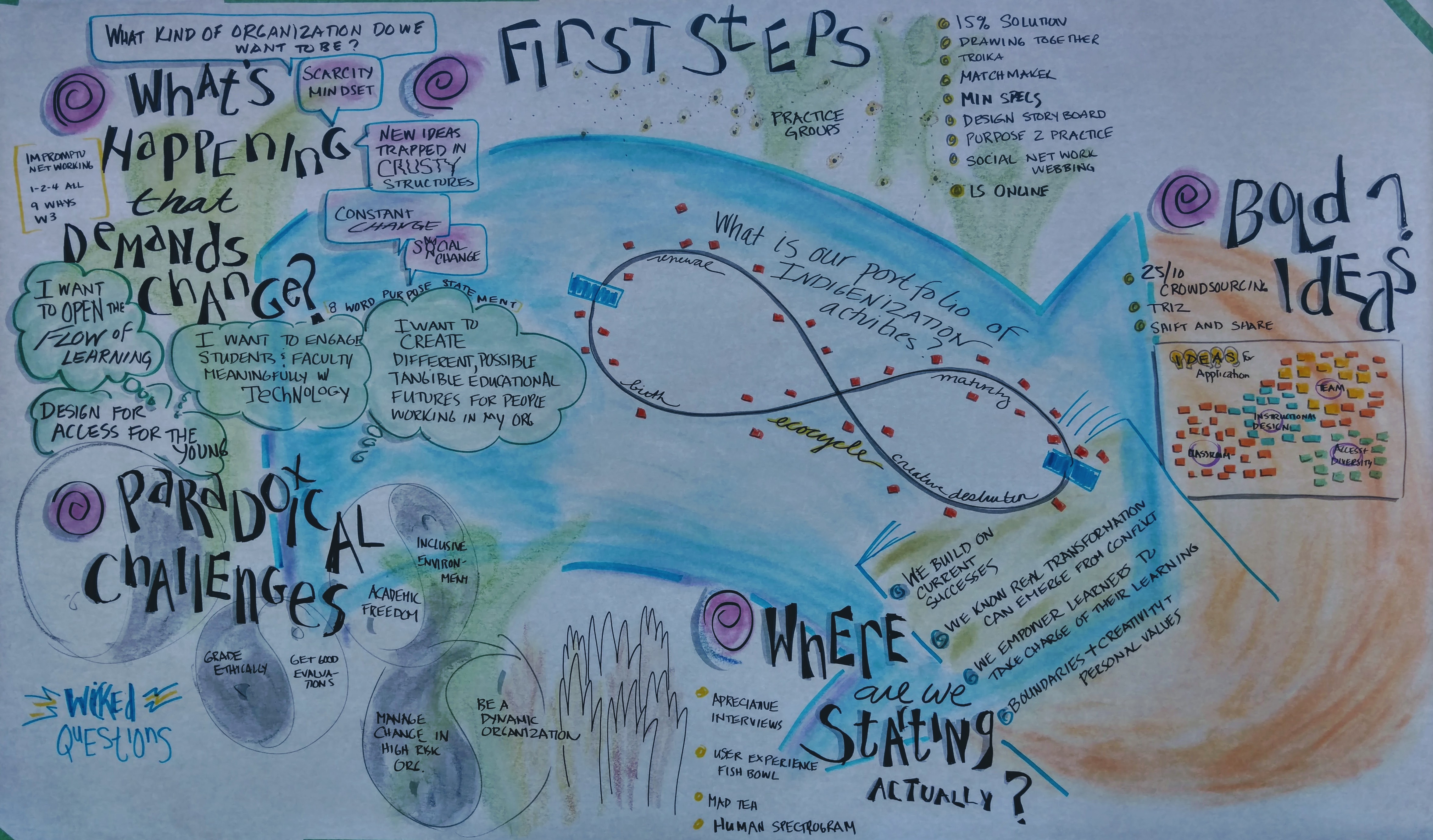
 Designing in complex and emergent contexts challenges the traditional log frame approach. With a set of Liberating Structures we can create a more adaptive and actionable strategy for project design and development that contextualizes the plan into a fuller picture of the landscape within which it operates. This is a very belated follow up on the application of the process with the good folks at the University of Illinois for the INGENEAS project where we used this approach in April.
Liberating Structures are easy-to-learn microstructures that enhance relational coordination and trust. They quickly foster lively participation in groups of any size, making it possible to truly include and unleash everyone. Liberating Structures are a disruptive innovation that can replace more controlling or constraining approaches. They are engaging, easily learned and replicated and “complexity friendly.” To learn more about Liberating Structures, please visit http://www.liberatingstructures.com.
With a fully engaged and flexible approach, challenges such as complex international development projects can work with emerging contexts, rather than struggle against them. Business with rapidly changing markets can develop a portfolio of approaches to respond quickly and accurately.
As a process, participants in all parts of a system can engage, probe and sense on the ground, and loop the learning back into the strategy e for iterative improvements. Monitoring and evaluation approaches that require flexibility to work in complex contexts are designed as part of the landscape, not afterwards.
Framing the strategic planning as an adaptive landscape versus a document situates the work in its complex setting. By complex, we mean we may not be able to predict outcomes, even with extensive expertise, and only understand causality after the fact. For example, most international development work operates partially and sometimes mostly in complex settings. So the use of complexity-based approaches helps us work more productively and adaptively in these contexts.
The Six Essential Questions of the Adaptive Strategy Landscape
The strategy landscape, or “knotworking” as it is increasingly called, is framed around six essential questions and held together through the Ecocycle. These questions frame, drive and help us evaluate our strategy.
- PURPOSE: Why, why, why is this work important to us and the wider community? How do we justify our work to others?
- CONTEXT: What is happening around us that demands a fresh/new/novel approach (creative adaptation and change)?
- BASELINE: Where are we starting, really?
- CHALLENGE: What paradoxical challenges must we face to make progress?
- AMBITION: Given our purpose, what seems possible now?
- ACTION & EVALUATION: How are we moving/breaking away from the present and moving toward the future? How do we know?
The questions, particularly the focus on purpose and ambition pull a group into possibilities as they make choices and identify next steps. While they seem linear, there are feedback loops. As the group discovers new things, they may come back and modify earlier “answers.”
The Ecocycle
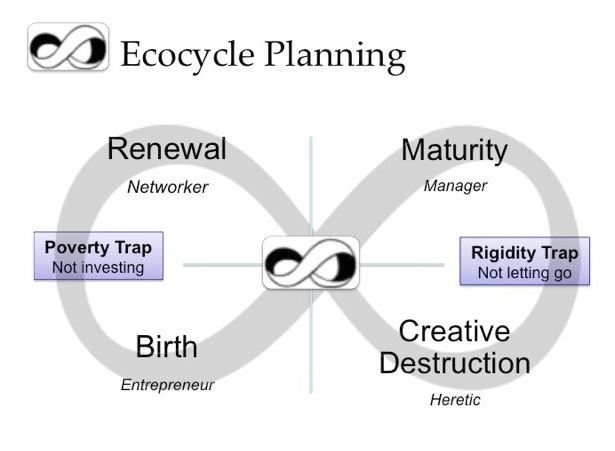 The Ecocycle provides the glue across the six questions and helps us recognize that we are always working in emerging contexts. To fully exploit knowledge and practice that has been vetted and ready for scale (maturity), we also have to pay attention to what is no longer adding value (creative destruction), what is needing to be birthed (networking) and then iteratively developing those ideas (birth) until they reach their own maturity. The Ecocycle illuminates the pulling from gestation to birth to maturity to creative destruction where strategy-and-tactics are combined. A new mindset pops into view. It can also help assess current state of activities, assets, relationships and resources, as well as identify future possible actions.
Strings for Each Question
Liberating Structures are most often used in a combination. The six questions are engagingly answered through a series, or “string” of Liberating Structures. There are a range of structures that can be used for each question. Here are some examples:
PURPOSE: Why, why, why is this work important to us and the wider community? How do we justify our work to others?
- 9 Whys – Make the Purpose of Your Work Together Clear. When we dig into our assumptions, our true purpose may reveal itself – and surprise us!
- 1-2-4-All – Engage Everyone Simultaneously in Generating Questions, Ideas, and Suggestions. Thinking alone, clarifying in pairs then building a sense of ideas across larger groups help us step beyond the “usual” ideas and observations and facilitate input from all – even the quiet folks.
- Drawing Together – Reveal Insights and Paths Forward Through Nonverbal Expression. We tap into different parts of our brain, may reveal new insights and prevent jumping to premature judgement or closure.
CONTEXT: What is happening around us that demands a fresh/new/novel approach (creative adaptation and change)?
- Mad Tea – Connecting with others to reveal surprising truths and action steps. Using rapidly rotating paired conversations, we also provide a smaller, safer space to reveal initial ideas, fears, and issues.
- Discovery and Action Dialog – Discover, Invent, and Unleash Local Solutions to Chronic Problems. We build on our strengths, even the ones we didn’t know we had!
- Users Experience Fishbowl – Share Know-How Gained from Experience with a Larger Community.
BASELINE: Where are we starting, really?
- What, So What, Now What? – Together, Look Back on Progress to Date and Decide What Adjustments Are Needed.
- TRIZ – Stop Counterproductive Activities and Behaviors to Make Space for Innovation.
- Critical Uncertainties – Develop Strategies for Operating in a Range of Plausible Yet Unpredictable Futures. We get out of our “thinking ruts.”
- Note: The baseline also gives us a starting point for monitoring and evaluation design at the start, not the end of our work!
CHALLENGE: What paradoxical challenges must we face to make progress?
- TRIZ – Stop Counterproductive Activities and Behaviors to Make Space for Innovation. It is amazing how liberating it is to STOP something. We do too much adding…
- Wicked Questions – Articulate the Paradoxical Challenges That a Group Must Confront to Succeed. Finding the AND instead of the EITHER/OR.
AMBITION: Given our purpose, what seems possible now?
- 25/10 Crowd Sourcing – Rapidly Generate and Sift a Group’s Most Powerful Actionable Ideas. Get some initial ideas on the table rather than trying to design the perfect solution. Especially by committee!
- 15% Solutions – Discover and Focus on What Each Person Has the Freedom and Resources to Do Now. Empower immediate action, results and iterative improvement.
- Troika Consulting – Get Practical and Imaginative Help from Colleagues Immediately. Sharpen ideas for launch.
ACTION & EVALUATION: How are we moving/breaking away from the present and moving toward the future? How do we know?
- What, So What, Now What? – Together, Look Back on Progress to Date and Decide What Adjustments Are Needed. At the micro or macro level, for process and for the actual work or practice.
- Ecocycle – Analyze the Full Portfolio of Activities and Relationships to Identify Obstacles and Opportunities for Progress. Situate the work.
- WINFY – Surface Essential Needs Across Functions and Accept or Reject Requests for Support. Identify how we work together practically and honestly.
- Purpose to Practice – Design the Five Essential Elements for a Resilient and Enduring Initiative. Get the work GOING!
The Visual Canvas
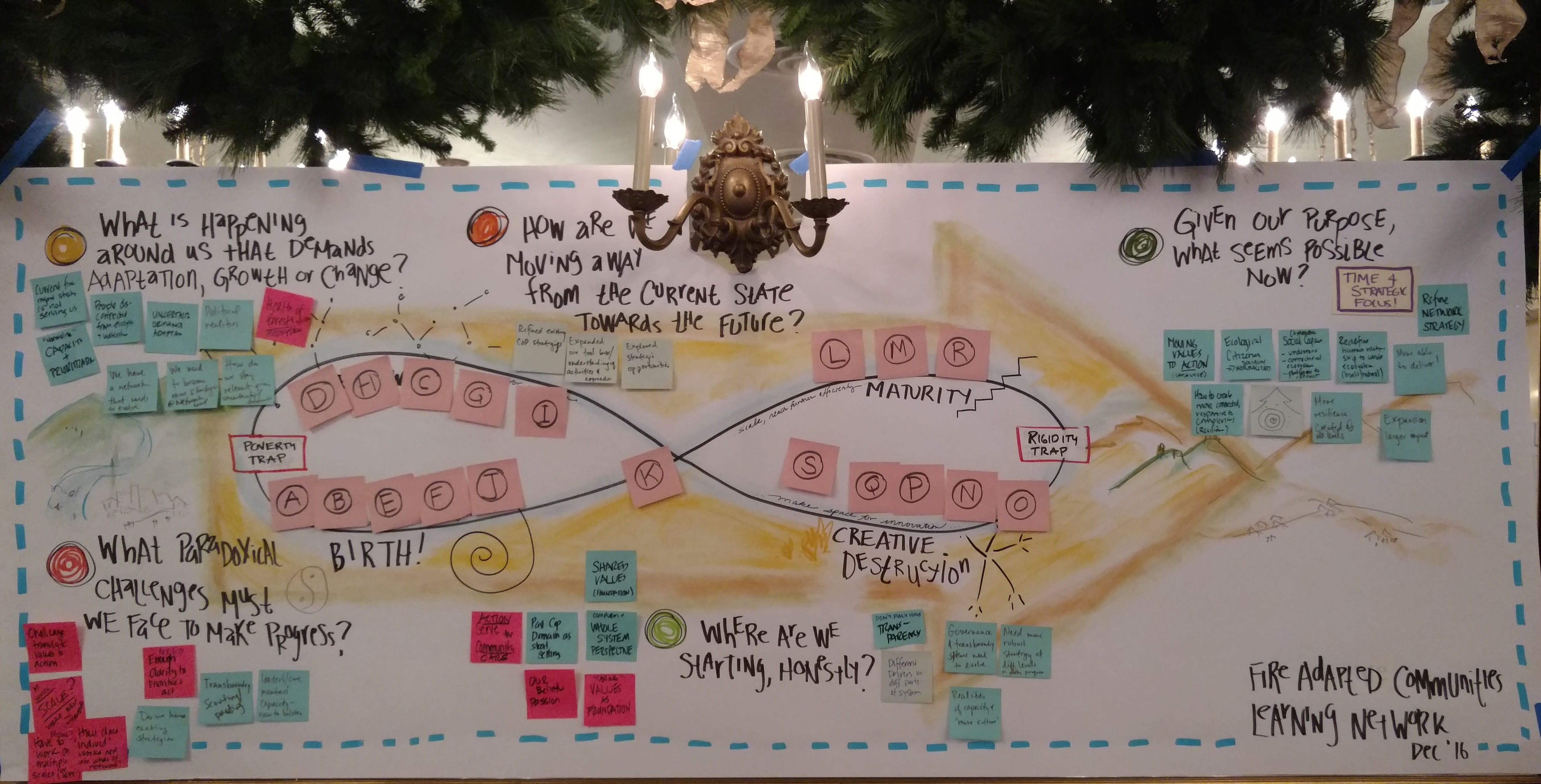
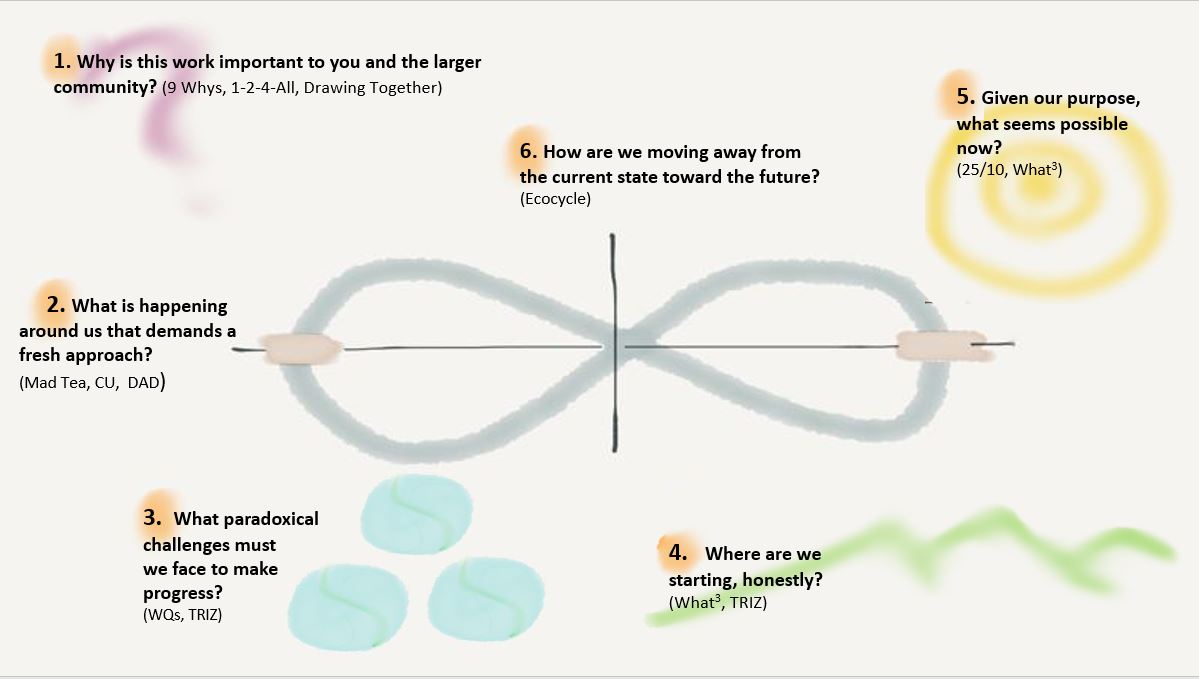 When working in complex contexts, there is often a lot to track and wrap one’s head around. Some of these things are simple next steps, clear data, and identified issues. Others are less certain. We have developed a visual canvas with Ecocycle at the center, surrounded by the six questions for capturing and making sense of the most important findings of the group as they work through the process. Keeping both the questions and the Ecocycle visible throughout the process helps ground and reground as the group progresses. Often post it notes are used so that as new data, insights, and challenges are surfaced, the canvas can be updated. At the end, there is a “story spine” that can support the telling of the strategy story to others.
The visual can be on a large piece of paper on the wall for face to face groups, or a digital artifact online with movable digital notes.
Examples from Other Groups
I have used this approach with a number of groups over the past three years. The results have been:
From the Fire Adaptive Communities retreat Surprising – One group not only entirely rethought their approach, but the use of Liberating Structures also reshaped their process.
 Fast – Quick, iterative interactions revealed far more than traditional SWOT approaches. People are usually amazed at how much they can get done in a day in developing their strategy and implementation.
- Possibly threatening – If one or more people come in to the process thinking they know the outcome and their agenda will prevail, this approach can destabilize them and stimulate sabotaging. It is important that everyone knows that Liberating Structures engage and unleash everyone and if you open that Pandora’s box, you need to be ready to listen to and respond to that engagement.
- New questions – Some of the things that have surfaced in this work include: how to mine the past without falling into thinking traps in complex contexts where the past may not help us understand our path towards the future; understand how this approach supports and makes visible the decision making processes and finally, how to weave it into developmental evaluation.
Inspirations/Resources
This was developed off of the initial inspiration from Keith McCandless, co-founder of Liberating Structures, and conversations with Fisher Qua and Eva Schiffer. The first draft was developed to support a strategic planning workshop at the University of Illinois for the INGENEAS project.