Zoom and Re-Zoom for Facilitators

Last month I finally got a chance to use a facilitation activity called Zoom which I found on the Wilderdom’s Game resource page — a great resource!  I deeply appreciate that they put the “copyleft” designation on all their resources. THANKS!  As I learned and read facilitation ideas from other sites, I realized I should share some of my experiences as well. Here is the description from Wilderdom’s resource page (which also includes all instructions – I’ve attached a pdf copy at the bottom for taking to an event, but please DO visit their page!):

This game is based on the intriguing, wordless, picture books “Zoom” and “Re-Zoom” by Istvan Banyai which consist of 30 sequential “pictures within pictures”.  The Zoom narrative moves from a rooster to a ship to a city street to a desert island and outer space.  Zoom has been published in 18 countries. The Re-Zoom narrative moves from an Egyptian hieroglyphic to a film set to an elephant ride to a billboard to a train.

I’ve done similar activities, but I love the multicultural perspective of Istvan Banayi’s books, so now I’ve stocked up on multiple copies of both ZOOM and RE-ZOOM, and have on my to do list to break them down and put into protective pages. I left the last set with my colleagues at ICRISAT in Hyderabad. I am also keeping my eye out for used copies, because I like the idea of leaving the book pages behind for groups to use with OTHER groups they work with. Viral facilitation and collaboration!

We did the exercise with a large group of social scientists who work in different parts of the world. Most of their work is done in smaller teams, but there was a real need to connect as a whole team as well. It was very interesting to observe the exercise. First we started with the version where you can’t show your card to anyone else. The group didn’t make much progress finding their order. Imagine if we had tried the “no talking” version! With the “no show” round, I asked if they were ready to show and see if they got it. There were some totally confident and others totally sure they did not have it. So I asked them to put themselves in order (again without showing the cards) and then we’d check.  Uh uh, not even close.

Then they used visual clues to reorder the series. This is where a few individuals really went to work and the rest of the group stood back. It was an interesting shift in agency. When there was a higher degree of “not knowing,” more of the team participated in working the solution.

When we debriefed, I did notice a shyness to share some of the observations people gave me individually as the power dynamics in the group made some of these things harder to say. I try not to be the voice for others in the room, so I had to represent my observations as just that — my observations. But I need to think more critically how to handle this during the debrief.

Here are a few angles on our play together…
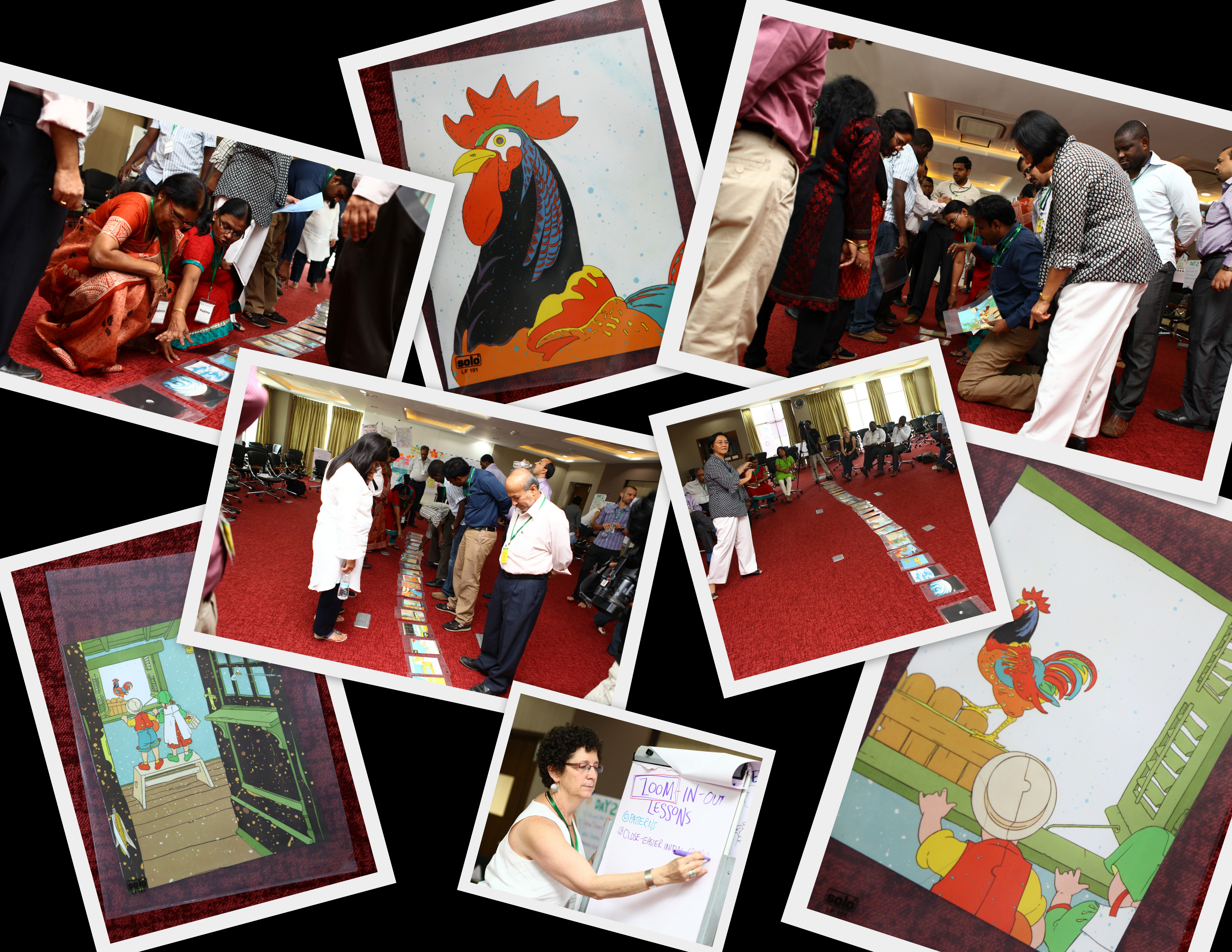
zoomcollage1


Resources from Wilderdom, copyleft – please share with attribution out of kindness!
mar ruiz: “No se puede moderar en una red sin límites “

Mar Ruiz of Spain has been posting a series of questions and answers she has cultivated with people who have been facilitating online for a while. I wanted to answer the question she posed, but I can’t seem to get a blog comment to stick, so I’ll do it here and hope the trackback works! From:mar ruiz: life & interests: Nancy White: “No se puede moderar en una red sin límites “. The gist of our conversation was the differences in facilitating in a network, vs bounded community context.

The blog post, in Spanish:

Nancy White: “No se puede moderar en una red sin límites “

Y esta es la respuesta de Nancy White, pionera en esto de dinamizar comunidades:

Hay un número asombroso de las similitudes y diferencias, que me parece fascinante. Pero ya que la pregunta es sobre las diferencias, aquí están mis tres mejores!

1. Ahora se trata más de redes sin límites que de comunidades delimitadas, lo que cambia fundamentalmente lo que queremos decir por “construcción de la comunidad y la moderación.” No se puede moderar en una red sin límites. Puedes influir. Puedes estimular las conexiones de red. Puedes hacer lo que June Holley llama “network weaving  (“tejer en red”) – pero no se pueden gestionar las redes.

2. Las comunidades delimitadas deben tener mayor número de propuestas de valorque antes porque la gente está recibiendo una gran cantidad de lo que quieren y necesitan en las redes abiertas (es decir, Facebook, LinkedIn, Twitter, etc). No quieren tener que entrar en algún otro lugar. Por lo tanto la integración de las actuales identidades digitales (y contraseñas) es más común, pero esto también hace que se rompan algunas de las distinciones de las comunidades anteriores. Se convierte todo en algo borroso.

3. Es más difícil entrar en conversaciones más profundas en el mundo en red, mientras que al mismo tiempo, tiene un alcance más amplio y potencialmente mayor diversidad y por ello mayor riqueza.”

La verdad es que leyendo esto, me he quedado con las ganas de saber…¿y cuáles son las similitudes?
Por otro lado entiendo que ambos necesitan de profesionales que lo dinamicen y procuren contenidos. Hace días leía en twitter que sea quien sea el Community o Social Media Manager, por favor, que sea un profesional:

“Los peligros de que tu primo (o “ese chavalito que parece que sabe”) se encargue del #socialmedia en tu empresa http://bit.ly/KnYxtF #comma vía @commaradas”

At the end, Mar asked about the similarities! Here is my answer, Mar: Both communities and networks give us access to the experience and resources of HUMAN CONNECTION. Thus they are both critically important. Learning how to work with the dynamics of these different forms is therefore valuable!


Edit: see this related post from Jessica Lipnack on the challenges of scaling collaboration!

The web makes it possible for, in effect, infinite numbers of people to collaborate. But how do you collaborate with infinite numbers?

You don’t. You can’t. Thus network thinkers are trying to solve this problem. INSITE, the European Union’s program on innovation, sustainability, and information technology, is including this issue as a worktrack in its Masters of Network symposium later this month in Venice.

Strategic Communities of Practice for The Nature Conservancy

strategicCopsI had the great pleasure of leading a webinar yesterday with The Nature Conservancy on Strategic Communities of Practice. We focused on gaining some shared sense of what we mean by “communities of practice,” a framework fo looking at them strategically, some of the basic roles involved in communities and a quick peek at evaluation options.

There was some lively interaction in the chat. Many of these folks work in parts of the world where web based online interaction is not so great, so a wonderful thread on mobile-device-supports for communities emerged. If you know of any great examples, please share. ( I just found this one with a quick search and also suggested looking at http://www.mobileactive.org. I think some of the Twitter chats could serve as a model for a mobile-based distributed conversation by a community as well! Here are some examples in education.)

In addition, the good folks at TNC said I could share the webinar recording. I’m not sure if you can bear 90 minutes of recording, but just in case, here is the link. I’ve put the slides below as well, but as usual, they don’t make a ton of sense without the narrative. Thanks to Olivia, Nicole and Gillian at TNC for being such fabulous hosts and webinar facilitators!

via Strategic Communities of Practice.

GroupWorks Deck Method Mapping at NCDD2012

This past weekend I’ve been hanging out at the National Coalition for Dialog and Deliberation‘s national confab, NCDD2012. Synopsis? Amazing people. Also it was great to connect with folks I’ve met/known online and demoralizing to NOT connect with others who were there in the flesh. Not enough time or energy. 🙁

Thursday I took part in pre-conference workshop using the fabulous Group Works Deck to map out the elements of a variety of group methods and processes. (I wrote about the deck a while back here. )

As we did the exercise, I realized that I needed the narrative with the map, so took these off the cuff videos, now debuting as this week’s Monday Video.

via GroupWorks Deck Method Mapping at NCDD2012 – YouTube.

What I noticed about the mapping was the more we did it, the more discerning we became at identifying the essential “spine” of a method AND,through reflecting on the other possibilities offered by the patterns in the cards, observed new ways of “fleshing out” the method depending on context. In other words, the cards enabled us to have great learning conversations about the methods. Very cool. I plan to use the cards a lot in the coming weeks of crazy work and travel! I also deeply appreciated all the knowledge in the room. As I learned about Participatory Budgeting from John Kelly, I was getting all kinds of ideas about how to reapply the basic idea to Knowledge Sharing/Budgeting (in terms of time and attention — which seems to be a big problem in my world these days!)

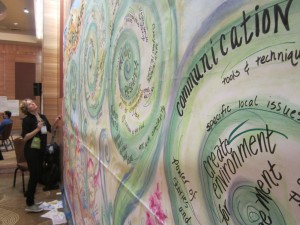
At the meeting, I also was part of a fabulous team of visual practitioners who volunteered to do a visual capture of the plenaries of all three days as a unified product. Tim Corey helped us envision a 24 x 8 foot image and then we all figured out a) how to work together to b) make a coherent capture. I’ll write more about this later after our debrief, including links to all the fab people I got to work with. But it was great fun and a lovely learning laboratory.


Other NCDD Materials:

  • NCDD 2012 Tweets (I hope someone Storify’s them or harvests them before they are gone. It was not a huge tweeting crowd, but there are some good captures!)
  • My photos, including some not-so-great images of the giant collaborative graphic capture 8 of us worked on (better images to come)

Monday Video: Sandy Schuman Facilitators should not be Neutral

Oh how happy I was to come upon this on Sandy Schuman’s blog. I have long struggled with the perspective that facilitation must/should be neutral. I struggle with the fact that it is HARD as a human being to be neutral. In fact, I can’t pin down the range of practices required to be and stay neutral, especially when facilitating. Neutrality has long been preached by the International Association of Facilitators.

I came to the conclusion then, that I was either a bad or a renegade facilitator. For me, it was about being AWARE of my influence, power, position and opinions and not letting them distract me from serving the group. And at times, yes, using my opinion, with clarity and transparency (I call it “taking off my facilitator hat and putting on my citizen/subject matter expert/Nancy hat!) Take a look…

And thanks, Sandy. I knew I have been right to admire and learn from you all these years!

via IAFNA2012 Fast Talk Sandy Schuman Facilitators should not be Neutral.mov – YouTube.