A Response to Seth’s field guide to the Meeting Troll

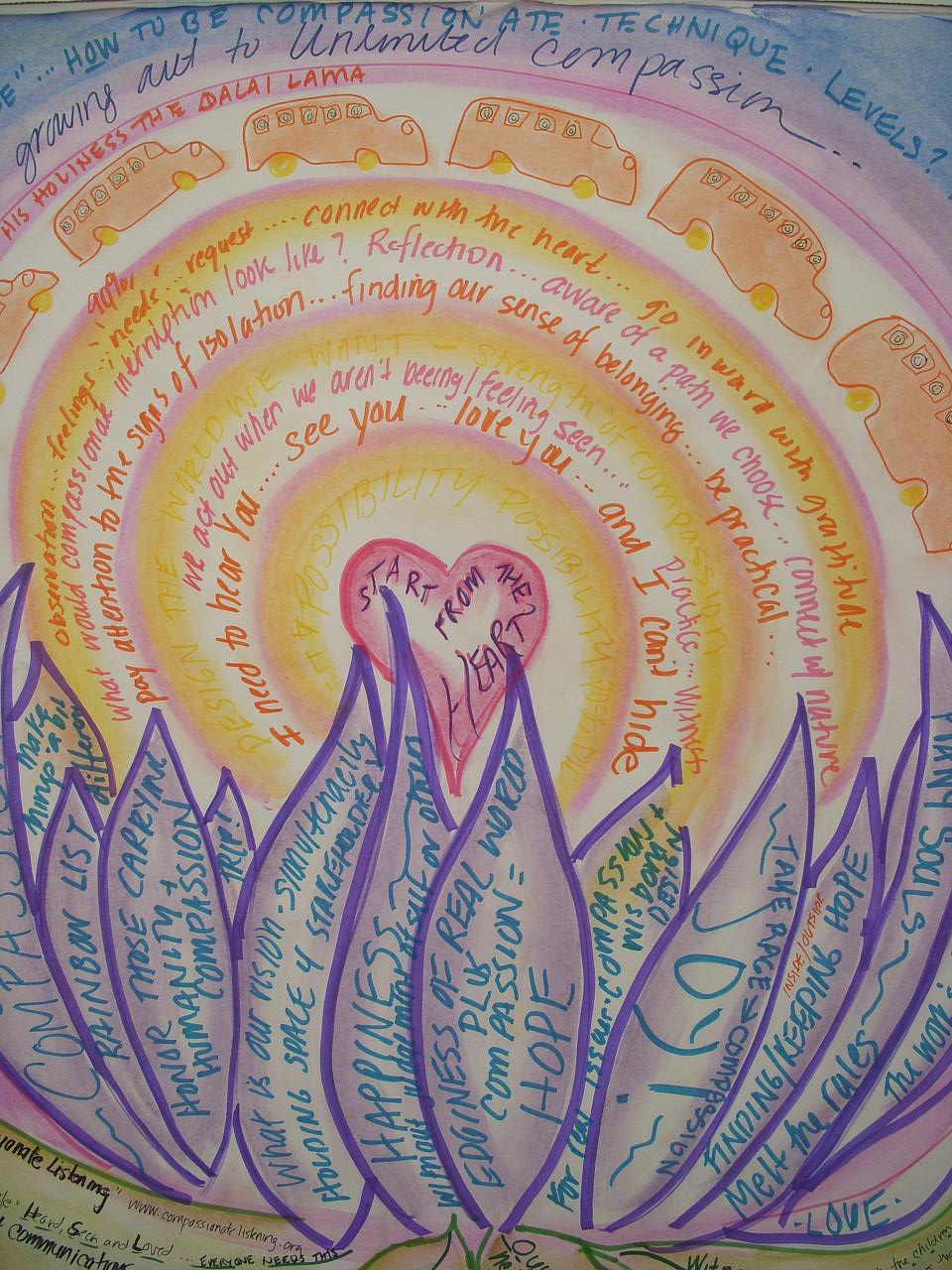
Lotus of conversationAh Seth, we know the troll of which you speaketh in your blog post,  Seth’s Blog: A field guide to the Meeting Troll.

In response, here are the people I want to invite into the circle. (See, I even avoided the word “meeting” as we have so many coded “dirty words!”)

Come into the circle with me.

  1. You are curious. “Not knowing” is an asset, not a deficit. You ask AMAZING questions.
  2. You are playful. Risk taking is in your repertoire.
  3. You love creating opportunity for yourself and others. Love is an operational word here…
  4. You love solving wicked problems… I can see the glee on your face.
  5. You bring and SHARE your chocolate (oranges, carrot sticks, croissants, coffee, etc.)
  6. You create space, not only fill it.When you occupy space, it is always with genuine presence and  contribution.
  7. You don’t hide behind your words. Or your positional power.
  8. You explain your acronyms (this is important to me– I work in international development!)
  9. Failure is a learning opportunity for you. You help me mine the learning from my failures. You seek multiple perspectives to learn from your failures.
  10. You discern when something is simple and when it is complex and act accordingly. This includes knowing when to STOP doing something.
  11. You are not fearless, but you do not shy away from fear.
  12. You trust me. I trust you. We know how to honor and forgive.

Roland Harwood on Tapping Each Other to Solve Our Problems

nancy and charles chatting
nancy and charles tapping into each other

Via Johnnie Moore (thanks!) comes something that is remarkably akin to the Liberating Structures approach I’ve been diving into deeply.

2 degrees of separation – 100%Open.

And so recently, we’ve prototyped an exercise at various workshops and events called ’2 degrees of separation’ that has worked so remarkably well that a) I wanted to share it and b) see if anybody can help prove exactly how it works. The way we have run it to date is as follows:

In a room of at least 30 people, ask everybody to think of a project or problem they are working on right now where what would really help them is to be introduced to a specific person or organisation.
Invite people to then take it in turns to shout out the name of who they are trying to reach, and also to briefly introduce themselves (if necessary) and why they want this introduction.
Ask the whole group if anybody knows that person or organisation directly, or might know how to reach them, and if so to raise their hands.
If so, just point them out to each other so they can chat afterwards and repeat the process a few times.
We’ve now done this exercise 3 or 4 times with group sizes varying from about 30 to nearly 100 and every single time we’ve been able to make a productive connection. And whilst I thought it would probably work I am struck how well it has worked so far.

Feedback to Amplify vs. to Recognize

Creative Commons from the wonderful Roland Tanglao via Flickr

The title of the article, Talent Isn’t Fixed and Other Mindsets That Lead to Greatness, drew me in. Here is the opening paragraph.

According to Stanford University’s Carol Dweck, the psychologist behind the much-praised book Mindset: The New Psychology for Success, the attitude that we bring to our creative work—and to mentoring our juniors—can play a huge role in shaping just how much of our inborn talents we realize.

One of the most important things that I think I offer the individuals and groups I work with is to notice their contribution, their creativity, passion, persistence –> whatever the quality. The article calls this people’s “inborn talents.” I think it is more than inborn, but I won’t quibble…

I call my role or function “holding up a mirror.”  Helping people see for themselves their power and agency. But that is an oversimplification. So it seems useful to consider how we give feedback — it matters. Take a look at some wise words from Stanford University’s Carol Dweck.

Could you give me an example of how that language would actually play out if I were giving someone feedback?

A fixed mindset approach would be saying something like: “This project turned out amazing. You’re a genius. I knew you had the talent. This is proof of it.” As opposed to a growth mindset approach of, “Wow, this project turned out fantastically well. I loved the way you mobilized the team, the way you kept everyone focused, the way you brought it to fruition, the way you made everybody feel the ownership.” These are things you can replicate and that you should replicate the next time. Whereas, when I say, “You’re a genius!”…how do you reproduce that over and over?

And what about when you need to give someone criticism? Or point out an area that needs work?

As I mentioned, when you are giving criticism, you need to carefully critique the process someone engaged in and discuss what skills they need to learn and improve.

But I’ve also fallen in love with a new word—“yet.” You can say to someone who fell short: “You don’t seem to have this,” but then add the word “yet.” As in, “You don’t seem to have these skills…yet.” By doing that, we give people a time perspective. It creates the idea of learning over time. It puts the other person on that learning curve and says, “Well, maybe you’re not at the finish line but you’re on that learning curve and let’s go further.” It’s such a growth mindset word.

The “yet” thing is interesting and it reminds me of the power of “Yes, And,” from improv. Interesting that searching for a link took me back to the 99U site! Look at this. It both cases, I don’t think the feedback is limited ONLY to specific feedback — I really liked what Dweck said in response to the first question. But also having some lack of clarity also leads to possibility. Thus Roland’s fuzzy mirror photo inspired my thinking a bit more. Clarity on feedback, and possibility going forward. How’s that? How do you give feedback?

Photo from my friend Roland Tanglao.

Listening and Acceptance as Core Facilitation Skills

I’m preparing for what might be a challenging facilitation gig this month involving a very complex domain, diverse perspectives, at least three languages and rooms where the tables are nailed to the floor. I actually love the first three things. The tables nailed to the floor asks for every bit of my creativity and ability to improvise with space, sound and time. So in preparation, I’m keeping my radar attuned to things floating in front of me. This is how I get inspired. It is like a magnetic field for ideas. Here is what came across the radar today, via a link from the Applied Improvisation Network‘s Facebook Page.

Lives In Progress: Listening And Acceptance: Improvising Our Way To Relationship With The Pre-Contemplative Person.

Acceptance of their offer, even if it is tinged with hostility or hoisted by layers of defensive projections about me and what I represent to them, is absolutely essential to engagement with the group. Acceptance of their offer is most often acceptance of their worldview, which most of us will freely share with others who listen without judgment. That is the hard part. To listen without imposing our will on another person even when it seems abundantly clear that their worldview can wind up killing them. Listening and acceptance of the offer of another person’s worldview are power tools in the improvisers toolkit, the builders of meaningful connection. Because why should anyone collaborate with me about a difficult, usually painful and conflict-inducing process of change if I fail to understand the way they see their story? How can I become a part of someone’s story – and no amount of intellectualizing or information-giving influences a person’s choices unless the new message and the messenger become part of his/her story – if I set myself apart from it?

The author, Jude Treder-Wolff. goes on to quote Daniel Pink, from his new book, To Sell is Human.

“The first principle of improvisation-hearing offers-hinges on attunement, leaving our own perspective to inhabit the perspective of another,” he writes. “And to master this aspect of improvisation, we must rethink our understanding of what it is to listen and what constitutes an offer.” Digging into the meaning of improvisation exercises designed to cultivate these skills, he concludes that “once we listen in this new, more intimate way, we begin hearing things we might have missed. And if we listen this way during our efforts to move others, we quickly realize that what seem outwardly like objections are often offers in disguise.” (p. 192)

Then, of course, the magnetic field continued to strengthen and I came across a couple of Facebook posts from the amazing Kat Koppet, who probably doesn’t know that I regularly open her book (Training to Imagine) to some random page and, with that magnetic field, find inspiration and knowledge. She posted a scan of a letter that Robert Lowe sent her which contains some amazing advice to us that resonates with this idea of listening and acceptance. With permission, here are the two pages of the letter.
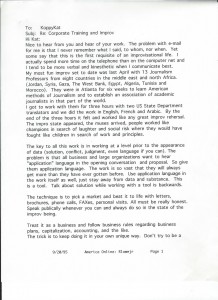
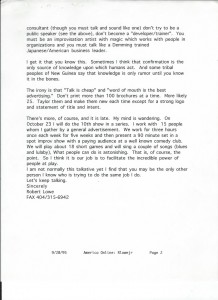
KoppyKat.1KoppyKat.2


In my work with international development agencies, people are passionate about solving global problems, feeding the world, saving the planet. With this passion can come an almost blinding form of advocacy, to be heard, to be validated, that can cripple listening, idea creation and collaboration. We SO want to be right and solve the problem, but this can become the problem. There is so much value placed on data, on solutions that we forget to listen for context and meaning. So I’m going to think hard, or maybe better yet, open my mind to what possibilities I can weave into my next engagement that seek space for listening and acceptance as the ground for working really hard, well and with joy on tough, intractable problems.

Any advice to share?


Edit, just a few minutes later… I see this Tweet from Linda Stone:
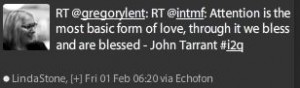
attentionlove

A great example of facilitation…

IMG_3776…at a restaurant! From: Foodtography: Seattle Is Not Jumping on the NYC Train of Banning Cameras at the Table. The context is Brian Canlis, co-owner of Seattle’s iconic Canlis restaurant, talking about how to deal with disruptions. In this case, the disruption is people taking flash pictures of their food! Substitute “customer service” with “facilitation.” Think about how we handle disruptions when people are meeting and working together…

Has he ever told someone to put the camera down?

“Yes, if it intrudes on the table next to them having a good time? Absolutely, I’ll do something! But I’m not going to ban it! I’m gonna look at, how can I find a new way to make this guest really happy? So if their flash is upsetting a table next to them, I’m going to invite them back to the kitchen, invite them to the wine cellar. Do you want to take pictures down there, because it’s bright and beautiful. Offer to send them my photos because I take photos of all our food here, for the website.”

Brian is certain that excellent customer service can solve any problem and he thinks completely banning photography at the table is just lazy.

“It seems like such a short sided, ego driven, silly thing to do. You’re getting in the way of people having fun. Canlis is an altar to our guests. They’re the whole reason we’re here and the whole restaurant revolves around them. I think restaurants that are doing bans like that are altars to the chef. The guest is asked to come in and revolve around them.”

When we facilitate, we want to move the “action” forward to create the conditions for groups to accomplish their goals. A pile of rules may only constrain. A creative perspective on a challenge may open up whole new vistas of understanding and work. Invite — a terrific word — these new perspectives, rather than blocking perceived disruption. Nice example, Brian. Thanks!