Forrester’s Online Community Best Practices

Last week I wrote briefly about the recent Forrester report on building online communities for marketing. Jeremiah Owyang followed up with me and gave me a copy of the report to read. House painting derailed my intent to read it last week and and post my thoughts, but a few quiet hours before Northern Voice in my room up here in Vancouver BC finally gives me the opportunity to reflect on the report.

First, it is a very nice compilation of solid, basic advice on building commercially oriented communities. There isn’t anything particularly unique about the content. It is common sense you can find by combing through what is offered on the net. As usual, the value is in the compilation. But here is where I have to confess. I have read VERY few analyst reports. I work in the non profit world where such products are rarely affordable. I think I had this fantasy idea of what they would be like. I expected some secret sauce. Maybe I know online communities so well that I forget that this stuff is NOT basic knowledge. So I have to wonder about the market for analysts reports. Clearly I am naive!

That said, here are the things that struck me as highs and lows of the report.

Highs:

  • It is succinct. Something I am terrible at! 🙂
  • It focuses on the community members and their needs – be in service to your community
  • It offers sound advice for both resourcing a community and being clear on the goals and how they might be tracked. (I’d suggest linking to Beth Kanter’s great stuff on ROI. I need to find the links)
  • Solid advice on community management (very happy to see this validated)
  • A good attempt to frame community planning in terms of community activity needs rather than from a technology position.
  • I was THRILLED to see the advice to make sure you don’t get your community data locked into a platform. This is really important and a lot of people miss this one.

Some of my critiques:

  • As I mentioned in my previous blog post, the image about community growth does not give an accurate picture of community life cycle. Communities ebb and flow. Membership turns over. Communities do not grow out and out. It is more like a recursive spiral. Networks, however, can bring life into communities and nurture the emergence of new communities. They are far more scalable than communities, but harder to both measure and “manage.” Which leads me to my next point.
  • The report doesn’t fully address or distinguish this very interesting intersection of communities and networks. There is one mention of “a group within an existing social networking site” but this is a huge sweet spot. I suspect most commercial endeavors really want to foster both a network and the communities that form within it. (I define communities as a bounded set of people interacting with each other – not just with content – around some shared purpose over time. So one time use does not a community member make! ) If I were exploring an “online community” strategy for my company, I would not do it without a network strategy as well. I could prattle on about this forever, but I can’t miss the party tonight…
  • This raises the issue of identity, which wasn’t present in the report. Identity is a tough topic for an intro piece, but in the end, people define themselves by their identity as an individual (how they show up in a community) and as a member of a community (I am a member of the X community.) There is mention of profile tools, which help manifest identity, but not about how community hosts can nurture a sense of individual and group identity in a community. Identity is a core aspect of brand loyalty. So some attention to how identity shows up and can be nutured is a key strategy.
  • From a design standpoint, I think this point is made, but I also think it could be stronger. You need to work with your developers to develop both the technical AND social architecture. Some tools for example, while they look like “conversation” tools, in practice they aren’t and thus don’t support a social conversational architecture, even if the vendor claims they do. There are some great developers who really understand social architecture and there are a bunch who think they do. This is a slippery slope/trap.
  • Visual design is not mentioned. I used to dismiss this as secondary. Boy, was I wrong. Visual design that is appropriate to the target audience in critical. I learned this with http://www.shareyourstory.org. Visuals tie to identity, to navigation, and distinguish your community from the hundreds of others out there.
  • How to work with “the competition.” Like I said, there are hundreds of other communities out there. Is your strategy to work with or fight against that dynamic? Do you make it easy for your members to move across their communities or do you want to be their central community? The latter is getting harder and harder to do. That’s why (and the report mentions this) thinking about working with a FaceBook strategy might make sense. Having multiple ways for your members to interact in your community that make it easy, while still maintaining enough distinct identity that they IDENTIFY with you.

All in all, it is very cool to be able to read and publicly critique the report. Jeremiah walks the talk of transparency and participating and listening to his network and communities. It is only a pity that the readers of the report may not see this practice in action. It could inform their community strategy as much, if not more, than reading the report. Because supporting online communities is not a formula. It is a practice. And practices have to be… well… practiced!

Archive: The Masks We Wear

(Repost of an archived blog post from my old blog here.)

Back in the “olden days” of my first online community experience (1996-1997) on Electric Minds there was a topic called “The Mask We Wear.” It was one of those discussions that enabled me to see the power of online communication, and to explore with others how we can hide behind masks and use them to express our identity.

I can’t recall the details of the conversation. But I remember the visceral feeling of understanding something more deeply than before I entered the conversation.

Tonight I came across a link via the New Media Consortium’s Blog (Thanks, Alan) to this video from Robbie Dingo called Mask.

After watching it, I had that same feeling I had in the Electric Minds conversation those many years ago.

How we both see ourselves and represent ourselves, online and off, is an essential part of our connection with others. Even when we “hide” behind our masks, we are being some part of ourselves.

When we had only text based online interaction, with the occasional picture thrown in, we created those masks in our writing. Second Life, World of Warcraft and other games and virtual environments give us new ways to express ourselves, to hide, to flaunt, and to embody our identity.

A good friend of mine, while expressing her delight in her new Second Life experiences, said “I love my avatar.” When I saw it, I understood what she meant. She had captured something ineffable about herself in the avatar. At 600 miles away, her spirit and love showed through that avatar. It was remarkable.

In making our mark online – in our blogs, wikis, discussions, emails, avatars, digital stories and writings – we are sending a bit of ourselves out to the world.

It is pretty darn remarkable, these masks we wear.

2 Comments:

Anonymous Candace said…
Interesting post but it loses something when the video is no longer available. Could you give an idea of what was there?

5:38 AM
Blogger Nancy White said…
Candace, the YouTube video embedded in the post is showing for me, along with the link. So it may have been unavailable for a bit. But your question leads me to think about how I can more carefully reference external material in case it IS unavailable. Good learning.In any case, it was a montage of Secondlife avatars, merging from one to the other with music in the background. What was fascinating to me was a) they way people have chosen to represent themselves in 2ndLife and b) what I saw in common and different as the images merged from one to the other. How are we alike? How are we different?

6:36 AM

Archive: Communities: Dancing with fire?

(Original post here on my old blog)


IMG_1149
Originally uploaded by pteronophobia182.

The ongoing conversation about communities, networks, groups and individuals is always fascinating to me. I deeply appreciate the new possibilities unearthed for networks in the digital era, the flexibility personalization allows the individual, particularly for self directed learning, but I cannot let go of this voice inside of me that affirms and reaffirms the value of community. Particularly of community in the larger contexts of networks and individuals. They are a productive and interdependent set of forms; an ecosystem.

Martin Dugage wrote:

Why is it that the strongest advocates of a networked economy fail to see the importance of communities, which they wrongly equate to social networks?

Perhaps our resistance or worries about community may come from the fact that communities are like dancing with fire. There is something exciting and beautiful about them. When we have sufficient practice, we can dance with fire. When we don’t we get burned. They can and are both “heaven and hell.” But we can do things within them that most of us simply cannot do alone.

This is just a simple analogy and full of holes, but it just came to me when I saw this picture of my niece, Ayala, fire dancing. And not just fire dancing alone, but with others. With her community of fire dancers. Have they ever “burned” each other? I’d hazard a guess of “yes.” But in that quick burn, comes learning (hopefully!).

Last week 18 of us gathered here in Setubal Portugal for 2 days of dialog about communities of practice and three days of working together for others. Three days of practicing together, as John Smith called it.

The last time we were together in such numbers was 5 years ago. We were a barely formed group them. I was struck this time of how much we had grown, both as individuals in our practices and as a group. We danced with fire better. It was a joy to reflect with some of the group about how I experienced their deeper practice and how they have nurtured their natural talents and energies into forces in their worlds.

We initially plotted to do this work for others, together, coordinated by Bev Trayner, to fund our gathering. It isn’t cheap to convene a F2F of a global community. Bev and I had had an informal conversation months ago about “how much would it cost to gather and who might want us to do something for them.” Bev, in her typical amazing way, created the connections and made it happen. (Note: don’t underestimate the amount of work, energy and reputation this takes. Bev gave with a depth and breadth that is hard to even calculate.)

This act of working together is not insignificant when you consider that we were doing work for real clients with little pre-planning. Last Friday we were in a van and two cars, split up into work groups and planned a series of workshops for that very afternoon where we would negotiate with a leadership team four workshops related to school librarians in Portugal, which these leaders would then offer to their wider, emergent community the next day. One of our team jokingly called it “van planning” – a new form!

How often would you trust others to do something seemingly insane as this?

We could, because we have relationships of both practice and trust with each other. We have danced with fire together and separately in various permutations, but never as a whole like this. But we pulled it off. And I think it went well.

There were some significant learnings for me, that I’m just starting to unpack. Here are the first set, most easily available to my cold-clogged brains. (Communities share viruses too!)

1. The role of the new-bees in our group. This is always an area of learning for me both about the identity of the group, of individuals and my place within that context. Of the 18, we had 4 who had never been to one of our gatherings, 2 more who had been to smaller gatherings and the rest returned from the original Setubal Dialog from 5 years ago. There is quite a bit of explicit and implicit negotiation that is required to both welcome folks in and to keep forward momentum. The key point for me was when one of our group expressed her feelings about our, um, ahem, chaotic practices, right up front. She made them discussable thus a place of learning rather than solely of stress. In hindsight I would probably not put all the new folks into one team. I think it happened that way because of their particular expertise, but we have so much to learn FROM and WITH each other that perhaps mixing us up might be good.

2. Gender. In talking with Bev after the event, I was struck by an observation she made about gender and the fact that I don’t recall us ever talking about how gender shows up in our community. I want to bookmark this to come back to in the future. I think this may be something significant to explore when we try and develop and improve our practices of planning community events. There is a huge amount of logistical coordination and “scene setting” that goes into a gathering. I don’t think it is an accident that it is usually women doing this work. I wonder if it is easy to romanticize “washing up together” as a central learning experience if you are not the one who has been doing that every day at home for your family and others. I wish I would have had a web cam at the sink to see WHO actually washed up and IF they had significant learning conversations at the sink. I bet things are somewhere between the romantic notion and “total waste of energy.” 🙂

3. Negotiating processes. In a community made up of smart, quirky and diverse individuals who really love and respect each other, sometimes we can get in our own way. (Are we collectively “high maintenance?”) I sense there is a lot of wisdom in our group about group process, yet I also sense (and I would love to KNOW) that we all don’t fully step into the role of convenors at the needed moments. It is as if we are afraid our actions are acts of control and imposition. Our reactions to control are also significant. It would be worth a conversation. We decided to convene in Open Space this time and while I think it was a really good decision, we sometimes did not embrace it fully and may have missed some of the value that way. I also re-learned a lesson that I know and should be practicing: don’t facilitate and meta talk on the process at the same time unless everyone wants that. I made that mistake again. Oi! But I would like to think with my community more about how we make decisions.

4. Caring for the little things. Bev was our Deva of the master plan, carried out in an amazing manner. But there is the community perspective as well. All along there were always these moments when a community member noticed and cared for the little things. A hug in a moment of insecurity. Notes taken and shared during ‘van planning” so we could remember our crazy ideas. Shared shoes and socks. Heaters turned on so a bedroom would be warm after a late night session on the veranda. Driving some of the shoe-lovers to a quick shopping session in Lisbon. Picking people up at the airport even though that meant another drive into town – even when they could take a train/bus/taxi. Food prepared with both expertise and love (THANK YOU >ROGERIO!) Little things matter. I love little things. Personally, they give me great joy. It would have been fun to try and document them and tell that part of the story of the gathering.

Of course, then there were all the wonderful conversations and learnings from them. We need to gather our notes, review our drawings and make sense of all them. But for now, this is enough observations. Back to work!

Oh, and yes, I’m quite happy to dance with fire with my communities!

links to this post

Archive: What does video do to your online identity?

This is a repost from my old Blogger Blog from here.

It is weird to see video of myself online. Robin Good’s WeblogProject captures me in a way that is both familiar and strange to me. Is this part of my identity on the web? Yup, I guess so, squinting and all, with, as my pal Rosana says, duck-bill lips. Mamma mia.

Tonight I was dealing with an issue about privacy and identity in an online community I support. We happily “talk” away to each other in ways and places that we forget are open to the spiders of search engines, the traces we are increasingly leaving across cyberspace.

What advice would you give to people? How much should we show? Why? When?

Nancy White: What is a blog?

Archived Post: Diagrams of Identity and Culture

I am doing a little more exploration about digital identity and have mined a few posts from my old blog. While you can search on key words and find the post, they can’t be tagged and categorized the way the post on my newer blog can be. So I’m reposting some old post on WordPress and back dating them to build a stronger archive. Here is the first (source here).

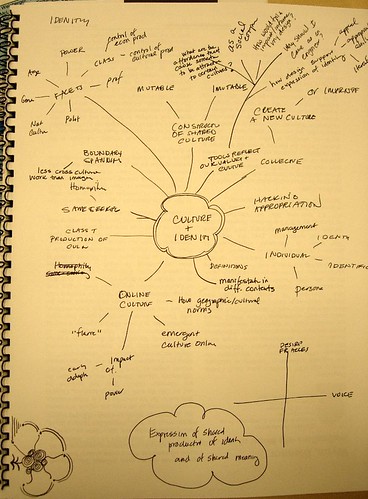
I still haven’t blogged my notes from the 2005 Microsoft Social Computing Symposium (my bad) but I uploaded a hand drawn mind map from our open space session on Culture and Identity to Flikr with the tag “identity. ”

Peter Davis at identity4all picked it up — Diagrams of Identity

“The Technorati Identity tag lead me squarely here at Nancy White’s photo blog w/flickr.

Since I tend to think pictorally, just like this (and have a growing collection of mind-maps myself), I thought I’d blog this one up the stack a bit (and a mental bookmark).

What this map really demonstrates is the true relativity of Identity. Given some completely different context, the map shows compliance, strong authentication, and patient privacy.

So Nancy, the next time you make this great diagram centered on Identity, push the edges a bit, and lets see how diverse these perspectives really are! I’d bet some would recoil and others rejoice! I cannot help but wonder if Identity Perspectives will ever allow Identity Commons?”

I can’t resist an invitation like that, so I took one little branch off the original picture and did this mind map. I left a comment on Peter’s blog and hope he stops by here!

.

, , ,