Moving Online in Pandemic #5: This is the time of creative destruction

This is 5th in a series of posts about the tidal wave of moving online in the time of Covid-19. #1#2#3 and #4 Slide deck and artifacts for the event.
Many people learning together

It is being said around the globe: move a bad meeting online and you have a terrible meeting. People are already in “zoom fatigue” and are “Zoombie Zombies.” The signal is loud and clear: we need to figure out what to stop doing so that we can focus on what is truly important.

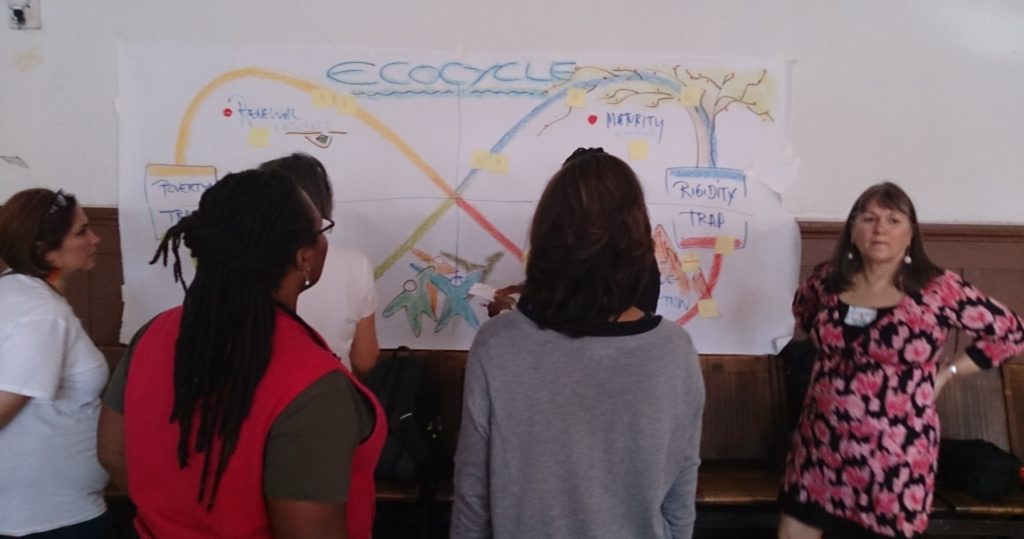
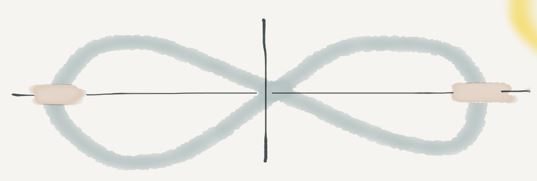
In talking to people desperate to figure out their next move with strings of critical upcoming face to face (F2F) events, it has become clear that one way forward is to first DEconstruct. Get clear on the deepest purpose of each meeting or event. Figure out what NOT to do or to STOP doing, and prioritize only those things that will move them towards their goals. That was the signal I was sensing when I wrote about Ecocyle to notice what is shifting a couple of weeks ago.

Now is not the time to simply tick the task box as done.

I decided I wanted to engage my communities of practice in figuring out how to help people DEconstruct and then REconstruct. Thus was born the DEConstruct/REConstruct episodes. The idea is to put together a string (sequence) of Liberating Structures that groups can use on their own or with a facilitator to focus on essentials, and then, and only then, move into design and facilitation considerations of what is born anew through the process.

I asked one of the people calling for help if they would help us “learn in public” by going through a rapid version of the deconstruct/reconstruct (D/E) process online in a Zoom meeting. I proposed we would do this in a “fishbowl” context with the team from the organization being the fish swimming through the process, and observers in the fishBOWL (fish bowlers) first listening, then breaking out into small groups to offer questions and suggestions to the fish team.

By using this learning in public approach, we could also facilitate a few other things. Potential facilitators and consultants in the bowl could reach out and offer support (getting me out of the matchmaking position). And the wise crowd in the bowl could give suggestions to improve the process.

My friend and colleague Eva Schiffer brought her team as the fish for Episode 1 yesterday. This group has the challenge of redesigning what was going to be a two week field based capacity building program in an African country. There were multiple levels of travel – of the consulting team to the country to work with their government partners, then out into the field with private sector wildlife conservation partners. Now none of these folks can travel. AND the pandemic is creating an new challenge for those using tourism as a way to preserve ecosystems.

In preparation for the fish bowl I shared the six questions I’d ask and we spend just 30 minutes on a call to walk through the process. Through some email back and forth there were just initial consideration of the questions because we wanted the conversation to be fresh and alive during the Zoom gathering. I also set up a Google Slides deck with the meeting agenda, process overview, a slide for each of the six questions for note taking, and then templates for note taking by the fish after their breakouts.

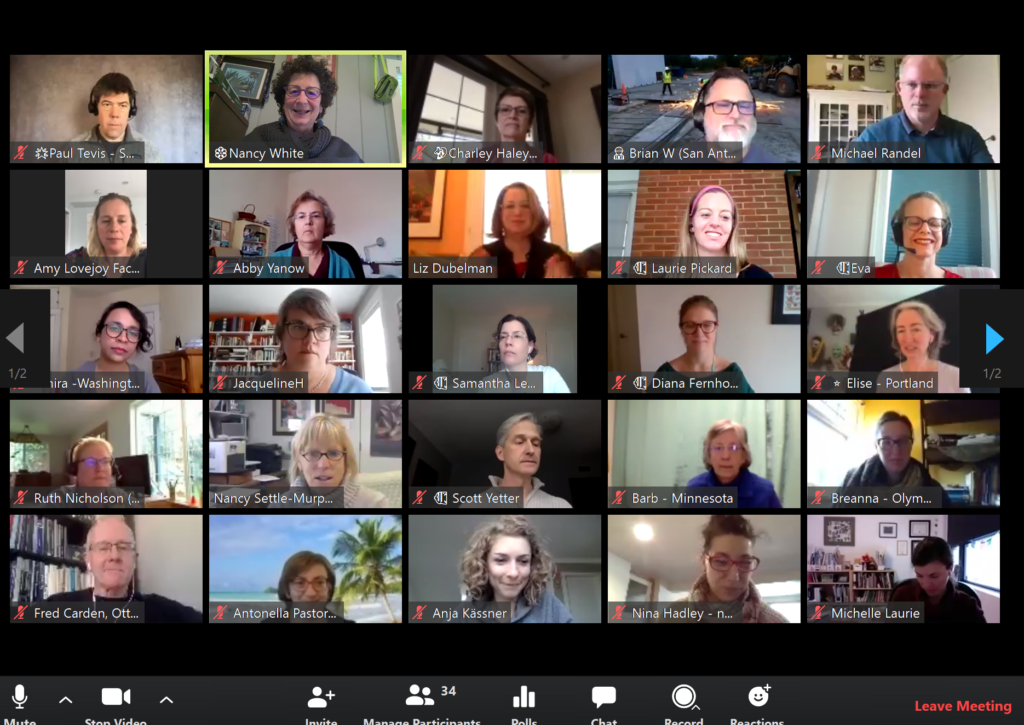
By start time we had 48 people on the call (out of 66 registered), six fish and the rest bowlers. After brief verbal introductions of the fish, and text introductions by the bowlers, we dove in with a story of their current challenge.

Next we launched into the deconstruct using the six questions from Strategic Knotworking. Here are the six questions.

  1. What is the deepest purpose of our work through this gathering and why?
  2. What is happening around us that demands change (in how we were planning this gathering –go deeper than social distancing if possible!)?
  3. What challenges and wicked questions do we face in achieving our purpose?
  4. Where are we starting, honestly? 
  5. Based on what we have learned, what is now possible?
  6. What is our first step and how will we know we are making progress towards our purpose?

Over the course of the next 45 minutes we focused primarily on question 1, around purpose, really digging past the signposts of their contract deliverables. Then we spent a few minutes on questions 2-4 to set context, challenges and baseline. I mentioned that question 4, “where are we starting, honestly” really benefits from a deeper look and suggested the use of Ecocycle Planning both to map out their project activities AND relationships. The team consistently talked about the importance of relationship and trust which typically they develop and deepen in F2F moments.

Finally we got to the really juicy question, “based on what we have learned, what is possible now?” That is when I felt the shift from what was, to what is now possible. The team thoughtfully balanced both their responsibility to their client (contract, deliverables) and the unique opportunity afforded by the shift online. Instead of the human and financial constraints (we can send the four people who are willing to travel), they realized they could tap more widely into the talents of their own team beyond the four. They could potentially engage more of their government clients and their private sector partners at a time when those partners are most stressed and could use support, even if there was no immediate money or business deal to be had.

Next we did breakout groups of 4-6 with the bowlers where they formulated a sharp, insightful question(s) and their most salient advice for the fish. They put these in dedicated slides (one for each group). While the bowls were doing this, the fish went into their own breakout room to make sense of what was happening. This unplanned innovation proved really helpful for the fish. So I want to repeat that twist – maybe keeping the fish in the main room so the facilitation team can learn from them. We’ll find out tomorrow when we try Episode #2

Take a peek at the insights from the Bowlers in slides 20-30 .

Finally, we did a VERY FAST (too fast?) What? So What? Now What? process and captured the insights in chat. I feel we could have gotten more out of this, but it was also important to stick to the 90 minute window.

Debrief

When faced with new constraints, we are able to leap past our old habits, assumptions and ruts. Something new becomes possible. This is at the heart of the idea of creative destruction and DEconstruct before REconstructing.

Looking across the amazing notes of the 7 bowl groups and the overall chat, including the debrief for those who stayed on for an additional 10 minutes, I think there was a) enough value to repeat this experiment next week with another NGO, b) gather and share a bit more information for the bowl folks so everyone get dive in quickly, and c) run the experiment one more time to see which questions deserve what amount of time.

We rushed through some great stuff, probably missed some stuff and really filled the 90 minutes, but it would have been wonderful to get the bowl engaged sooner and more interaction between the fish and the bowl. It would have been really wonderful to let the fish debrief themselves before we finished. That is lot in 90 minutes.

I was surprised that some actionable ideas emerged even before we got to the action planning question #5 – particularly Liberating Structure ideas that could be used in the deconstruction and assessment elements that could pull out some of the more complex issues and help the team prioritize actionable next steps.

As I second guess myself, I need to remember that my goal was not that these experiment could be fully completed – the full deconstruct and reconstruct – in 90 minutes, but to start the process. To explore and test the process. To connect people around the process. I think many of us hungered to fully DO the process which tugs at us. We want good things for each other and results. So I need to frame that this is a starting point.

I’m not sure if anyone followed up with anyone for the matchmaking intention. We’ll see if that shows up. I plan to check back with my fishes over the coming weeks to see what happens and will invite them to write up their reflections if that is helpful.

If you would like to be the FISH in the DE/RE bowl, please leave a comment before. We have more facilitators stepping up to do more!

Resources:

https://www.eventbrite.com/e/deconstructreconstruct-your-meetings-online-episode-2-tickets-101316392056

Timezone Converter Link

Criticisms and Cures around Liberating Structures

Last year I was inspired to mimic a cool format, criticisms and cures, on the topic of facilitating in complex contexts. I have found myself recently in conversations with people who can’t see the value of using Liberating Structures (LS), of engaging in immersions or communities of LS practitioners for people in NGOs, international development organizations and other cause related groups. There seem to be some unique barriers – and I’m not sure I have them right, so school me in the comments. But there seems to be some unique challenges in the NGO sector that I think are related to the diversity and complexity of the sector, and that creepy crawly sense of scarcity that comes into play. There are other sectors, like the Agile Programming world, who have adopted LS quickly – perhaps because LS gives with Agile philosophy and practices where are pretty specific. There is little such shared philosophy or practice in the NGO world. So I thought I’d try a C&C around this topic. (P.S. if you don’t know what Liberating Structures are, watch this little video!)

P.S. If you are interested in joining me in a Liberating Structures immersion in Atlanta, Georgia, USA September 18-19 check out
https://www.eventbrite.com/e/liberating-structures-immersion-workshop-atlanta-tickets-62928099640

PS. If you are interested in LS in Europe, join the Liberating Structures Learning Festival in The Hague, Netherlands, October 7-9, go to
https://liberatingstructures.eu/the-hague-ls-festival/

Impromptu Networking

Criticism: Why should I go to a Liberating Structures Immersion workshop. I already know how to facilitate?

Cure:  LS is not simply about facilitating. It is about essentially stripping down our group interaction practices to the bare bones to better understand how to unleash and engage everyone. It is about finding that space between over and under-control. It is about getting real work done, not just using clever techniques to keep people amused. If we have a practice that can help us diagnose and design for real needs, that is worth the time invested. Besides, once you get the hang of LS, you can design meetings in half the time as traditional approaches – or less. Even better, as you role model using LS, others will adopt it, so this is about behavior change in a system, not just one person learning something new.

25/10 Crowd Sourcing

Criticism: Liberating Structures takes away all of my control.

Cure:  Yes, and that is bad because? Group process is not about our control as leaders or facilitators or whatever. It is about getting stuff done together. So instead of framing in terms of control, focus on the purpose of the gathering and create the space (using the LS) to enable people to get that work done. Is there a risk? Compare it to having an awful meeting and getting nothing done, and that risk grows very small. This may be a great moment to reflect on our need for control and how that negatively impacts groups. Think about it. Do YOU like being controlled? And by the way, it will most likely be more enjoyable and the next time you invite people to a meeting, they may be happier saying “yes.”

Additionally, in NGO work we are often stating our values to be participatory, and led by those we are working with, not leading them. I don’t know about you, but I’ve found there are some bad habits I keep having to break around what I think is right, how I think things should be done. LS help me from falling back into those old patterns by using just the right amount of STRUCTURE, as opposed to keeping CONTROL.

Criticism: Meetings are fundamentally a waste of time. I don’t need to learn how to design and run better meetings, I just need to get rid of all of them.

Cure:  Purpose. The meetings you may have been forced to attend or lead may have been worthless. If you are in a very hierarchical and/or large organization, you may be suffering from bad meetings. By all means, stop those.

Next, think about what do people need to do with each other to meet organizational goals? How much clarity can you generate around purpose? Don’t confuse purpose with an agenda. Purpose is the reason to meet. If there is no purpose, don’t meet. If purpose is unclear, then there is a reason to meet. If purpose is clear, then an LS-infused gathering can convert that purpose from idea, assessment, action and first steps. There are six questions that have emerged from the LS community that are really helping me think about meeting (or project, or strategy) purpose.

  1. What is the purpose of our work? (What are we “making,” for whom and how do we know it is of value.)
  2. What is happening around us that demands change in our work? (If nothing, well go have a coffee and congratulations!
  3. What are the challenges and wicked dualities we are facing to do our work?
  4. Where are we starting, honestly?
  5. Based on what we now know, what is made possible?
  6. What are our first steps in those possibilities and how will we know we are making progress?

When groups can seriously consider and answer these questions, tapping into each person’s perspective and knowledge, much more becomes possible. This can be framed from the perspective of a status update or retrospective, all the way to the launch of a major initiative (with tweaking of the questions, of course!)

Criticism: As an NGO or international development organization, we don’t have the luxury of going to capacity building workshops. We are too busy address others’ capacity building needs.

Cure:  Calculate how much time is wasted in boring, unproductive, inappropriate meetings and group interactions. Query what you know about good adult learning. How are you applying that to the capacity building you are doing? If you don’t cultivate your own capacity, how can you do that for others? If money is an issue, ask for a scholarship. The worse thing you can hear is no. The best thing might just be a yes. You are WORTH it!

The 2 of 1-2-4-All

Criticism: People are getting totally annoyed with me breaking them down into groups, doing 1-2-4-All and all that. Come on!

Cure: I have struggled with this and what is dawning on me and others is that there are some essential interaction patterns or microstructures in LS that need repeat practice until they become habitual. We have a lot of things we have habituated in our meeting practices – we are just not very aware of them. These basic structures, once cultivated and practiced, become automatic instead of feeling like they are imposed upon us. Read this useful post on Medium.

Ecocycle

Criticism: Complexity is a buzzword or indicates a mess so big we can’t deal with it. I’m done with complexity.

Cure:  Go back and read this blog post!

Two Liberating Structures Workshops at University of Illinois April 5 and 6

Are you at or near the University of Illinois at Champagne/Urbana? Interested in Liberating Structures? Then join us for one or two days of hands/heads/hearts on workshops.  The first one is a new offering I’ve put together that builds on some of my recent blog posts (and more to come) about facilitating in complex contexts!

April 5 Learning the Strategy Game Plan: Liberating Structures for Development

The first workshop is on April 5th, 8:30 am – 5:30 pm. It is designed to explore how we can use Liberating Structures, a repertoire of 33 group practices, to improve project planning and execution for participatory projects that are often on complex and emergent contexts. While a funder or boss may want a linear log-frame and a budget, we need to find approaches that embrace ambiguity with practical approaches, ensure learning and improvement are part of the design, not an afterthought, and which consistently liberate and unleash the knowledge and experiences across the system at play.

In the workshop you will practice 6-8 structures and utilize an overarching framework to tie the pieces together in a cogent, visual whole. The fee is $100.00, registration is here, and a brief flyer is attached to this blog post.  Leave me a comment with any questions. Spread the word!

April 6th, Unleashing Learning Engagement in the Classroom 

The second is a series of three, 90 minute workshops that dive increasingly deeper into the use of Liberating Structures for increasing classroom engagement in higher education. We’ve designed this with the busy professor/lecturer/Graduate Student/TA in mind.

Is it a challenge to engage all student voices in your classes? Do you look for ways to spark deeper student engagement the subject matter and with each other? Do you wish they would take more ownership and risks in their learning? Engagement deepens learning and application. It strengthens the muscles that help students work with ambiguity. But it can be challenging, in both small and large groups.

Come explore Liberating Structures, an easy to learn and deploy repertoire of of 33+ open source interaction structures that can build patterns of easy, regular student engagement in the classroom.  They quickly foster lively participation in groups of any size, making it possible to truly include and unleash everyone.

You can start with a short 90 minute introductory workshop, or stay for all three learning sessions. First is an introduction of the easiest and most often used Liberating Structures, second, a focused application to solve a real challenge, and third, a deeper dive into the theory and practice behind Liberating Structures.

8:30 – 10:00  Workshop 1: Liberating Engaged Learning: discover and use 4 structures that can immediately increase engagement in your classroom.

Friday, April 6, 2018
Illini Union Ballroom

8:30 am to 10:00 am  Workshop 1: Liberating Engaged Learning: discover and use 4 structures that can immediately increase engagement in your classroom. In this 90 minute session you will get a hands on introduction to some of the easiest and most commonly used Liberating Structures to build student engagement in your class. It will conclude with a debrief and identification of immediate applications in your classroom. You can then build your practice by turning to the instructions for individual structures on the website (www.liberatingstructures.com), mobile phone app (available free on  iTunes and Google Play) or continue with the two following workshops.

10:30 am to 12:00 pm Workshop 2: Stringing Structures to Tackle a Challenge in Your Classroom: learn how a sequence of multiple structures can address specific challenges (student, passivity, unequal participation, lack of critical thinking, etc.) and larger outcomes. This builds on Workshop 1. 


Liberating structures can be used individually, but their power becomes more visible when they are joined together or “strung.” In this 90 minute session we will use a string of 2-3 Liberating Structures to collaboratively work on addressing a concrete shared classroom challenge such as how to create an open environment and tackle a lack of student participation, end student passivity, weak discussions, or the lack of productive risk-taking. You will walk away with at least one actionable solution you can apply the next time you are in the classroom. You will learn how to use the Liberating Structures Matchmaker tool to select and string the structures. Prerequisite: Workshop 1

12:00 pm to 1:00 pm   Lunch Break (grab lunch in the food court or on Green Street) with someone you just met this morning

1:00 pm to 2:30 pm Workshop 3: Understanding the Theory Behind Liberating Structures: an advanced workshop that looks at the underlying elements of Liberating Structures and how they can become part of the everyday pattern of highly engaged classrooms. Liberating Structures can appear to simply be “yet another facilitation tool.” What sets them apart is the attention to five microstructures that sit beneath each Liberating Structures, and the ten principles that guide them. These give us insight as to how and why Liberating Structures work well for stronger classroom engagement, enable more critical thinking, innovation and action. In this workshop we will explore some of the theory behind Liberating Structures and experience a few of the more complex and rich structures. You will also be introduced to various vectors for continuing to learn and practice Liberating Structures. Prerequisite: Workshop 1 and/or 2.

It’s worth your time to come to all three, but if you can only attend one, then come to the first. If you can do two, then combine workshops 1 and 2 or workshops 1 and 3.

Registration is here and the short flyer is attached below.

Flyer – LS Workshop on April 5 2018 – Strategy Game Plan

Flyer – LS Workshop on April 6 2018 – Unleashing Learning Engagement – external


Facilitating Strategic Planning in Complex Contexts

My clients have been asking for more support in planning for the future. In almost every case there have been internal or external factors that suggest significant inflection or turning points. Policy changes due to political shifts. Growth in networks. Shifting priorities. Emerging possibilities. New combinations of partners.

They usually ask for traditional strategic planning. I have realized I don’t do this anymore. Won’t. Forget your SWOT analysis. I’m fully into the “liberating planning” space. A liberated facilitation space. This work has been deeply enhanced by my collaboration with folks like Keith McCandless and Fisher Qua, fellow “struturalistas!” Many of the words below came from or were inspired by them and others from the Liberating Structures community.

Context

Why do we need complexity informed planning? Three big reasons.

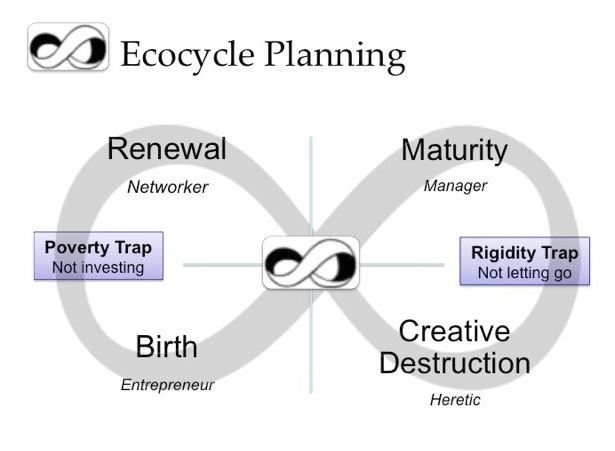
  • Portfolios, not just projects: Very few organizations have just one element, yet planning is often linear and isolated at the project level. Strategically we need to take a portfolio perspective on planning which is quite different than “planning a project.”  When you work at the portfolio level, you are looking not for a single success (or failure), but for signals that can show how to move the whole field forward. A portfolio approach can help buffer against the typical three-year grant funding cycles and keep focused on strategy. Tactics should include “safe fail” probes (http://cognitive-edge.com/methods/safe-to-fail-probes/) and experimentation in areas of uncertainty, and then, once some clarity has emerged, scale up or adapt to more mature results.  Among many useful things, the Liberating Structure Ecocycle Planning (http://www.liberatingstructures.com/31-ecocycle-planning/ ) supports a complexity informed portfolio approach.  Interestingly it also allows simultaneous work on strategy and tactics.
  • Complexity requires complexity informed facilitation practices. A portfolio approach is complex, with many unknowns, variables and dependencies. Even within a project, the challenges people are facing are rarely simple cause/effect problems. They are complex. It does NOT mean that things are SO complex, we simply can’t address the complexity.The facilitation implication is that people need a handle on complexity, to recognize it, work with it, and not get overwhelmed by it. If we are to tackle system level problems, we need a repertoire suited for complex contexts. Look at the work of Cognitive Edge (http://cognitive-edge.com/ )  , Harold Jarche and many others. (http://jarche.com/2010/10/organizations-and-complexity/, https://jarche.com/2016/04/complexity-in-the-workplace/ , http://www.ontheagilepath.net/2015/10/complexity-and-methods-to-succeed-thanks-for-the-books-organize-for-complexity-and-komplexithoden.html and https://www.odi.org/sites/odi.org.uk/files/resource-documents/10604.pdf )
  • Planning itself becomes an Ecocycle. My recent work with the Ecocycle Planning tool has opened a new repertoire of facilitating in complex contexts by helping us recognize that our work does, and should, span the four spaces of maturity, creative destruction, networking and birth. The Ecocycle recognizes that we operate across a range of contexts and projects that are, from a Cynefin framework perspective, simple (rules based), complicated (expertise driven),  complex (not predictable) and chaotic (we will never fully know!) A manager may feel most accountable for the maturity space, where tested approaches can be scaled up. But without an eye to the pipeline in, simply managing the mature space is self-delusion. It may require making space through creative destruction. Opening up to wider networks to identify new possibilities and steward them through the innovation process. Yet maturity is the manager’s area of comfort. To embrace the other areas, they must see the action of the continuum of the Ecocycle. (EDIT: For some great background on Ecocycle see https://www.taesch.com/references-cards/ecocycle by Luc Taesch!)

The patterns I notice across the Ecocycle and other useful facilitation processes for working in a complex context are that:

  • they ask us to shift our perspective about how past experiences inform our present analysis,
  • they support the emergent (often unpredictable), and,
  • they are iterative.

Another thing I notice is that this practice embraces a different mindset for planning which also attracts REALLY INTERESTING people. That, of course, attracts me.

The Adaptive Strategy Landscape for Project Design & Development

We have been struggling about what to call this and how to describe it. My newest experiment is “Adaptive Strategy Landscape.” I’m currently designing a workshop for practitioners in international development to use Liberating Structures in project design – thus my need to blog about this and think out loud with you. I am drawn to the term “landscape” because it is visually strong, and implies an ecosystem of inter-relating elements. I am very open to other name suggestions. 😉

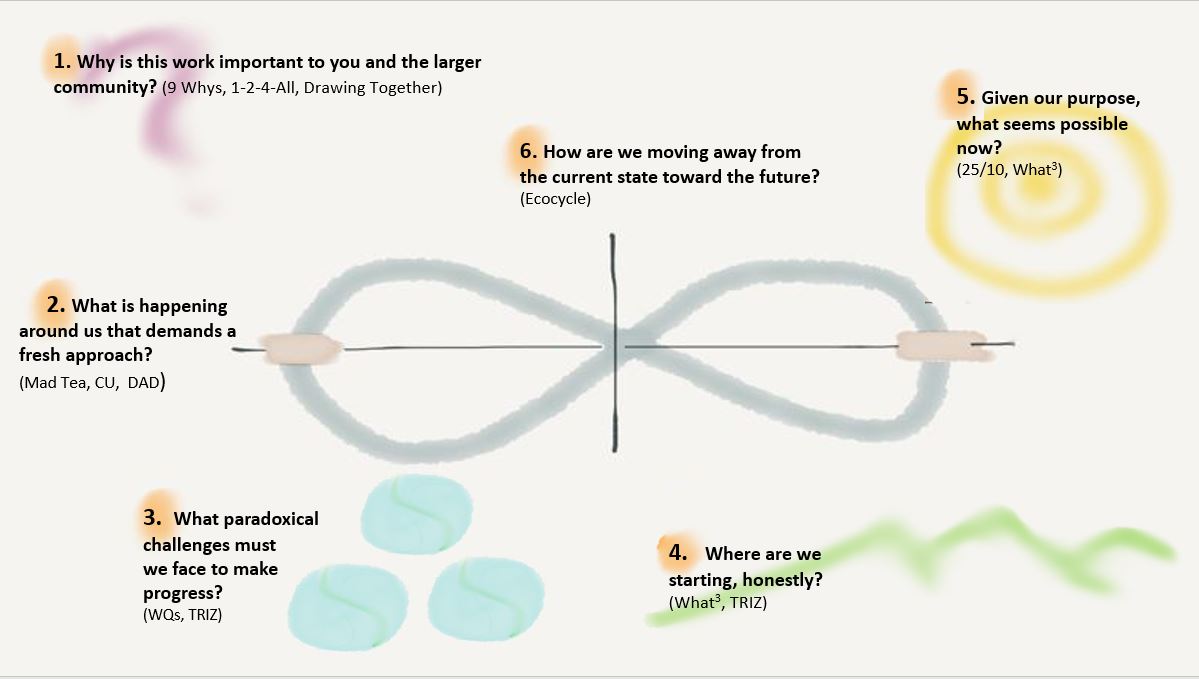
So what does this Landscape, this “emergent, complexity-friendly strategic planning” actually look like? Right now we are framing it around six questions I learned from Keith. Typically I tinker and modify them to the domain in question. This is their generic form.

  1. PURPOSE: Why is this work important to us and the wider community?  How do we justify our work to others? What makes this important?
  2. CONTEXT: What is happening around us that demands change? This question is particularly energizing to help identify and sharpen purpose. It shocks me how often this is ignored or left muddy and far from strategic. A good idea out of context is often a blind alley.
  3. BASELINE: Where are we starting, honestly? This question has many layers and process options, from identification of strengths (things in our “Maturity area” of the ecocycle), positive deviance (http://www.liberatingstructures.com/10-discovery-action-dialogue/ ) , identification of challenges, or the things we have resisted or feared discussing, the light and the dark. It surfaces the things we must work with. AND the things we need to creatively destroy to make space for innovation. The creative destruction is ESSENTIAL to this process!
  4. CHALLENGE: What paradoxical challenges must we face to make progress? This invites the ground shifting conversation to enable working in a complex environment. It is not “if we do X, Y will happen.” It is not X or Y.  It examines competing priorities, uncertain futures, and antagonizing circumstances. It explores multiple perspectives and truths. Paradoxes are not things to defeat us, but tools to change how we view a problem. To shift our mindsets.  A useful sub-question if things get stuck is What happens if we don’t change? How do we keep moving forward in this land of “wicked questions?” ( http://www.liberatingstructures.com/4-wicked-questions/ )
  5. AMBITION: Given our purpose, what big ideas seem possible now for our purpose? What big opportunities do we see? What is ready to be imagined and then stewarded into birth? This frames our shared impetus forward. It is the genesis of our monitoring and evaluation framework as well, informed by the other five questions. This is super-important and includes a developmental evaluation perspective right from the start. This is useful to engage project funders in dialog, both in the proposal, planning and discussion of outputs and outcomes from a complexity perspective.
  6. ACTION: How are we moving away from the current state to our desired future state? This is the practical piece. What are the next steps? Things we can decide and do. Start now, no matter how small the step. Do something. Don’t wait to plan for perfection. ACT! Build iterative learning into the design. Monitor and evaluate as a way of working, not an afterthought or a tick on the checklist.

While these each have a number attached to them that informs sequence, this is not by any means always a linear process. A discovery around “where are we starting, honestly,” may lead us to rethink our purpose. Learning loops abound.

Process

A portfolio approach, complexity and the Ecocycle, informed by the six questions, has lead to the construction of a set or “string” of processes (many from Liberating Structures) that inform design of the process.Here are some example structures for each question.

  1. PURPOSE: Why, why, why is this work important to us and the wider community? 
    1. 9 Whys
    2. 1-2-4-All
    3. Drawing Together
  2. CONTEXT: What is happening around us that demands a fresh/new/novel approach ?
    1. Mad Tea
    2. Critical Uncertainties
    3. Discovery and Action Dialog
    4. Users Experience Fishbowl
  3. BASELINE: Where are we starting, really?
    1. What, So What, Now What?
    2. TRIZ
    3. Critical Uncertainties
  4. CHALLENGE: What paradoxical challenges must we face to make progress?
    1. TRIZ
    2. Wicked Questions
  5. AMBITION: Given our purpose, what seems possible now?
    1. 25/10 Crowd Sourcing
    2. What, So What, Now What?
    3. Troika Consulting
  6. ACTION: How are we breaking away from the present and moving toward the future?
    1. 15% Solutions
    2. Ecocycle
    3. WINFY
    4. Purpose to Practice

I pay close attention to turning points, where something shifts in the group, and adjust my string to respond to these emergent factors. I use large visuals to anchor and capture salient information, ideally identified by the participants and NOT me. (This helps avoid one of my pitfalls, over-harvesting!) Post its, paper, pens are all in everyone’s hands. Fisher has started adding a timeline to the bottom to build off of question 3 with more detail.

We iteratively stop and take turns telling the story of the emerging visual to get clear on what we understand and what we need to process further. Often, this is the moment when we go back and sharpen the purpose, and find the right level of granularity around each question. Sometimes we capture these on videos. There are moments when you see new clarity emerge right on the spot.

From this a smaller team usually transforms this into a written plan, conforming (ahem!) to the needs of the organization and or funders. There is still a gap between the very learning intensive process of complexity-based planning and the formats we use to write, manage and evaluate projects. More work to do!

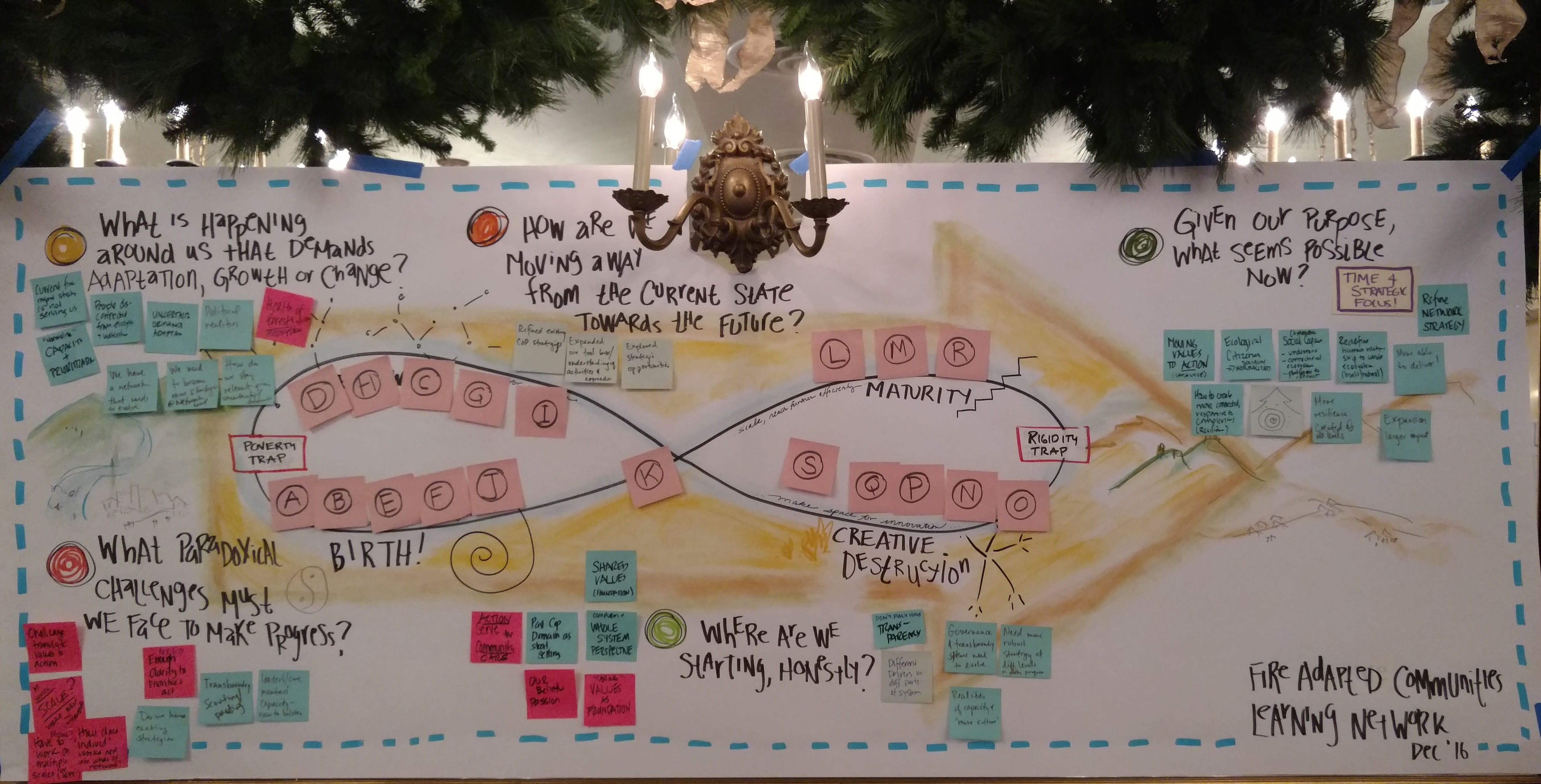
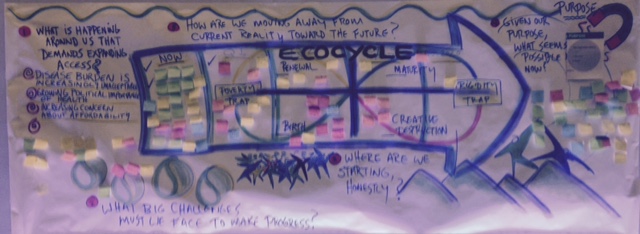
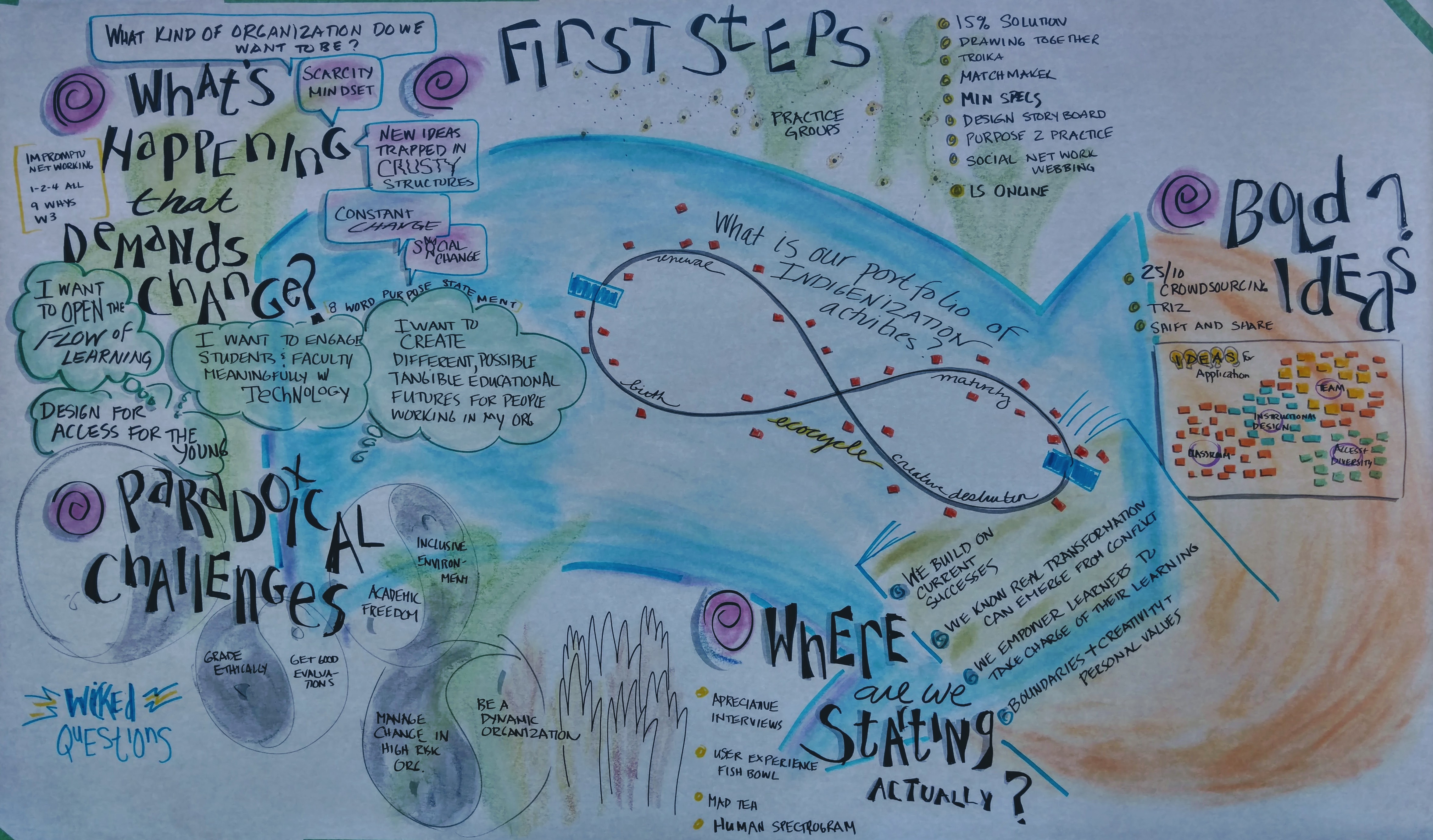
Here are a few examples of the visual after a planning session.

From the Fire Adaptive Communities retreat

From Keith McCandless


So what do you think?

Please add, comment, critique, rename in the comments! Thank you in advance for thinking WITH me!

Resources/Inspirations:

Innovation Barrier #2: Your Network Is Embedded In An Older Model

At this point, most people are aware of the power of network effects.  Everybody uses Microsoft Office because everyone else uses it.  If you want to sell something, you put it on eBay because that’s where the buyers are (and they’re there because that’s where the sellers are).  Apple’s iOS is popular, in part, because everyone wants to develop for it.

via 3 Things That Can Stall Innovation (And How To Overcome Them) | The Creativity Post.

Event: Preparing Teachers of Refugees

Diana Woolis, a friend and colleague at the Carey Institute for Global Good is convening an online event that begins soon and culminates on March 14-16. It will focus on preparing teachers of refugees.

Please join me and other educators from around the world in  Action for Teachers of Refugees a free global online event about teaching teachers of refugees.  We will be discussing critical issues and sharing ideas and experiences about professional learning. You can participate in some or all of the activities, for as much or as little time as you choose, and whenever you want through-out the 3 days.

We have several activities lined up:

  • Showcasing  professional learning platforms people are using or wish they had for professional development – add yours, learn about others.
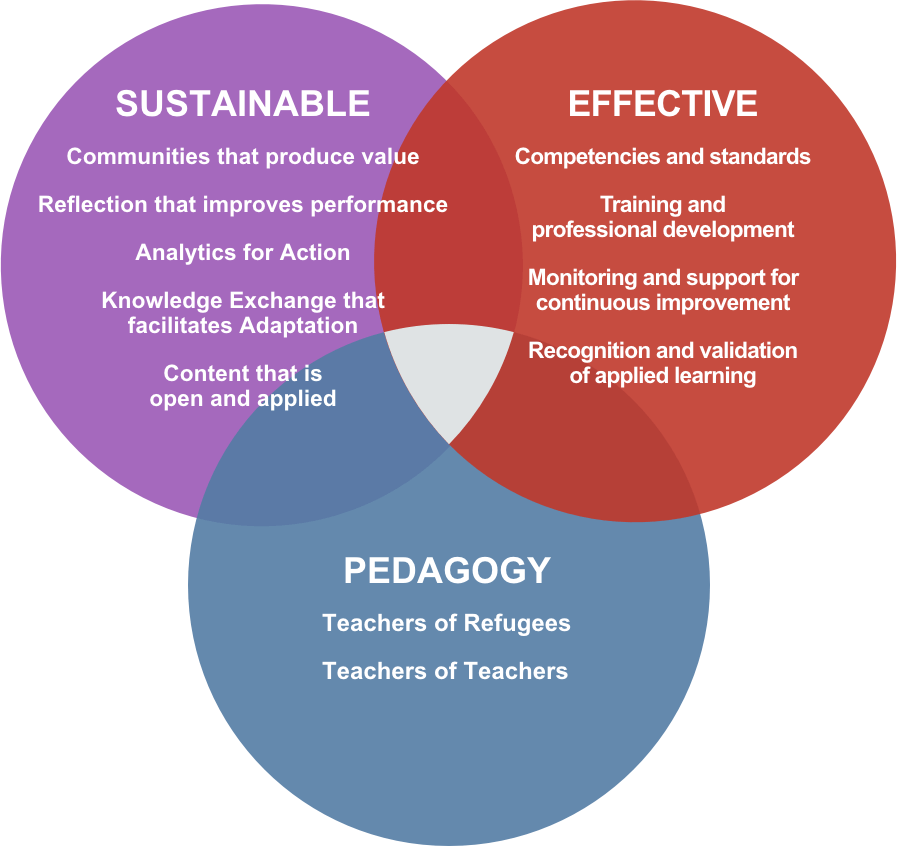
  • Structured facilitated discussions: Text-based exchanges facilitated by guest Discussion Hosts (I am one) focused on addressing the question: What is sustainable, effective pedagogy for teachers-of-teachers of refugees, and how can it be enacted?
  • A Practice Lab – for those who want to reflect, in community, on their experience developing or participating in teach-the-teachers initiatives.
  •    Signature Pedagogy – A consideration of a draft version for teachers-of-teachers of refugees.

Especially needed are the voices of teachers, pre-k through college, so please share this invite with your teacher networks!

 Here is the overall description:

PREPARING TEACHERS OF REFUGEES
Many organizations in the United States and around the world are designing effective content and curriculum for teachers of refugees in a range of settings- from camps, to college campuses, to classrooms and online, on a range of topics from math to English to arts and humanities as well as social-emotional support for students.

As a group, we are universally challenged by how best to “teach-the-teachers” – how to engage, prepare, assess, certify and support them.

The Center for Learning in Practice seeks to contribute to addressing this situation by codifying ways in which continuous learning for teachers/educators and practitioners, real time data about teaching practice, and valuable feedback can be provided to teachers regardless of context and with fidelity. We seek to do so in community and in dialogue with educators and practitioners and help build a knowledge network among us.

The full schedule is here.

In addition, beginning now anyone who has registered can post a submission by simply writing a short description of their platform- what it is used for, who it serves, and how success, impact, or outcomes of its use are or will be assessed. On March 13 posting closes. On March 14, the Peer-Source is open all day for comments, and then is put in “read-only” mode, when we move to the Forum discussions.

I encourage you to join us for part or all of the event. Free. Online. Register now!