
What art can teach us about knowledge work

painting4How Art Reveals the Limits of Neuroscience” by Alva Noë is a fascinating read that asks us to step beyond the idea that we are our brains. It is stimulating me to reflect on some things I’ve been trying to articulate about knowledge sharing and  the transformation knowledge into new ideas, application, etc. It relates to some conversations on how we share knowledge across research projects, between journalists who care about their communities, and people who are trying to improve the world.

In observing how our experience of art changes when someone else shares their experience of the work, Noë writes:

This shift — from not seeing to seeing, from seeing to seeing differently, from not getting it to getting it — is actually very common. We live and learn, look and ask, bring what’s around us into focus continuously. At least part of what makes art different, or special, is that it yields the opportunity not only to “get” something, perhaps something new, but also to catch ourselves in the very act. In this way, art illuminates us to ourselves.

Interestingly, when I started to read it, I was not actually looking at art itself. The experience Noë writes about resonated deeply to my experiences of seeing people take in an idea and transform it into something they can use, apply, and “own” in the very productive sense. Own it in terms of being able to to use it meaningfully. Imagine a way of reducing open defecation, or changing water use habits. Imagine being able to take the building blocks of an idea and transform it into a locally useful solution. She frames it as the “world as the playing field for our activity,” and thus the interplay with it.

“This is not to deny that the world acts on us, triggering events in the nervous system. Of course it does! But the thing is, we act right back. Every movement of the eye, head, and body changes the character of our sensory coupling to the world around us. Objects are not triggers for internal events in the nervous system; they are opportunities or affordances for our continuing transactions with them. The world shows up, in experience, not like a diagram in a brain chart but as the playing field for our activity. Not the brain’s activity. Our activity. Not activity inside our head. But activity in the world around us.”

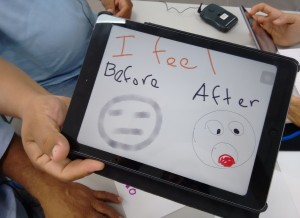
Now that I’ve read it, I’m thinking about how art can help me address my challenges with knowledge work!! Take a few minutes to read the article.

Choices in Learning and Teaching: More Humane? More Engaging?

Last week I blogged a little piece on the power of inviting a human being into a learning or doing experience. The human side of it. Today I finally read the post from Ryan Tracey that a number of folks have mentioned, Collateral damage | E-Learning Provocateur.

Ryan, after acknowledging the lack of evidence that supports the theory or learning styles (yay!), brings some nuance into the conversation and tackles the contextual issues around learner preferences.

If someone is in a classroom or a job-mandated training session, they will take what you give them. They may not be happy, but the in-room environment creates more pressure to conform.

In independent, self-driven learning, we hew more to our own personal preferences. Like Ryan, I cringe when I have to learn through videos, not just because so many are bad, but I’m a fast reader and can pinpoint what I want more efficiently. I certainly CAN learn with videos, I just prefer NOT to.

Creating a space for choice seems a pretty humane thing to do. I am more likely to follow through, to say YES, if you give me the respect as an adult learner and, where practical, some choice. I’ve observed this increases engagement over time (mine and others’). I wonder if there is any data to support this?

I think back to the JIBC/UdG Guadalajara group last month and even the conversations around Adroid vs. IOS, even without their religious zeal, reflect that driving impulse to have some level of choice, both as instructors/teachers/trainers and as learners.

P.S. I enjoyed the images in Ryan’s post as well!

P.S.S. The network and Ryan have circled back and now we know the image is the work of  Allie Brosh at Hyperbole and a Half: http://hyperboleandahalf.blogspot.com – Allie, your work rocks!

The Power of Ordinary Practices – Quotes Worth Amplifying

Well, this seems to be a fitting follow up to my last blog post.

Amabile: I believe it’s important for leaders to understand the power of ordinary practices. Seemingly ordinary, trivial, mundane, day-by-day things that leaders do and say can have an enormous impact. My guess is that a lot of leaders have very little sense of the impact that they have. That’s particularly true of the negative behaviors. I don’t think that the ineffective team leaders we studied meant to anger or deflate the people who were working for them. They were trying to do a good job of leading their teams, but lacked an effective model for how to behave.

So, I would say sweat the small stuff, not only when you’re dealing with your business strategy, but with the people whom you’re trying to lead. I would encourage leaders, when they’re about to have an interaction with somebody, to ask themselves: Might this thing I’m about to do or say become this person’s “event of the day”? Will it have a positive or a negative effect on their feelings and on their performance today?codrawing2

Amabile also calls out the rich, internal emotional lives that we all have, and how that influences our working together and collaboration.

One, people have incredibly rich, intense, daily inner work lives; emotions, motivations, and perceptions about their work environment permeate their daily experience at work. Second, these feelings powerfully affect people’s day-to-day performance. And third, those feelings, which are so important for performance, are powerfully influenced by particular daily events.

This again has resonance with last week’s #UdGAgora work where we explored the role of empathy in course design. The red threads are really showing up today. Maybe this will help me start pulling together a full post about The Agora. Alan has already started the “reflective ball” rolling.
Source: The Power of Ordinary Practices — HBS Working Knowledge

Confusiasm/Confusiasmo at the UdGAgora

Many years ago at a KM4Dev community meeting, Carl Jackson coined the word “confusiasm,” a combination of confusion and enthusiasm. This has become a way of being for me. It represents, quite simply, learning in action.

We used this concept at the University of Guadalajara Diplomate program on mobile tech for engagement the last two weeks in Guadalajara with the Agora project. There is much more I want to write, but at the minimum, I want to start curating and sharing the artifacts. Here is the first one, a Storify of the Confusiasm Twitter thread. (Edited 2/3/2020 – link is dead because Storify is dead. 🙁 )

https://storify.com/NancyWhite/confusiasm-confusiasmo-at-the-udgagora

Learning is everywhere — From Lilia on Mathemagenic

Too good not to share. Go read it. And look at her son’s amazing Kale photo. I’m not reproducing it here to tease you into clicking into her post. I’m evil that way. 😉

Learning doesn’t necessary take a lot of time. Mainly it takes a mindset of recognising learning opportunities everywhere and going for them. And a bit of practice – of observing, improvising and not making a duty out of play 🙂

via Learning is everywhere — Mathemagenic.