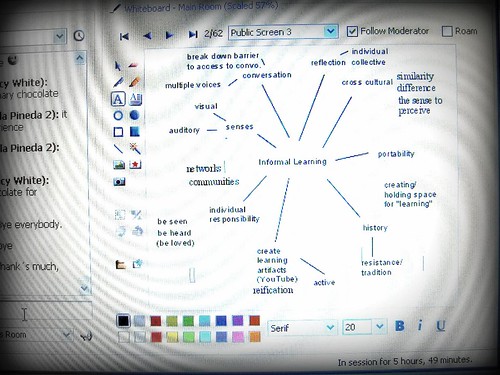
Today I took part in a small portion of a larger online/F2F event originating in Germany from LearnTec.
It was fun to trade ideas with Heike Philips, Dave Cormier and Jay Cross (and I am sorry Jennifer Jones was unable to chime in due to timing/home rhythms at the early time of day). We all were strong proponents of the value of conversation in learning (informal or otherwise) but I found myself backing off a bit and reminding myself that conversation is one of the three legs of my learning stool.
Conversation – making meaning, getting different perspectives, trying out and testing ideas, challenging assumptions.
Individual reflection – (because group reflection is a subset of conversation, no?) Stepping back, reviewing, observing, evaluating our own learning both in terms of process and content. Reflection provides us needed self awareness and the ideas we bring back into conversation.
Reification – borrowing from Communities of Practice theory, what we create that expresses what we are learning or have learned. With internet tools makeing self publishing so easy, this area has blossomed – videos, images, blogs — things that manifest both our conversations and our reflections and put them out for wider consideration.
These three are a vortex, always intersecting with each other, even competing for our attention, eh? I wish I had paid more attention to reflection when I was younger. 😉
I have a habit of worshippping at the altar of conversation. But like all things, I must not let that blind me to other elements. It is in the interplay, the fluctuation between things, the margins, the tensions of what we know and don’t know, that learning happens.

One of the things that John says in this video is the importance both of a view of a community from the inside AND the outside. This is why I love it when communities sit within wider networks to make this possible.
As we work through the final layout, it is starting to actually feel real. YAY!
Tomorrow I’ll be the guest of Heike Philip (in Germany) along with Jay Cross and Ken Thompson for an online roundtable on virtual learning, informal learning and virtual teams. We’ll mix it up, I’m sure. It is part of a larger day of activities that are F2F and online in GERMAN in the morning, German time, and in English in the afternoon, German time (early morning for us on the US West coast). Join us!
Virtual Collaboration Moderation Heike Philp
Introduction with Lutz Berger, free journalist 2.0, Science&Faction
Virtual Round Table – Panel Discussion Jay Cross, author of the book ‘Informal Learning’, Nancy White, consultant for communities of practise and Ken Thompson, virtual team expert and author of the ‘Bioteaming Manifesto’, meet live online to discuss strengths and opportunities as well as weaknesses and threats for virtual teams.
This is an unusual and an explosive mixture of experts and trendsetters who have been doing the ground work of connecting people. We are looking forward to hearing their views on the ‘next 5000 days’ of the Internet, an Internet that appa rently took 5000 days to reach the same amount of connections than our brain has todate. Heike Philp will be moderating the discussion and invites all present, namely all ‘virtual’ and all ‘local’ participants to testdrive virtual collaboration and to freely share ideas.
Via Hyperlocavore, I watched this video on preparing an urban, raised-bed garden. It focuses on the building of raised beds, using rotating small animal waste, and hoop houses to get an early start on the gardening season. If you are interested in gardening, take a look at the video. If not, skip the video and hop below for the online community connection.
So what are the practices for communities that are akin to the late winter preparation for Spring gardening?
In the video, Gardening Girl talks about:
start with clean, well drained soil
use a modular design so you can easily take care of your garden
use all the creatures available – chickens and rabbit hutches rotated over dormant beds to do off season soil building (in other words, good s$%#)
take advantage of free stuff to build soil – leaves and grass clippings
cover unused beds
build simple hoop houses to get an early start on the season (she even shows us how – it’s easy!)
raised beds take the back breaking work out of gardening, bringing the garden to you
intensive gardening saves water and increases yield
From an online community building perspective, this might translate to:
Clean soil – simple environment. Make sure the technology you use is aligned to the core needs of the community – what tasks do they need to do together. Other stuff can be added later, but if you start with a mess, you’ll end with a mess.
Modular – can tools, processes and content for or developed by the community be used easily in different ways? Can you repurpose something for another use if needs change or you need to expand or contract? Can you easily add and subtract activities and tools?
All the Creatures – who is already doing something similar? Are there early joiners who have something to add to the initial start up building and process? Use what is available! Be creative. Don’t let things go to waste!
Use the Free Stuff – Look around and see what free things can support (build the soil) your community. Can you put up with some ads and use a free tool? Can you recycle existing resources (and save the earth a bit along the way). If you have a budget, where is it best spent? On tools, or the rare chance for a face to face? On technology, or chocolate? (well, I may be getting carried away.) Make recycled chic and focus your resources where they count – on people.
Cover Unused Beds – empty spaces create empty feelings. Is some part of the community technology configuration unused? Are there dead forums? Pull out the good content and recycle it elsewhere, and either archive of button up the empty spaces. But be careful about what you delete. See thesethreads on the ComPrac list about the dangers of assumptions about archives.
Hoop Houses for Early Starts – sometimes online communities need a smaller, protected space to germinate, build trust and get strong to withstand some of the buffets of the open world. This may mean finding an existing set of core members and gradually growing, or creating a little hot house to get things going.
Raise the Beds – like higher planting boxes that reduce stooping, bringing community as close to where people are now rather than making them go further out of their way to participate. Can you piggy back on their community rather than starting a new one? Are there some simple overlaps or complementarities that suggest some sort of cross community collaboration?
Intensive Gardening – good soil retains water and has greater yields. Good nurturing, leadership, stewardship and followership makes it easier for communities to focus on why they came together in the first place. This is not about control, but creating space and conditions for success. So a little extra work up front can go a long way. But like anything, don’t get carried away. Like a garden, a community has its seasons and it changes over time. Be as intensive as is right for the moment!
So is Spring approaching in your community? What are you doing to prepare?
We use cookies on our website to give you the most relevant experience by remembering your preferences and repeat visits. By clicking “Accept”, you consent to the use of ALL the cookies.
This website uses cookies to improve your experience while you navigate through the website. Out of these, the cookies that are categorized as necessary are stored on your browser as they are essential for the working of basic functionalities of the website. We also use third-party cookies that help us analyze and understand how you use this website. These cookies will be stored in your browser only with your consent. You also have the option to opt-out of these cookies. But opting out of some of these cookies may affect your browsing experience.
Necessary cookies are absolutely essential for the website to function properly. These cookies ensure basic functionalities and security features of the website, anonymously.
Cookie
Duration
Description
cookielawinfo-checkbox-analytics
11 months
This cookie is set by GDPR Cookie Consent plugin. The cookie is used to store the user consent for the cookies in the category "Analytics".
cookielawinfo-checkbox-functional
11 months
The cookie is set by GDPR cookie consent to record the user consent for the cookies in the category "Functional".
cookielawinfo-checkbox-necessary
11 months
This cookie is set by GDPR Cookie Consent plugin. The cookies is used to store the user consent for the cookies in the category "Necessary".
cookielawinfo-checkbox-others
11 months
This cookie is set by GDPR Cookie Consent plugin. The cookie is used to store the user consent for the cookies in the category "Other.
cookielawinfo-checkbox-performance
11 months
This cookie is set by GDPR Cookie Consent plugin. The cookie is used to store the user consent for the cookies in the category "Performance".
viewed_cookie_policy
11 months
The cookie is set by the GDPR Cookie Consent plugin and is used to store whether or not user has consented to the use of cookies. It does not store any personal data.
Functional cookies help to perform certain functionalities like sharing the content of the website on social media platforms, collect feedbacks, and other third-party features.
Performance cookies are used to understand and analyze the key performance indexes of the website which helps in delivering a better user experience for the visitors.
Analytical cookies are used to understand how visitors interact with the website. These cookies help provide information on metrics the number of visitors, bounce rate, traffic source, etc.
Advertisement cookies are used to provide visitors with relevant ads and marketing campaigns. These cookies track visitors across websites and collect information to provide customized ads.