Patterns for Humane Online Meetings

Screenshot of gallery view of Zoom

I’m working on a pro-bono project and came across a request for an online meeting resource. After scrolling through a mind-numbing number of “ok” resources, and struggling to re-find old favorites, I thought I’d share some patterns instead of a recipe.

This is something I’ve been playing with for the new Liberating Structures (LS) book Keith McCandless and I are writing. It comes from a draft chapter on how to get started with LS. It describes six steps or phases of implementation and builds on common meeting and facilitation practice, and expresses the “how” by using LSs. You can replace your favorite interaction processes, all the while y’all know I dearly love Liberating Structures!

Each section has a section for purpose, process/Liberating Structures and tech/artifacts. This just gives you a taste, some hints and resources, but not the full meal. If there is something specific you want to know more about or have questions, please leave comments!

TDLR: Connect people immediately through small group breakouts for meaningful conversation. Reduce presentations. Alternate pacing, mix up people in breakouts and collectively identify what is important to capture. Enable technologies that give power to people to contribute visually, verbally, in text and to interact with each other rather than centralized control.

One: Design, Document & Prepare

Purpose

Define the group’s purpose to inform agenda design.

Hints:

  • Include participants’ needs and perspectives in planning (vs. just the sponsors). Include some of them in your design team! 
  • Consider crafting a statement to frame the purpose like this: The purpose of this meeting is to (DO WHAT) so that (WHO) can (DO WHAT). We know we are making progress when (DESCRIBE). To dig deeper into purpose, try 9 Whys.
  • Attend to relational practices in the context of your group. For example, in times of change, grief or trauma, make space at the start for people to be seen and heard in small groups of 2-4. Take pauses for people to process not just thoughts, but feelings. 
  • Remember: content can be delivered asynchronously; relationship and connecting benefit from synchrony.

Process/Liberating Structures

Design your agenda. Prioritize people and connection before content. You can use LSs for planning too. Purpose to Practice helps include all the aspects of a meeting plan. Design Storyboard helps consider process options and patterns. Always be ready to shift if something shows up in the room suggesting change and adaptation.

Hints:

  • Ensure balance between purposeful interaction and content. Reduce presentations to a minimum. Alternate fast and slow interactions. Alternate frequently between small/large group options where people have a smaller space to share ideas and a larger space to make sense across ideas. Build in time for quiet reflection. Offer space for “no video” time or options for whom video is draining.
  • Craft invitations for each step, activity and/or LS. Iterate till you have the clearest, simplest invitation that both guides and leaves space for emergence (we call this precise ambiguity!)
  • Ensure the participant agenda you send in advance is focused on purpose, not minute by minute process details that can pre-program people to decide what to skip and what to attend to. 
  • Use the Matchmaker to select and sequence (“string”) your LSs/processes that meet the needs of people doing the work. Here are some examples of some of the easiest LSs to use. More are also noted in subsequent steps.

Connect People/Get Started

Share Information or Expertise

Explore Context (internal and external)

Devise Options

Attend to Process and Feelings

Reflect

Tech and Artifacts

Identify and prepare the technology and visual supports needed for your meeting.

Hints:

  • Prepare a run sheet (a.k.a. “Run of show”) that adds on the details including  prompts ready to paste into chat, visual materials (slides, shared whiteboard or document, polls, etc.), and breakout plans.
  • Identify roles (who leads what, who tech hosts, cybrarian tasks: who supports capturing artifacts, etc.)
  • Ensure tech is configured for maximum P2P interaction (group chat, direct messaging, hands on creation of knowledge artifacts.)
    • Support verbal instructions with prepared visual materials.
    • Carefully consider value of recordings from a value creation (or not) and privacy standpoints

Two: Get the Meeting Started and Settled 

Purpose

Support connection and a graceful entrance into technology and launch with interactions that set the tone for the meeting. Attend to the diverse needs of people with a welcoming, inclusive and aesthetic environment.

Process/Liberating Structures

Immediately use LSs that focus on small group breakouts so people can connect and be seen/heard/respected through meaningful, relevant conversational prompts. This is very different from “go around the room and introduce yourself” which can be numbing after a while. Avoid random ice breakers and focus on your purpose. If people are new to tech, make the breakout process as simple as possible to serve as “practice.” You may be pleasantly surprised at how effective starting with meaningful conversations in breakouts changes the tenor of the whole meeting. It says “what you think, say and feel matters!”

Hints:

  • Open the room 5 minutes early and encourage informal greetings, sharing something in chat.
  • Focus on people’s faces, not a slide or agenda.  

Tech and Artifacts

  • Hosting team arrives early for a tech check to ensure all settings/plans/roles are clear and in place.
  • If recording, start after the informal 5 minutes. Pause recording during breakouts and stop recording at end of meeting.
  • Provide tech support (“how to” slide for features you are using, breakout for individual tech support, share hints in chat.)

Three: Dig Into the Work

Purpose

Support the use of LSs (or other relevant processes)  to achieve the group’s purpose.  Delete anything that does not serve the purpose and the participants, where possible. This includes generic welcome talks, over-general presentations and a detailed description of the agenda. Hit the points that move the purpose forward.

Process/Liberating Structures

Follow the minimum specifications of each LS, at least until you are familiar with them. Then improvise. Notice where people do or do not understand your prompts and invitations; take a breath and try again. If people are getting confused, slow down. If things are getting repetitive and “speachy,” speed up.  If a moment arises when everyone wants to talk, send them into breakouts so everyone gets a chance to talk (not just those comfortable speaking or dominators) and ask the groups to share back ONLY what they think everyone should hear. Capture key points. 

Tech and Artifacts

  • Attend to verbal and visual support.  Sometimes we don’t listen as well online so reinforcement with visual instructions is helpful. 
  • Support shared capture of key content – try and get participants to identify what is important. They know best.  Can use chat, shared documents, whiteboard, polls, etc. This is different from having, for example, a staff member “take notes.”

Four: Debrief and Identify Next Steps

Purpose

Develop practices to identify next steps and preparation for moving forward. Debrief for future process and improvement. Next steps can be at any or all levels—individual to whole group.

Process/Liberating Structures

Tech and Artifacts

  • Continue to provide participants a mechanism to capture content that is identified as important to participants (vs “capture everything”) 

Five: Close

Purpose

Bring the meeting to a close so everyone has clarity on next steps. Provide a human transition in a tech-driven, abrupt environment. F2F we can chat after a meeting has ended, wave, and say goodbye. With intention, we can do this online. 

Process/Liberating Structures

  • Just Three Words in chat (Reflect over our time together. Use three words, just three words, to describe it. Put it in chat.)
  • Positive Gossip
  • Sharing appreciation (The thing I heard from NAME that is staying with me is DESCRIBE.)
  • Turn on cameras and waving goodbye 

Tech and Artifacts

  • Save all digital artifacts that are needed going forward. Identify follow up cybrarian tasks. 

Six: Organize the Artifacts

Purpose

Keep data organized and available for “lifting off from where we left off.” For one time meetings, this can be as simple as bringing together all the artifacts and sending out links or pdfs. For ongoing work, call out conclusions, next steps and actions and send them as soon as possible to participants. 

Process/Liberating Structures

This work is more administrative than something connected with group process. However, having the participant representatives involved in designing the meeting suggests we can also do this at the output stage. What do THEY find important? What meaning do they make of the data?

Tech and Artifacts

  • Have a plan for where artifacts are stored, what format, how public/private they should be, what and how things are shared or distributed and by when.
  • For meetings with follow ups, ensure what has been captured from where the group left off and a sense of how they will be used in the next meeting for “lift off.” 
MOIP #6: Get and Give Help Online With Liberating Structures

I’m shortening the title… Moving Online in Pandemic is now #MOIP! This is 6th in a series of posts about the tidal wave of moving online in the time of Covid-19. #1#2#3,  #4  and #5. Slides for the event mentioned here. And chat...

I do get enthusiastic… and then things go fast and other things fall behind. VERY SLOW. How is it that March 21 can seem so far away? How is it I started drafting this on March 31 and now it is April 13th???

Our Liberating Structures community has done so many experiments, moved the practice of using Liberating Structures online SO FAR, SO FAST, that time is playing tricks on me. I’m trying to circle back and at least share artifacts and a few reflections, if not a fuller description of what happened, what that means and what is next.

Here goes a super hurried drafty effort for our gathering 3/21/2020 to explore how to use Liberating Structures online to give and get help. The purpose of the gathering was to engage people in experiencing how even strangers can give and get help, we can do it online, and we can do it humanely. Slides and built in-created-in-the-moment harvest/notes here: https://docs.google.com/presentation/d/1SPIaIjyu2_6bf0AIU1KZJJ_eqcB9-plERZQq79CTjLk/edit?usp=sharing

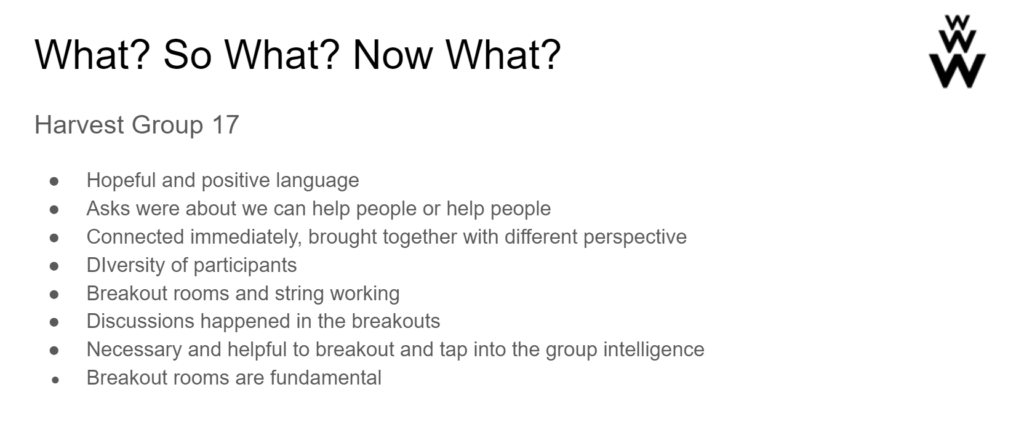
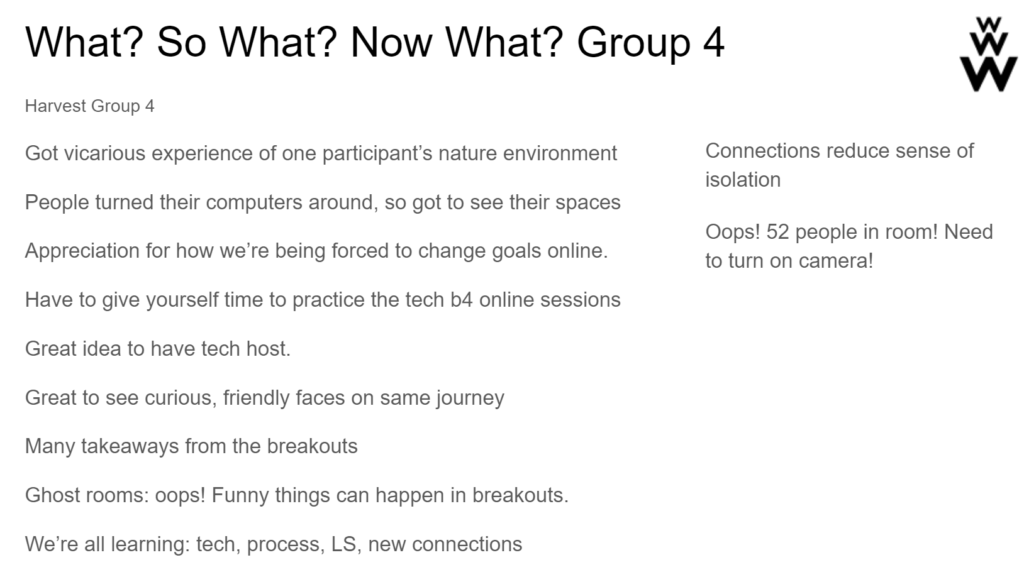
The slides lay out all the process should you want to try this. The What? So What? Now What? harvest slides #19-24 are totally worth reading through. I am still trying to process it all, but if I wait for that, this blog post will NEVER get posted!

I’m going to use What? So What? Now What? as my own reflective structure. Feel free to amplify in the comments!!!

What Happened?

  • We mobilized a volunteer team from the Liberating Structures community to facilitate, tech host (manage all the zoom breakout rooms), harvest key insights, and generally help people as needed. Those with Zoom experience renamed themselves with a * in front of their names so people could private message those folks for help.
  • We set up a set of slides with instructions for each LS we planned to do, along with some “punctuation” in between. In LS language, punctuations are little connective tissues pieces between LSs themselves.
  • We had a very large group… I think it peaked at 68 but I lost track. My sense was it was diverse – familiar folks, new folks, folks experienced with LS and some brand new, some tech familiar, some not.
  • We all were getting a little frazzled with all the Zoom events, so our punctuations all focused on taking a breath, being in our bodies, even as we were connected electronically. We used “Just Three Words” to get settled and present. (For more on Just Three Words see https://fullcirc.com/2014/03/04/faciliplay-play-as-an-online-facilitation-technique/)
  • To identify WHAT we wanted to get help on, we used 15% Solutions.
  • I rolled out 15% pretty awkwardly and confused a number of people.
  • We did Troika Consulting in breakouts of 3 people.
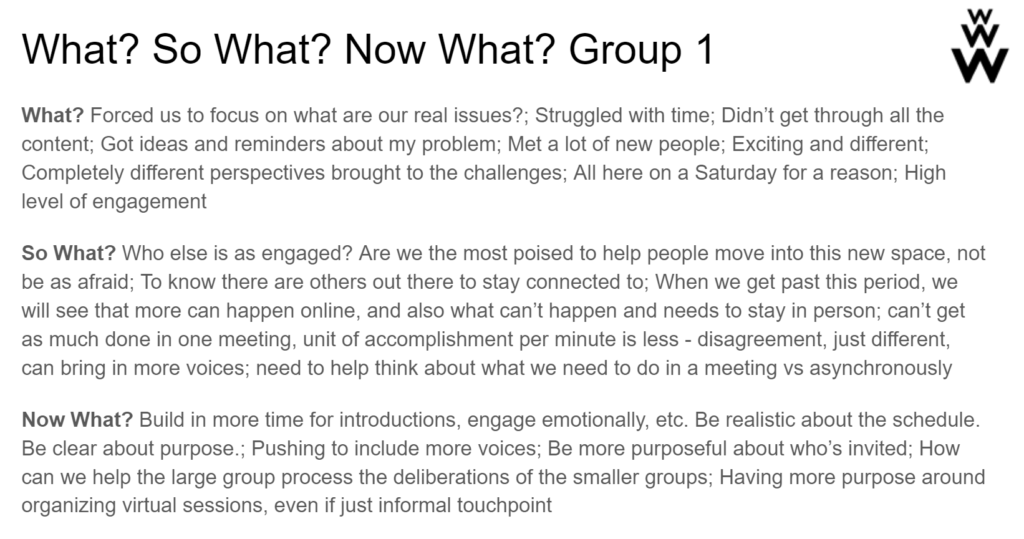
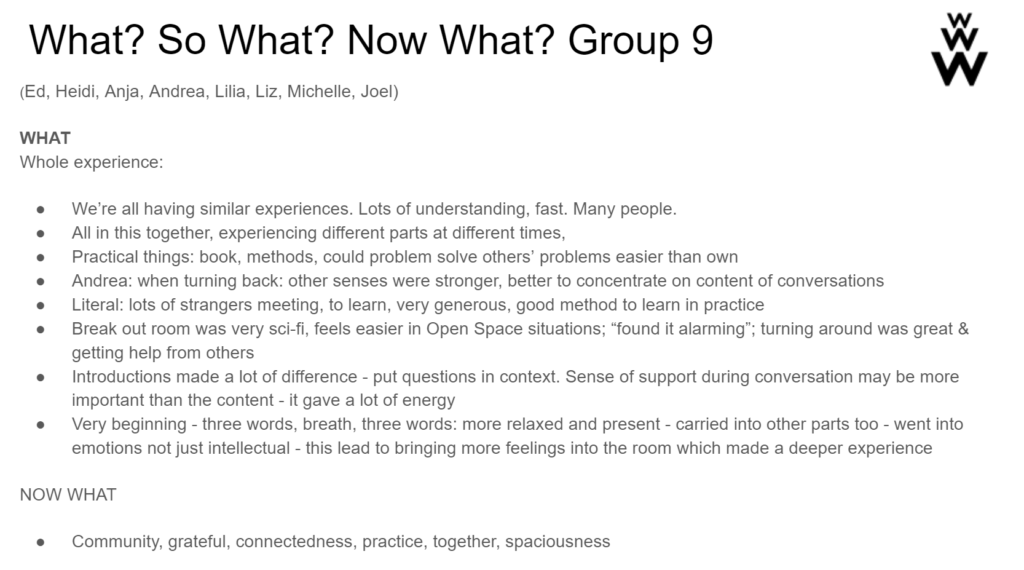
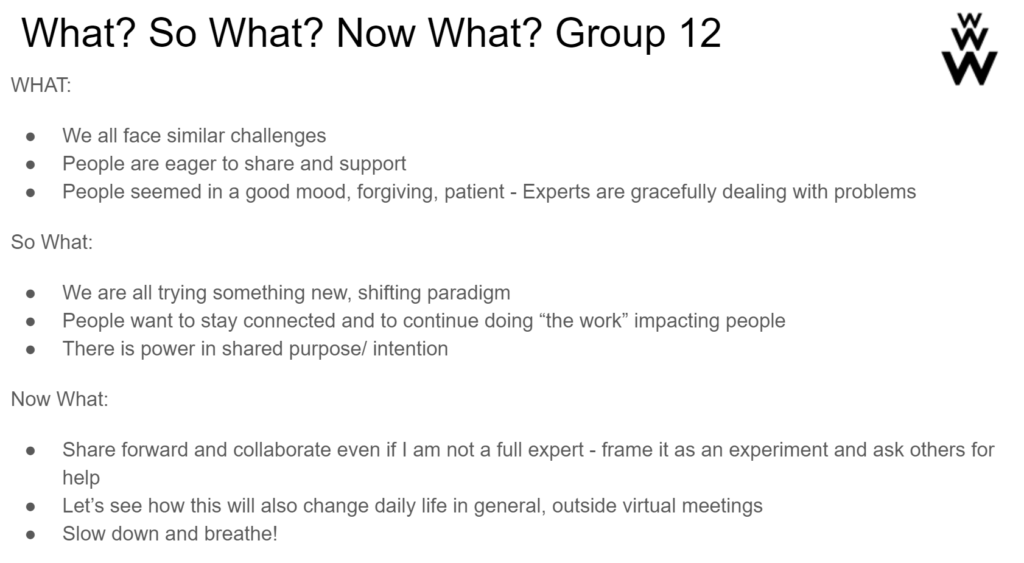
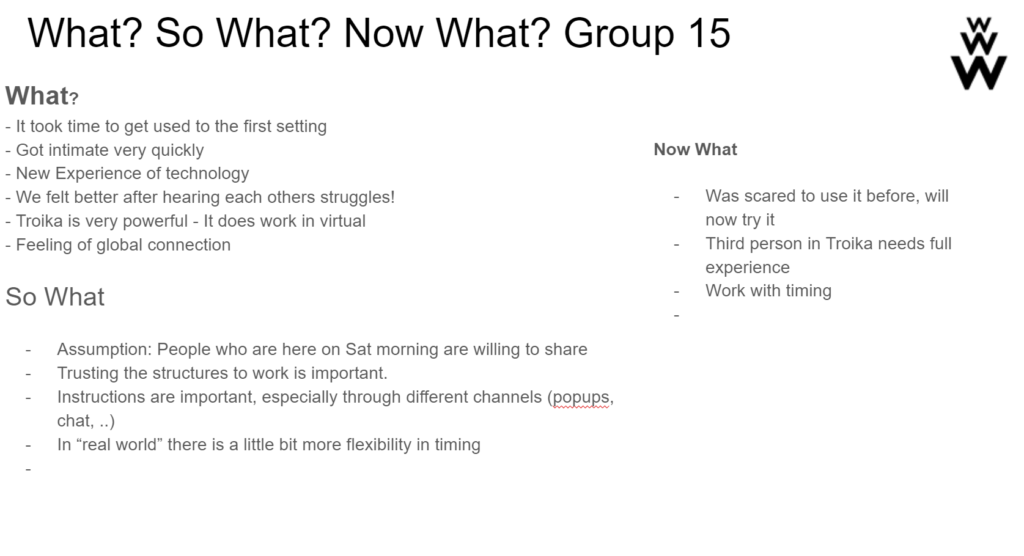
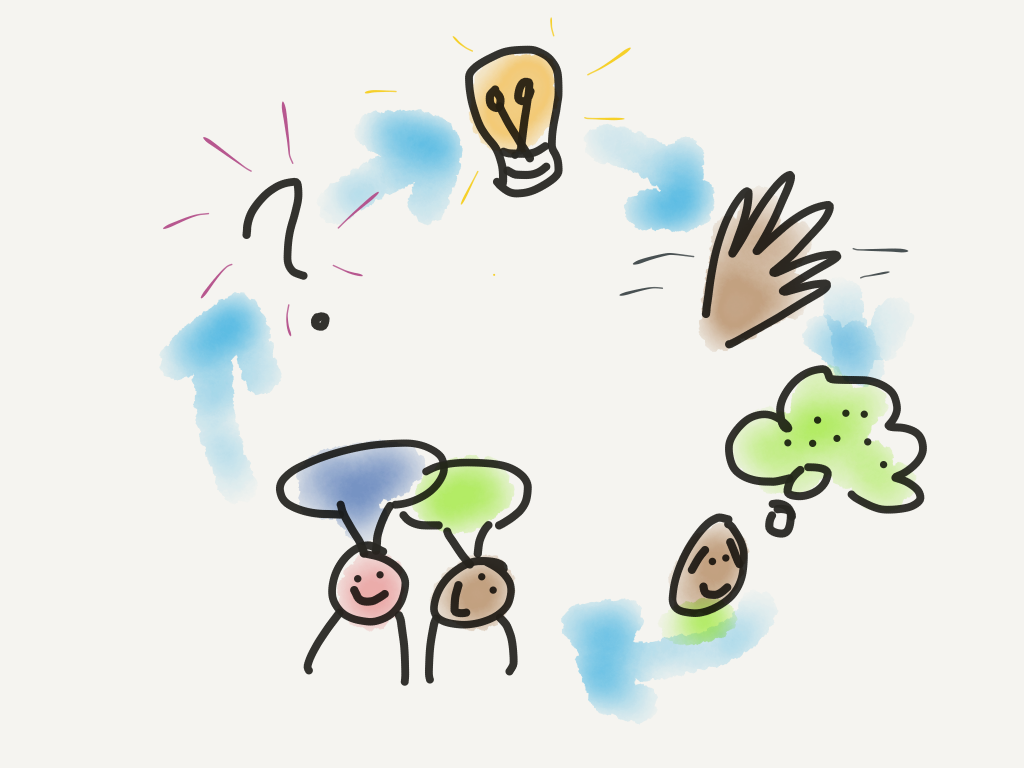
  • We debriefed with What? So What? Now What? in groups of six people (two troikas joined up).
  • People captured their WWW in the slide deck, one slide per group.
  • We informally said goodbye and some stayed on for a longer, informal debrief.
  • We did NOT record – we decided less recording was a little freer, more intimate.
  • We DID capture the chat notes to share.

So What? What meaning to we make of it?

  • No matter who shows up in your triad, there is always something of value they bring. It astonishes people, yet it is real.
  • Don’t do this alone. If I had not had my friends as my team, this would have been a mess, particularly since it was a large and heterogeneous group in every sense of the word.
  • Breathe. Breathe. As we paused, slowed down, we could go more deeply and thoughtfully. The stress of the initial response to moving things online in Covid19 time has amped many of us up, winding our clocks a little too tight???
  • Small groups/breakouts are essential to scale large groups, creating both a broader shared experience AND deeper interpersonal connection and intimacy.
  • Clear instructions, Nancy, CLEAR instructions. Will I never learn?
  • WWW in small groups seemed to work well – with a little confusiasm. It needed more than 6 minutes of breakout time.
  • Tech note: need to figure more graceful ways of dealing with the “two user” problem when someone is on video through their computer and audio through a phone. Zoom treats them as separate users and when you automatically do breakout rooms, they often end up in two places and the video is a “ghost.”
  • Time, time, time. I wrestle with that wicked question of “how is it that time constraints make us sharper and we need more time.” (Or is it simply right now we crave more time in the smaller conversations?”

Now What? What is the next step?

  • I’m working on a series of online “peer assists” for a client in the natural resources sector and I want to encourage them to do Troika Consulting. There is an inclination towards wanting consultation from wider sets of stakeholders, or focused “experts.” What happens when we resist those inclinations and simply turn to each other?
  • How can people quickly find and convene Troika Consultations in these crazy days? What can function as matchmaking/matchmaker?

Moving Online in Pandemic #4: Basics of Online Meetings

4th in a series. #1, #2, #3

A long long time ago, on a planet far away, Pete Cranston, Susan Stewart, Bonnie Koenig and I wrote this piece, So You Want to Host a Web Meeting. Some of the links are dead, but the advice is still solid. Enjoy! If someone wants to do an update, I can dig up the original file. Onward!

https://fullcirc.com/wp/wp-content/uploads/2015/12/SoYouWanttoHostaWebMeeting.pdf

Susan Stewart http://guidedmeetings.com/
Pete Cranston http://uk.linkedin.com/in/petercranston
Bonnie Koenig http://www.goinginternational.com/about/

Moving Online in Pandemic #3: What to STOP doing!

This is the third of a series of posts to support anyone working to move their offline/face to face group interactions online. It is pretty “drafty” and hopefully there will be energy to improve.

The preamble is here and Part 2: Ecocycle here. If you are an online facilitator or finding yourself in that role, join our group here. If you are looking for resources, check here.

In the race to do SOMETHING as we are forced to move many group interactions online, there is something we MUST NOT DO. That is replicate terrible offline meeting habits online. They only get worse. If it was bad F2F, you will have total turn off and rebellion online.

So the first step is to figure out what to STOP doing, before you make a list of all the things you are GOING to do. There is a fantastic Liberating Structure called TRIZ, which works really well online (as well as offline!) Here is the intro from the Liberating Structures website.

Making Space with TRIZ* – Stop Counterproductive Activities and Behaviors to Make Space for Innovation  

Every act of creation is first an act of destruction. – Pablo Picasso

What is made possible? You can clear space for innovation by helping a group let go of what it knows (but rarely admits) limits its success and by inviting creative destruction. TRIZ makes it possible to challenge sacred cows safely and encourages heretical thinking. The question “What must we stop doing to make progress on our deepest purpose?” induces seriously fun yet very courageous conversations. Since laughter often erupts, issues that are otherwise taboo get a chance to be aired and confronted. With creative destruction come opportunities for renewal as local action and innovation rush in to fill the vacuum. Whoosh!

*  Inspired by one small element of the eponymous Russian engineering approach teoriya resheniya izobretatelskikh zadatch.

http://www.liberatingstructures.com/6-making-space-with-triz/

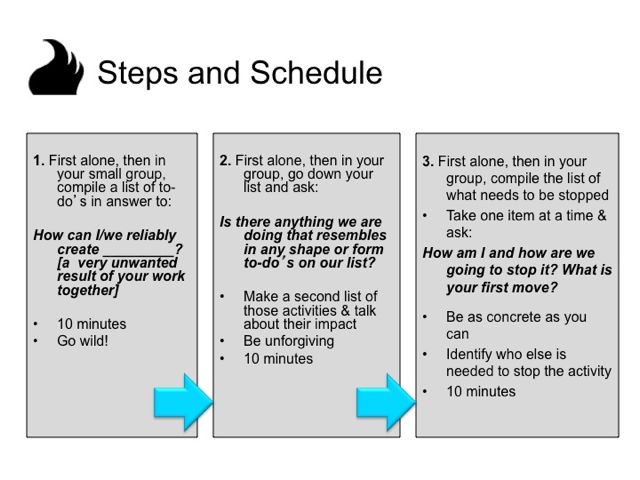
This post will take you through step by step doing TRIZ online, supported by slides on Google Drive. Here is the visual on the LS site that gives a great quick gist of the process.

I’m assuming you typically get your team together in your video conferencing space. Ideally you are using a tool that allows breakout groups like Zoom. (Pssst, someone told me today that breakouts are possible on Microsoft Teams. If you have instructions, leave a comment!)

The preparation:

  • Prepare a Google Doc, Slides (one slide per group) or something similar for each breakout group. Set the permissions so everyone can edit. Have the urls handy to paste into the chat room at the appropriate moment.
  • Have the step wise instructions ready to copy/paste into the chat room. One instruction – they go do it – then the next. Don’t put them all in at once.
  • Refine your invitation. The one below is for specifically stopping bad meeting habits before they go online, but you have many options!

The invitation: In plenary in your online meeting space welcome folks and then dig in. “First alone, think about how we could reliably design our online meeting so that nothing got done, everyone had a TERRIBLE time and our leadership and credibility is seriously damaged. Make a list of all the things you would have to do to make this happen. Go wild! I’ll post this instruction in the chat to keep it top of mind.” Paste these first instruction in chat. While people are thinking alone, prepare your breakout groups. 2 minutes

In your group: In a moment tell folks you are going to put them into breakout groups (If you need to, describe how that works on your platform!) In chat paste the next step instruction, and then the urls for each breakout group Google Doc – so doc #1 goes to breakout group #1. Sometimes people get confused. If they all end up in the same google doc, that is ok. They can figure it out!! Here is their task: “In your group, share your ideas and compile a master list in your Google Doc. You have five minutes then I’ll pull you back into the ain room for a touch point. In the template I’ve drafted, you can do the lists right into the Google Slides too! Make a separate slide for each group. 5 minutes

Touch point: At this point you can quickly bring everyone back to briefly check in and set up the next step. “Have you created the design for absolute failure? Give me a few examples of the most horrendous things you can do.” This gets people riled up even more!

Next Step: What is real? Tell them you are going to send them back into their groups. “Now run through each element. Which of these elements is currently present in your work practices. Highlight those in your Google doc. Calculate what percentage you are actually DOING? You have five minutes then we’ll come back for a touch point. Paste in this instruction then send them on their way!

Touch point: Quickly ask what percentage are highlighted. This is where it gets real, my friends!

Next Step: Tell folks you are going to send them to breakouts one more time. “Next pick one or more of those things to STOP doing before you design your online meetings. What is the first step you need to do to STOP it? Make a plan to do that. Be as concrete as you can and identify who has to be involved to make it happen. Be prepared to share your next steps when we return to plenary. You have 10 minutes. Paste in this instruction then send them on their way!

When everyone is back, prioritize your collective next steps to STOP doing. Then reflect on the process. What is liberated when we identify what to STOP doing? What is made possible?

Riffs, Variations and Hacks:
There are some hacks here, too. The timing may vary, don’t go too slow. People can start turning into a complaint session and that is not the intention. If your group is small, keep them all in the main video conferencing room. If you are in a tool like Zoom where you can send messages to the breakout rooms, you can help them keep track of time.

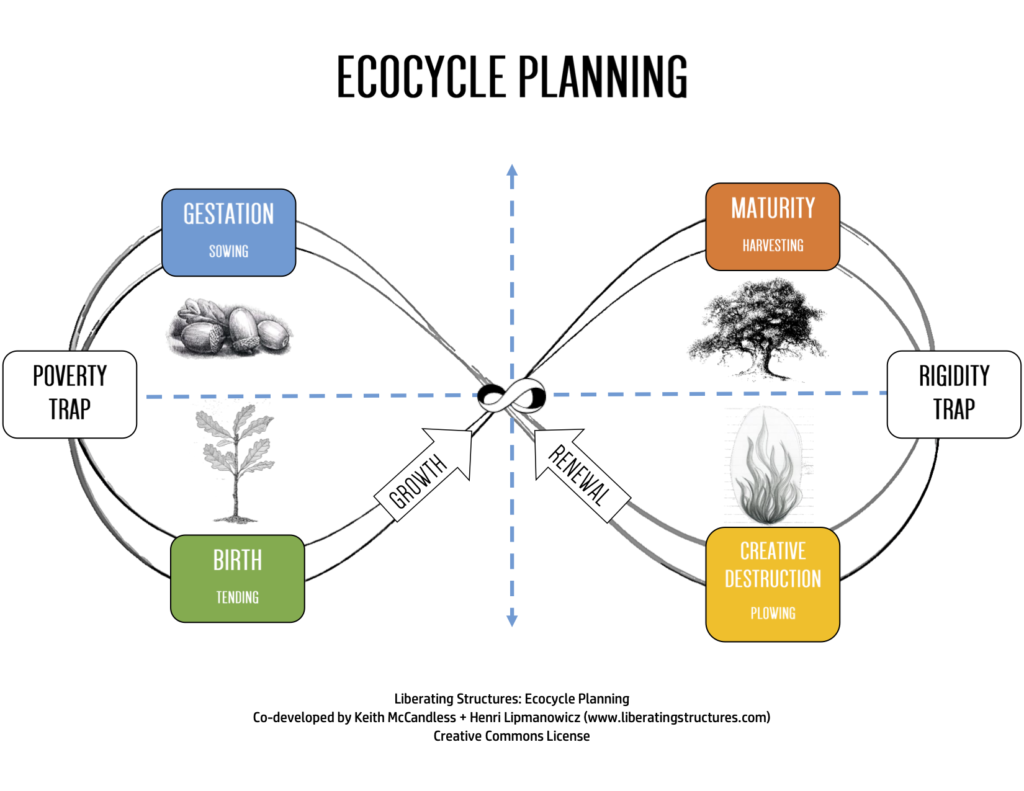
In the second post of this series I wrote about Ecocycle. TRIZ is great to move past being stuck in the “rigidity trap” in the Ecocycle, and into creative destruction. It is great to help people get out of their individual and collective ruts. The example here is focused on stopping bad meetings, but your invitation can be anything that needs a little creative destruction!!

Thoughts? Feedback?

Moving Online in Pandemic: Ecocycle to Attend to What is Shifting

This is the second of a series of posts to support anyone working to move their offline/face to face group interactions online. The preamble is here. If you are an online facilitator or finding yourself in that role, join our group g here. If you are looking for resources, check here.

In the preamble, I shared my thinking that  we need to avoid starting with technology, or even the redesigned agenda as we move online. To make progress, we need to pause and pay attention to what is shifting in the systems around us. Use something like the Ecocycle to get a sense of what is happening at a systems level.

Here is a description of Ecocyle Planning from the Liberating Structures website:

Ecocycle PlanningAnalyze the Full Portfolio of Activities and Relationships to Identify Obstacles and Opportunities for Progress What is made possible?

You can eliminate or mitigate common bottlenecks that stifle performance by sifting your group’s portfolio of activities, identifying which elements are starving for resources and which ones are rigid and hampering progress. The Ecocycle makes it possible to sift, prioritize, and plan actions with everyone involved in the activities at the same time, as opposed to the conventional way of doing it behind closed doors with a small group of people. Additionally, the Ecocycle helps everyone see the forest AND the trees—they see where their activities fit in the larger context with others. Ecocycle Planning invites leaders to focus also on creative destruction and renewal in addition to typical themes regarding growth or efficiency. The Ecocycle makes it possible to spur agility, resilience, and sustained performance by including all four phases of development in the planning process.

http://www.liberatingstructures.com/31-ecocycle-planning/

By seeing the whole, diving into the details, and then zooming back to the whole helps us discern a direction forward and useful first steps for moving your meetings online and especially when we are in complex contexts.

I find Ecocyle helps me focus and prioritize rather than get stuck in all the possibilities and challenges. Because it is built upon a flow, we can observe  what is moving forward, what is stuck and where we may be over or under-investing our time and resources. If we spend all our time perpetuating our ok-but-not-wonderful F2F meetings with an unthinking transition to online, we may be making a total mess of things. If we pick just ONE way of going forward, we may lose sight of new, emerging possibilities. If we rush to a single solution, we may miss the possibilities of those who think differently, the positive deviants and ideas that need space to emerge. Ecocycle situates our work in flow and flux, rather than a linear to do list or rigid plan.

Just one more note before we dig in to how to do this. Sometimes we need to clear the field a bit. In this case, fear can cripple. Liberating Structures co-founder Keith McCandless’s work on LS started with superbug infection reduction in hospitals. Keith has been reflecting these past few days about the importance of getting past fear. He has created a playful process you might want to consider, a Pandemic Mad Tea. It can be a well spent 10-15 minutes and really get folks deep into their work, right from the start. (If you want to gain more insights from Keith and his infection reduction work applied to the emerging shut down of the SXSW in Austin this month. Check out this sketch.  It was designed for a F2F conversation, but it gives some very specific Covid-19 context.)   

How to Ecocycle Your Move to Online Meetings

  • Don’t work alone. Engage your colleagues.
  • Turn on the camera. Presumably you can’t meet face to face (F2F) with your team, so fire up your video conference software and turn on the cameras. YES REALLY, TURN ON THE CAMERAS!
  • Read about the basics of Ecocycle on the Liberating Structures website. Then briefly discuss your understanding with each other. Don’t worry if it feels confusing, and don’t spend too much time on this step. We are going to DO it together and then things will clarify!
  • Get a piece of paper, pens, post its. Draw the basic Ecocycle structures on the paper and get ready to start writing on it, putting post it notes – whatever. This is for your own personal doodling/note taking. Next you can do it digitally together.
  • Make a copy of this Ecocycle Online template and share with your team.
  • Follow the steps of doing Ecocycle Planning in the template. I’m including the steps here below in case you want to print them out as well.
    • First alone, make a list of all the things swirling in your mind about moving your meetings online. What are your activities? What are your most important stakeholder and collaborator relationships?
    • Place each activity and/or relationships on your list on your paper Ecocycle in one four developmental phases: birth, maturity, creative destruction, and renewal.What are you doing but you feel it really isn’t working. Position those around the “rigidity trap.” If you have already resolved to stop doing those things, put them in “creative destruction.” Things that have been suggested to you or which you are thinking about, but haven’t yet taken any action on, put in the “gestation area.” Note any really terrific ideas that you really think should move forward, but which are stuck (for whatever reasons) and put them near the “poverty trap” box. Finally, locate all the experiments or pilots in process (both before and in response to the pandemic) in the “birth” area.
    • Build your collective Ecocycle. In your web meeting room, share your items with each other. Discuss the placement of each of your items. You can use a shared whiteboard, Google slides (the template) using self made “post its” with the drawing tool, or share your paper artifacts on camera. Notice what you share that is similar and what is different (there is always useful information in noting both!) NOTE: If your team is more than 4 people, you may want to use your online breakout room and start in pairs, then build up to the whole. Yes, it is worth the time. In pairs you can hear and be heard and discern details that might start to get lost as you think together in a larger group. 1-2-4-All can help you tap your collective intelligence faster than a whole group conversation, even as it feels like it slows things down. Don’t worry!
    • Look at the details. Spend time discussing items that you feel belong in different areas. Tip: if something feels like it fits into multiple areas, break it down into its component elements. Things can get clearer.
    • Look at the big picture. Together discuss what you see. What patterns do you see? Where are there many elements? Few? Look on the middle right, in the “rigidity trap.” Your most liberating first step may be to decide what to STOP doing in order to make space for new and more useful meeting practices (online or off!) Too many things in gestation? Start with the great ideas that are getting stuck in the poverty trap. See promising initiatives in birth? What one step could you take to support and amplify those efforts. See MANY things in gestation? Consider gathering those folks and learn how and why they are succeeding taking their meetings online and build on current energy and success. (Consider “Discovery and Action Dialog” as a process.)
  • Decide what the next step will be moving your meetings online. You might want to consider Purpose to Practice which starts with getting clear on the PURPOSE of going online. Dig deep until you hit the hard-rock purpose!

In the longer term Ecocycle offers us approaches and mechanisms to adapt as conditions continue to change. In other words, there is no magic technology, group process approach or perfect online meeting template, so give that up. Right now is time for evolving!

P.S. Really pay attention to Creative Destruction. Don’t take poor meeting practices from offline into the online space. They only deteriorate! In a future post in this series I’ll share some fabulous alternatives!

P.S.S. The use of Ecocycle can help make sense at many levels. This article explores Covid-19 at the global level. https://medium.com/insurge-intelligence/coronavirus-synchronous-failure-and-the-global-phase-shift-3f00d4552940