Criticisms & Cures for Facilitating in Complexity

My friend and colleague Eva Schiffer asked the most delightful question after I wrote about Facilitating in Complex Contexts.  “How do you dive into and acknowledge complexity and then get s*&% done?”

I love that Eva framed this as a classic Wicked Question focusing on the AND versus either/or! I’m finally circling back to share what I learned. (Back in the writing saddle again!)

I enjoyed this article in Learning Solutions by Connie Malamed addressing  push back on Design Thinking. When I’m using Liberating Structures to enable design, planning, group process in complex contexts, there is this pervasive energy that shows up around the idea that “everything is complex,” and therefore there is nothing concrete we can do.” Another type of push back.

While I could blithely respond that they are missing the point, that’s not very helpful. Connie’s article broke down some of the resistance she has experienced with Design Thinking, so borrowed her approach and see if it works when trying to bring complexity friendly approaches to facilitation. Let me know…

Criticism: If everything is always complex and changing, how do you plan?

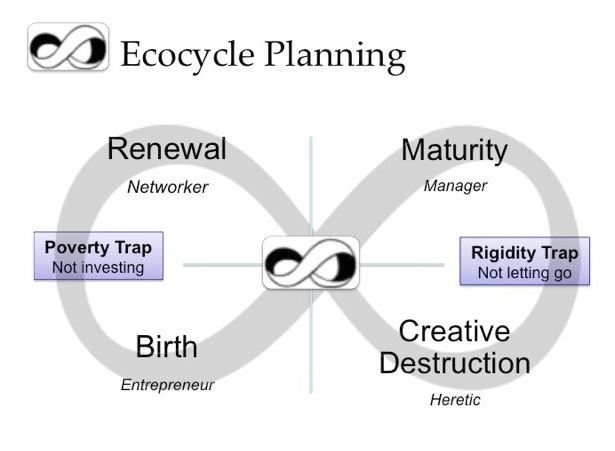
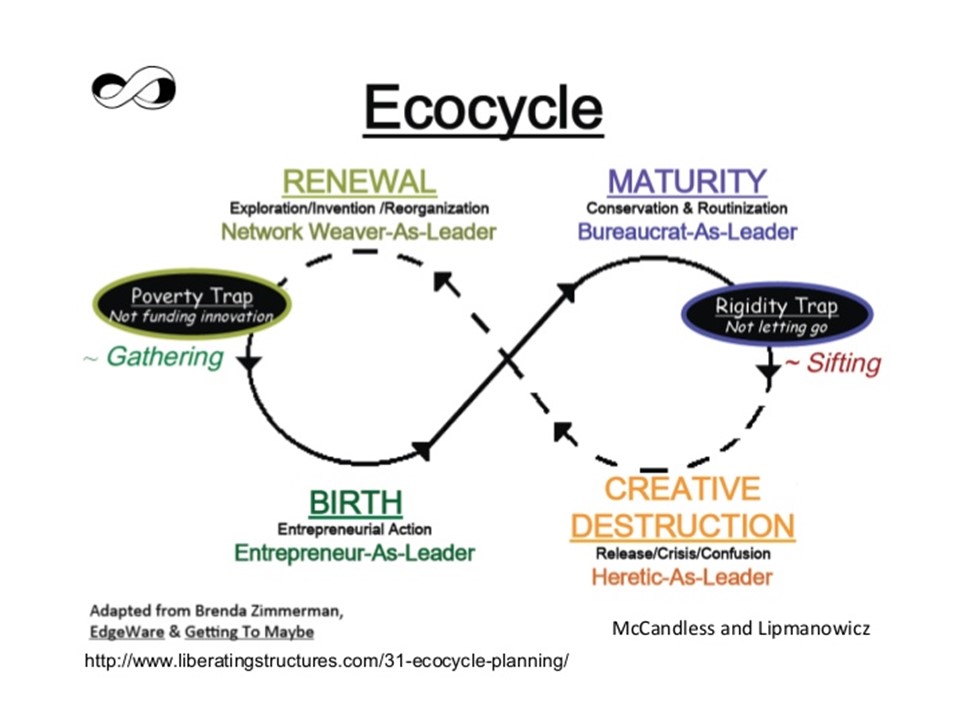
Cure: Discern what is complex, what isn’t and what can be “nudged” to a point of greater certainty or predictability. Using Agreement-Certainty matrix, the Cynefin Framework help in that discernment. If you think of your work portfolio in the context of an Ecocycle, there are things that are predictable (in the “Manage” quadrant”) AND there are things that must be destroyed to make room for innovation, innovation itself and the process of bringing that innovation into the Managed domain through iterative experimentation. If you can identify where each of your work processes fit in that ecocycle, you can breath a little easier because it is all connected… eventually!

Criticism: If I can’t predict outcomes, how will I know how to focus our work?

Cure: Utilize methods that help you discover possibilities in unexpected places such as Discovery and Action Dialog, those that allow you to iteratively move towards your goal or refine your goal. Consider Improv Prototyping or even Simple Ethnography. These can help us leap over our own cognitive biases — sometimes that alone is the problem, not complexity!

Cilliers wrote (again, via Chris Corrigan): “The elements interact dynamically by exchanging energy or information. These interactions are rich. Even if specific elements only interact with a few others, the effects of these interactions are propagated throughout the system. The interactions are nonlinear. ” This reminds us that our work is often non linear, even if our planning infers that it is. 😉

Criticism: If things are always changing, how do we make make ongoing decisions?

Cure: First, discern what kind of decisions you are making. Again, via Chris Corrigan / Paul Cilliers and complexity informed values: “Complex systems consist of a large number of elements that in themselves can be simple.”  Understand which decisions are the simple or complicated ones and make them. For the complex elements, use methods such as Critical Uncertainties to build a portfolio of options so you are ready to make decisions to shift if the conditions change. Finally, are you even conscious about HOW you make decisions? Look at that for a few surprises!

Criticism: And now Eva’s : How do you dive into and acknowledge complexity and then get s*&% done?

Cure: Acknowledge that this is the Wicked Question and then plan your next step. The beauty of  15% Solutions and similar approaches are that you can find the AND between complexity and your next move.  Use the Wenger-Trayner Value Creation framework to surface immediate value of your short term experiments rather than waiting for the “final evaluation!” You can use What, So What, Now What? to elicit the narrative fragments that can help you see the value created, even in uncertain or experimental moves.marbled swirs

One more from Cilliers/Chris: Complex systems are adaptive. They can (re)organize their internal structure without the intervention of an external agent. Chris notes that we must adapt – our plans, our actions, our strategies. So the bottom line is we have to move away from our adulation of certainty and just get on with it!


See also:

  •  http://www.hsdinstitute.org/resources/plan-in-uncertainty-strategic-adaptive-action.html

Shifting Conditions That Hold Problems in Place

Two of my colleagues/friends have written very useful posts reflecting on practices that can enhance any year end reflections and new years planning you may be cooking up. Many of you who know me how much I value what emerges from practice and my learning path is to understand these things from a complexity perspective in various systems. Recently a client pointed me to a FSG blog post which had a link to a quote that has enlivened this path.

Social Innovation Generation in Canada defines systems change as “shifting the conditions that are holding the problem in place.

Savor that one for a minute.

For me, the blog posts noted below give us some ideas about shifting those conditions that are holding our problems in place!

First, Mike Parker of Liminal Coaching shares a great set of ideas framing the complexity of todays work world (work in the broadest sense!) What is wonderful is that if you keep reading, you will get to Mike’s gift: the value of daydreaming in helping us navigate our complex worlds. Yes, daydreaming. He riffs on the time management Pomodoro practice and creates Liminal Pomodoro – a practice to relax and let your mind do its work in that daydreaming state of mind. This might be helping conditions in our own minds that are holding our problems in place. Read the post – seriously. Then go take a Liminal Pomodor break and come back and read the rest of this post. Who knows, you may see it in a whole new light!

The second post comes from Michelle Medley-Daniel from the Fire Adapted Network Community. I had the chance to work with Michelle and hear team last year and we played with many complexity informed practices such as Liberating Structure. Michelle informed me that what she learned during that retreat had continued to add value over the year – which of course made my day.

Michelle’s reflections came around the US Thanksgiving holiday and reflected one of my favorite themes, abundance and ditching the scarcity mindset. To me, these are not Pollyanna-ish practices, but survival skills. When you take a different perspective, you have the chances of shifting the conditions that are – yes – holding the problems in place. I’ve snipped the high level essence of 2 pieces of advice below, but let the beautiful pie picture lure you into her full posting.

How Practicing “Enough” and Looking Ahead Can Support Social Innovation

Idea 1: Adopt an abundance mentality and give scarcity thinking the boot!

  • Give freely.
  • Check your pace; make space for your priorities.
  • Practice gratitude.

Idea 2: As you reflect on the strategic opportunities that lie ahead, consider how people think about the future.

In the times of the immense wildfires in California, and the work that Michelle and her colleagues do at the Fire Adapted Communities Learning Network, this advice seems urgent and important.

Let’s shift the conditions that are holding the problems in place!

Transitions, Plumbers and Poets

In this season of immense natural disasters around the world (fires, floods, earthquakes, hurricanes, war, famine, drought…) and here in the northern hemisphere, with a shift in the seasons themselves, I woke up thinking about transitions, and how we use them as plumbers and poets.

As a group process facilitator and change agent (or as Keith McCandless says, a “structured improvisationalist!), transitions are where real progress or failure happens. They are the moments when more is possible – often much more than we ever imagined. Disasters are transitions at a grand scale. Moments in a meeting are often at a subtle and even unnoticed scale. Both can and do change our future trajectories.
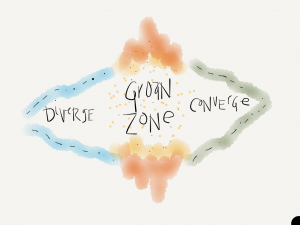
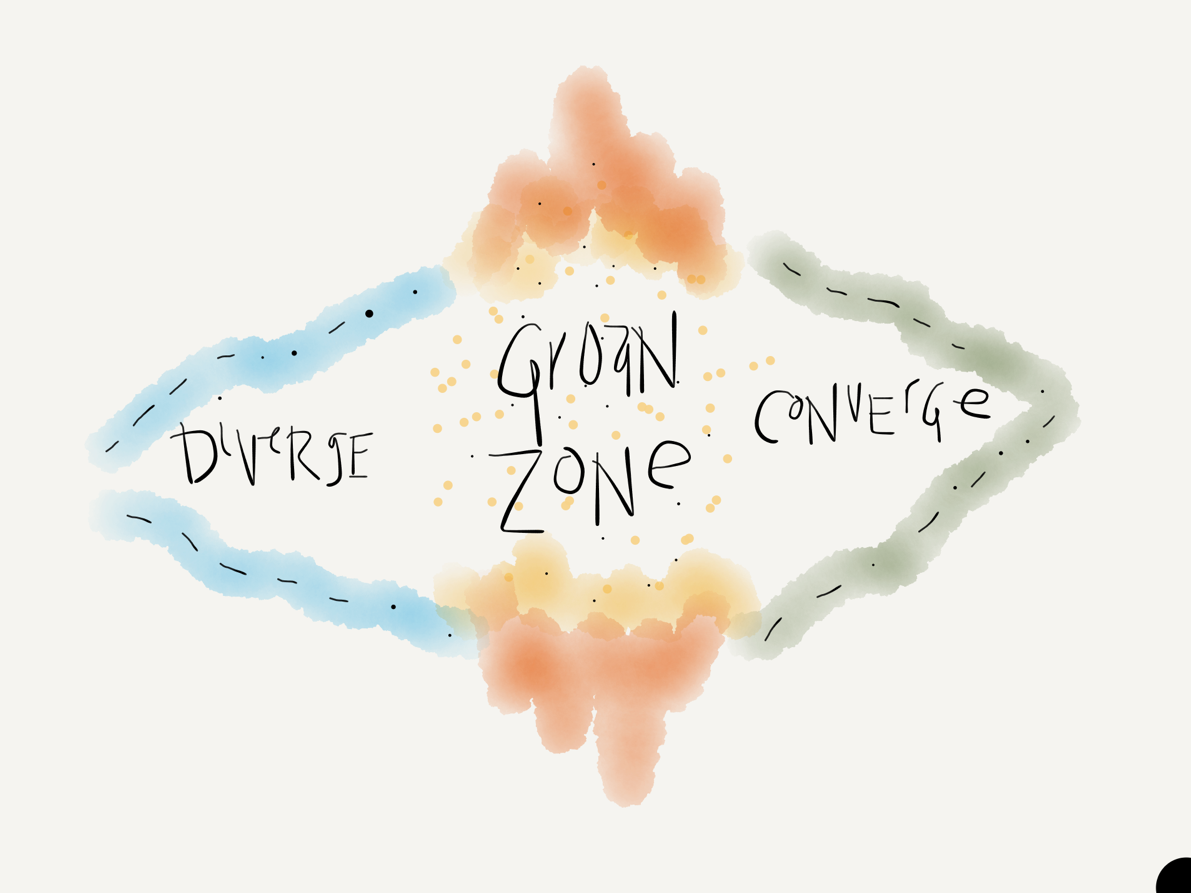
Transitions are often messy. Sam Kaner and his colleagues coined the term, “the groan zone” to describe a critical transition in group process. It is part of his larger “diamond of participation” from the “Facilitators Guide to Participatory Decision Makers,” an essential facilitation tome.

The groan zone is the transition from the opening, divergent part of group process to the convergent, decision making and acting part of the process. Think about the energy of ideation at the start of a project where people are flourishing in possibility (or not!). Then reality comes —  we move into decision making and, hopefully, action. In this liminal space we are often uncertain, confused, and lack confidence or momentum.  Intellectually and  viscerally the groan zone concept and its expression in my work  has always resonated for me. It named a transition that is critical for groups to move forward.

The wisest piece of advice from Kaner’s book was to name this discomfort and use it. I use that advice daily. But there is more to the practice than acknowledging discomfort. I want to reflect on both the intellectual and visceral, or intuitive aspects of this practice of working with transitions, especially groan zones.

This is where the plumbers and poets reference in the title comes in. Stephanie West Allen is a colleague who is constantly spotting and sharing resources. when the poets and plumbers link passed across my screen I paused. YES. Here is the quote from James March that Dale Biron shared in his blog post:

There are two essential dimensions of leadership: “plumbing,” i.e., the capacity to apply known techniques effectively, and “poetry,” which draws on a leader’s great actions and identity and pushes him or her to explore unexpected avenues, discover interesting meanings, and approach life with enthusiasm.  ––James March, Stanford Professor Emeritus

(I am looking for the original source. I think it is from “On Leadership” by James March and Theirry Weil)

The metaphor applies far beyond leadership roles. Here I explore it from the facilitator process, but think about it for leaders, for followers, for disruptors and peace makers.

The facilitator as “plumber” comes prepared with intellectual knowledge of how humans operate socially, and the context for their work.  This is a great place for the application of complexity theory, such as Brenda Zimmerman and Dave Snowden’s work, along with a sorts of socio/relational frameworks. This is often linked to theory, but I recognize some start with theory to build their approach, and others end with it to understand their work.

The groan zone is also an essential space for understanding and using differing views, contradicting view points and  embracing diverse possibilities. Dave recently wrote about this and one snippet from the post offers a good taste:

The use of parallel safe-to-fail experiments over short timescales based on differing and ideally contradictory hypotheses about what is happening and what is possible.  But critically any such experiment, which is ’nudge’ should only be to shift things to an adjacent possible, to something sustainable at the point of intervention.

Note the words “nudge” and “shift to an adjacent possible.” This is not only experimentation to identify next steps in complex settings, but they increase the diversity and its possibility within the group process. Sound like a possible transition or “groan?” Yup. So the work of my complexity teachers is essential for the technical “plumbing” work.

Technically we come prepared for transitions with skills on how to design them to meet goals and adapt to changing circumstances. So when I design with Liberating Structures, I assemble a string of structures that support the diamond of participation, including the groan zone, with options prepared and improvised as needed. Structures that support the groan zone include TRIZ, Wicked Questions and Ecocycle, which help to unmask polarities, “elephants” in the room and dig deeper into sensitive and challenging issues, 9 Whys to explore assumptions, 15% Solutions and Troika Consulting which allows us to quickly iterate and reflect on options with peer input, Helping Heuristics for when our interpersonal dynamics are slowing progress, among many others.

That said, intellectually and technically prepared is not enough for me. I can never be a good enough plumber (technician) without the poet side of things. The poet has to be present in every meaning of the word, with senses alert, intuition as open and calm as possible. Even the stance of my body can be part of the poet. For example, when I’m sensing disruption, confusion, fear or people feeling rejected and unheard, I stand or sit as straight as I can, arms and legs uncrossed, palms forward. Deep breaths. Most often I have no intellectual idea of what I should do at this moment beyond listening and being present. As I literally shift my stance, something changes for me. My observations and intuition tell me sometimes something changes for people in the room as well. Maybe it is mirror neurons at work.  We CAN be changed and influenced by what we see and perceive with our senses. Regardless, this is part of the flow of energy in group process. Can I measure this? No. Can I fully describe it in purely technical terms? No, not me. But it is inextricably linked to both self-awareness and something I find inexpressible.

Of the many masterful facilitators I learn from, the visual facilitator Kelvy Bird has most clearly articulated this presence element in her work here on scribing, and here on opening,  with a clear recognition of the “social field” within which we work. (No surprise as she is a key partner in the Presencing Institute! I am waiting for her book!)

Here is an example of what Kelvy helped me see. There is a distinction of presence and openness as compared to neutrality. Neutrality used to be one of the core values of facilitators (as previously espoused by the International Association of Facilitators and others.) As I’ve gotten further in my career, I’ve felt more and more like describing my stance as neutral was not only disingenuous, but it was false. I may be a listener at one moment, a provocateur in another, and a co-creator in yet another. I am happy that the language of neutrality has been left behind with a greater emphasis on attending to influence. The latest IAF facilitator core compentencies describes this as “Vigilant to minimise influence on group outcomes,” and “Maintain an objective, non-defensive, non-judgmental stance.” This resonates with my sense of stance and presence – even while I still struggle with objectivity and our ability to always be objective! This is far from technical “plumber” work, but it is useful to observe that the best plumbers I know have “hunches” about what they can’t see behind a sealed up wall! So the plumber and poet are not two, but one.

By being part of the process, I am changing the outcome. I am not neutral and I am influencing in certain ways. While I am strict with myself to clearly call out my own opinions, “take off my facilitator hat,” I do have influence. And it is only when I’m open and clear, self-aware and fully present, that that influence can be in the service of the group and influenced by the group itself, not to my espoused beliefs and/or ego. This is most important at transitions: the start of an engagement, during the groan zones, and as we move into resolution and reflection. It is a dance between the technician and the poet, between clarity and beauty. Between words and images.

I’m not sure this all makes sense as I struggle to write about it.  I guess the only way I can express it is to say the poet in me keeps evolving. Early on, I stuck to clearly proscribed forms (Limericks! Haiku!) Now my poetry is in process, words, images, and my own presence.

Let me be clear. There are many risks to this stance. If my self awareness weakens and fails, I can cause failure around me. If my openness cracks me open and I fall apart, I cannot serve. If I come without enough clarity and energy, my services suffers. This is not just a technical nor “expert” practice. It is all in. All. In. Again, from Kelvy:

We learn through copy. We advance through integration. We master by tapping into our own source.

So how does this relate to transitions? The technician, the plumber, can spot most of the the structural transitions. The poet senses the subtle ones, energy, hunches, buried treasures, that are often the ones that take us to new places, that help us make progress in complex or even chaotic contexts.

At this point in my career, I’m deeply interested in the poet. How about you?

Group Process Design Principles in Times of Turbulence

Ready for a thinking ramble? Payoff isn’t until the end. Fair warning!

I have found myself pointing to Donella Meadows’ “Leverage Places: Where to Intervene in a System” more and more these days.  First surfaced in the Whole Earth Catalog in 1997, and expanded in 1999, the essay resonated with me then and continues today. Read the whole thing, but if you just want to scan the leverage points, check out the Wikipedia article. When I mention the article, everyone starts pulling out their pens, phones or electronic note taking devices. People are hungry for clues about where to intervene in the complex systems within which they work and live. Here are her leverage points:

PLACES TO INTERVENE IN A SYSTEM (in increasing order of effectiveness)

9. Constants, parameters, numbers (subsidies, taxes, standards).
8. Regulating negative feedback loops.
7. Driving positive feedback loops.
6. Material flows and nodes of material intersection.
5. Information flows.
4. The rules of the system (incentives, punishments, constraints).
3. The distribution of power over the rules of the system.
2. The goals of the system.
1. The mindset or paradigm out of which the system — its goals, power structure, rules, its culture — arises.

Her number one leverage place: 1. The power to transcend paradigms. From the Wikipedia article:

Transcending paradigms may go beyond challenging fundamental assumptions, into the realm of changing the values and priorities that lead to the assumptions, and being able to choose among value sets at will.

Many today see Nature as a stock of resources to be converted to human purpose. Many Native Americans see Nature as a living god, to be loved, worshipped, and lived with. These views are incompatible, but perhaps another viewpoint could incorporate them both, along with others.

A bit more from Meadows’ essay on #1 and worth savoring, slowly:

There is yet one leverage point that is even higher than changing a paradigm. That is to keep oneself unattached in the arena of paradigms, to stay flexible, to realize that NO paradigm is “true,” that every one, including the one that sweetly shapes your own worldview, is a tremendously limited understanding of an immense and amazing universe that is far beyond human comprehension. It is to “get” at a gut level the paradigm that there are paradigms, and to see that that itself is a paradigm, and to regard that whole realization as devastatingly funny. It is to let go into Not Knowing, into what the Buddhists call enlightenment.

People who cling to paradigms (which means just about all of us) take one look at the spacious possibility that everything they think is guaranteed to be nonsense and pedal rapidly in the opposite direction. Surely there is no power, no control, no understanding, not even a reason for being, much less acting, in the notion or experience that there is no certainty in any worldview. But, in fact, everyone who has managed to entertain that idea, for a moment or for a lifetime, has found it to be the basis for radical empowerment. If no paradigm is right, you can choose whatever one will help to achieve your purpose. If you have no idea where to get a purpose, you can listen to the universe (or put in the name of your favorite deity here) and do his, her, its will, which is probably a lot better informed than your will.

It is in this space of mastery over paradigms that people throw off addictions, live in constant joy, bring down empires, get locked up or burned at the stake or crucified or shot, and have impacts that last for millennia.

Hold that thought for a moment.
A while back I happened on The Tragedy of the Commons: How Elinor Ostrom Solved One of Life’s Greatest Dilemmas – Evonomics, and another in the Atlantic about US post election responses, both of which resonated with my reading of Meadow’s essay. First, the snippet about Ostrom (another one of my compass points, like Meadows!)

“Evolutionary theory’s individualistic turn coincided with individualistic turns in other areas of thought. Economics in the postwar decades was dominated by rational choice theory, which used individual self-interest as a grand explanatory principle. The social sciences were dominated by a position known as methodological individualism, which treated all social phenomena as reducible to individual-level phenomena, as if groups were not legitimate units of analysis in their own right (Campbell 1990). And UK Prime Minister Margaret Thatcher became notorious for saying during a speech in 1987 that “there is no such thing as society; only individuals and families.” It was as if the entire culture had become individualistic and the formal scientific theories were obediently following suit.

Unbeknownst to me, another heretic named Elinor Ostrom was also challenging the received wisdom in her field of political science. Starting with her thesis research on how a group of stakeholders in southern California cobbled together a system for managing their water table, and culminating in her worldwide study of common-pool resource (CPR) groups, the message of her work was that groups are capable of avoiding the tragedy of the commons without requiring top-down regulation, at least if certain conditions are met (Ostrom 1990, 2010). She summarized the conditions in the form of eight core design principles: 1) Clearly defined boundaries; 2) Proportional equivalence between benefits and costs; 3) Collective choice arrangements; 4) Monitoring; 5) Graduated sanctions; 6) Fast and fair conflict resolution; 7) Local autonomy; 8) Appropriate relations with other tiers of rule-making authority (polycentric governance). This work was so groundbreaking that Ostrom was awarded the Nobel Prize in economics in 2009.”

Notice Ostrom’s core design principles. See any relation to Meadows’ leverage points?

Now switch to the Atlantic  article titled “Americans Don’t Need Reconciliation—They Need to Get Better at Arguing” by Eri Liu. Commenting on the need for work in the social sphere following our divisive presidential election, Liu suggested we needed three things:

  • Listen more to each other (in listening circles”)
  • Work more together (national service)
  • Argue more. But do it well (“We don’t need fewer arguments today; we need less stupid ones.”)

Liu gives us three concrete ways of unlocking the patterns and leverage points.

My work has clearly been situated in ever increasing turbulence. Traditional strategic planning? Throw it out the window. Focusing on mission and vision? Unless tied to concrete, actionable purpose, throw it out the window. It is too easy to be lost in our own abstractions and old/stale paradigms. (Thank you Donella!) Building knowledge management systems to capture everything? Fuggedabout it if we aren’t listening to each other (Thank you, Eric!) Trying to work just top down and with existing, rigid governance systems? Do you have all the time in the world? NO, ditch it! (Thank you, Elinor!)

So how am I designing now? Quickly, iteratively, and ruthlessly reflective. My group process practices in the last 18 months reveal a pattern where groups are getting more traction into creating insights on their work, and slightly increased  traction on acting on those insights.  I attribute this two two things: the application of Liberating Structures and other group processes that are informed by complexity sciences, and the use of emergent visuals to help show the path of thinking, understanding and action. The processes devolve power and responsibility to, as LS says, “unleash and include” everyone. They focus on immediate steps rather than waiting for certainty and perfection. They ask us to question our assumptions, measure our experiments and understand negative and positive feedback loops (Meadows again!) They seek to sidestep the barriers of traditional governance as much as possible without rejecting the participation of those institutions.

People get it. Quickly. The visual practices help bookmark the moments of insight and support telling the story to others.

The traction for action is still a bit elusive. Our reward systems punish many of the behaviors of emergent practices. Power is challenged. And just getting a grip on all the working parts can serve as an excuse to throw one’s arms up and give up. But we won’t give up. Nope. Sadly, Meadows and Ostrom died too young. But their words continue to feed us.

Stay tuned. Share your thoughts!

Edit: See this great post by Chris Corrigan on Prototyping and Strategic Planning. I had THOUGHT I had linked it in, but clearly that was in my dreams! Dave Pollard also recommends the work of Nora Bateson.

Responding to Clark Quinn: Technology or preparation? 

Clark Quinn has a great provocation on his blog today. I ‘ll share a quote, then reply.

So, many of the things we’re doing are driven by bad implementation. And that’s what I started wondering: are we using smart technology to enhance an optimized workforce, or to make up for a lack of adequate preparation?  We could be putting in technology to make up for what we’ve been unsuccessful at doing through training and elearning (because we’re not doing that well).

To put it another way, would we get better returns applying what’s known about how we think, work, and learn than bringing in technology? Would adequate preparation be a more effective approach than throwing technology at the problem, at least in some of the cases? There are strong reasons to use technology to do things we struggle at doing well, and in particular to augment us. But perhaps a better investment, at least in some cases, would be to appropriately distribute tasks between the things our brains do well and what technology does better.

Let me be clear; there are technologies that will do things more reliably than humans, and do things humans would prefer not to. I’m all for the latter, at least ;). And we should optimize both technology and people. I’m a fan of technology to augment us in ways we want to be augmented. So my point is more to consider are we doing enough to prepare people and support them working together. Your thoughts?

Source: LearnletsTechnology or preparation? – Learnlets

While Clark’s question is in the context of workplace learning, it is resonant in far wider contexts. I see it when I’m asked to design group process and gatherings. We are constantly putting “band aids” on instead of addressing underlying issues. We don’t really “prepare people and support them working together.” Why is that? Is it the continued desire for a quick fix, or the deep denial that how we work together matters and making it work more effectively might challenge too many things: power, status quo, cost?

The observation of this problem is neither new nor unique… it is how things often work. So the question  is how do we better shine a light on the underlying issues and take immediate steps — however small – for remediation? Rather than throw up our hands and say it is too messy, hard or difficult?

This is where complexity-informed practices come in. From the deep dives into understanding what is happening with sense-making tools like Cognitive Edge’s Sensemaker, to simple, reproducible group practices like Liberating Structures, we can stop shrugging our shoulders and saying “that’s out of my scope of work” or “I can’t do anything about that.” The point is we have to do SOMETHING. Not just plow on from tech innovation to tech innovation. Here are four possible sets of practices that could help us go deeper and do better. Here are four possible sets of actions.

 Creative Destruction to Make Space

What one thing, no matter how tiny, can we stop doing to make space for the things we want to try? Before we add a new technology, do we stop using another one? Before we seek a solution to an efficiency problem, can we find out what to stop doing that caused the problem? Cue up Ecocycle or TRIZ, and make some of these now-useless activities visible. So often we strive to manage and scale when we have either grown past the things we are scaling, or they are no longer fit for purpose. We operate in mostly dynamic environments, yet we try and shoehorn everything into an ordered domain. (The complicated and simple in the Cynefin framework. In an ordered domain “cause and effect are known or can be discovered.” Complex and chaotic domains are understood as unordered, where ” cause and effect can be deduced only with hindsight or not at all.”).

Space for Uncertainty and Experimentation

Maybe certainty and obsession with technical fixes is overrated. Earlier this week I participated in an online gathering hosted by Johnnie Moore on Unhurried Conversations. He offered five principles to support unhurried conversations and one was The wisdom of uncertainty. We can use uncertainty to experiment our way into useful solutions, rather than coming up with a “brilliant idea” that may inadvertently build on past weakness. We may miss the underlying preparation. We can use Improv Prototyping to “act our way into knowing.” We can use Helping Heuristics to strengthen our listening before we pounce with our own (half baked?) ideas, giving space to considerations that are lost for those of us who “think by talking.”

Leadership for Spotting and Picking Up Promising Experiments

When we start getting seduced by technological innovation, it reminds me that there are people who see the world differently and can look within and beyond the tech itself and spot the ideas for promising experimentation. Not everyone has these skills to imagine things. We want solutions and we tend to foreclose on them too quickly, or fail to do, as Dave Snowden loves to say, “safe fail” experimentation to test our assumptions and asses the complexity (or not) of a situation. Sometimes that means we are smart enough to notice others with these strengths, and not try and be the “solution maker” ourselves. Approaches such as Wicked Questions , Discovery and Action Dialog, and Critical Uncertainties can help us spot the things we might otherwise rush by.

Right Management of the Right Things

I do not want to dismiss the Ecocycle domain of “maturity.” When there is a useful technical application, we want to bring it productively into the work. Same for process issues. Not everything is uncertain and shifting. The critical issue is HOW we manage these things into maturity, and how do we ensure we don’t repeat the cycle of “getting stuck” when that thing ceases to add value. And how leaders and managers can both work in this quadrant of maturity while at the same time supporting the other three areas of creative destruction, networking and birth. Great leaders and managers do their magic in the maturity quadrant AND support others to deploy their strengths in the unordered domains. Keep a critical eye on what must be destroyed, reimagined/imagined and birthed, even if it is not their own area of expertise and comfort.

What are your ideas?

See also: