Kevin Harris, on his terrific Neighborhoods blog, offers a quick analysis of what looks to be a very interesting study on social networks, Social networks, social capital and refugee integration from Birmingham and Cardiff universities. I just want to quickly amplify this to my network with no further comment beyond a thanks to Kevin. DO visit and subscribe to his blog. I’m always getting great bits of thinking from Kevin!
Social connections have a clear impact on health and language.
Those who participate in quality English language learning get more help and have more frequent contact.
There were clear social capital benefits from family reunion.
Frequent contact with kin has no impact on access to employment.
Those in contact with a formal group are less likely to need emotional support.
No kind of social network is anti-integrative.
And there are a couple of surprises (to me at any rate). First, there seems to be comparatively low interest in associating with ‘co-national or ethnic groups’. When asked to rank 15 priorities, respondents placed greatest importance (understandably) on ‘Absence of verbal or physical attack’ (9.5) and ‘Housing’ (9.29). The lowest priority was accorded to ‘Volunteering’ (7.09) (understandably); and (surprisingly) association with ‘co-national or ethnic groups’ (7.49).
Secondly, the research challenges the model which suggests that if you spend time and energy investing in strong ties (e.g. for emotional support) that detracts from investment in weak ties and bridging social capital (e.g. for getting work). The researchers say there was ‘no evidence that having strong kin networks precludes getting support from formal networks’:
‘The positive correlations between different types of contact… provide compelling evidence against the argument that immigrant and ethnic minority communities are ‘inward looking’ and only ‘invest’ in bonding social capital… There is no evidence that receiving help from relatives and friends (widely considered as ‘bonding’ capital) is mutually exclusive with gaining ‘bridging’ social capital from ‘out-groups’ and more formal organisations.’ (p11-12)
Community indicators are everywhere, including embedded in how we design and participate in our online spaces. Read the whole blog post, ok?
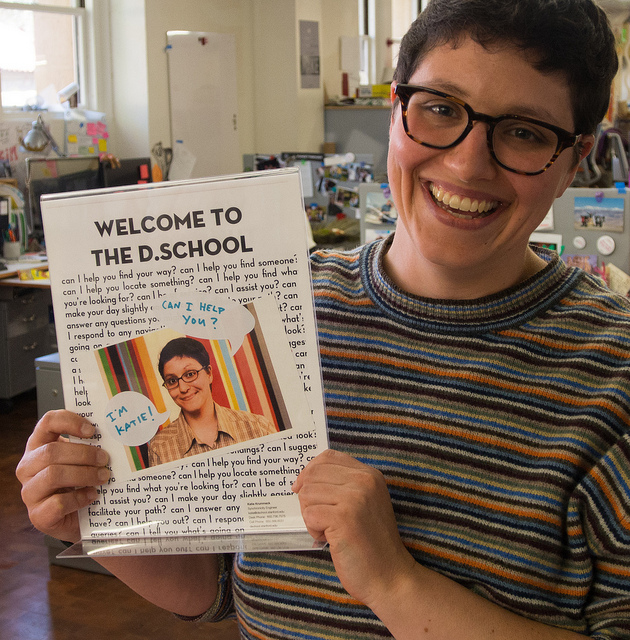
Creating delightful, inviting spaces is simple, but not easy. Unfortunately, we often make it unnecessarily complicated. I don’t expect most workspaces to have wide open, reconfigurable spaces with natural light on two sides and moveable whitewalls and furniture. But why can’t all workspaces have signs like this? How many actually do?
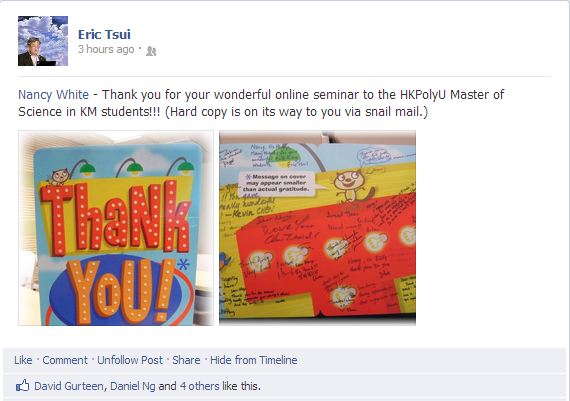
From a Facebook post the students in Eric Tsui’s class at Hong Kong Polytechnic sent me this amazing thank you note. (Paper version, I’m told, is on the way!) Now THIS is a great community indicator. I get up early and late to deliver online webinar guest presentations. Rarely do you get this kind of feedback. I love it. Click the images to see more detail! Thank Eric and to all in your class. I’m smiling in Seattle.
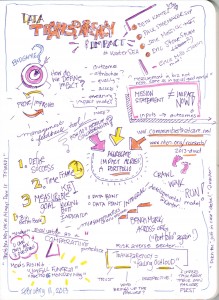
Yesterday I was grateful to attend a panel presentation by Beth Kanter (Packard Foundation Fellow), Paul Shoemaker (Social Venture Partners), Jane Meseck (Microsoft Giving) and Eric Stowe (Splash.org) moderated by Erica Mills (Claxon). First of all, from a confessed short attention spanner, the hour went FAST. Eric tossed great questions for the first hour, then the audience added theirs in the second half. As usual, Beth got a Storify of the Tweets and a blog post up before we could blink. (Uncurated Tweets here.)
There was much good basic insight on monitoring for non profits and NGOs. Some of may favorite soundbites include:
What is your impact model? (Paul Shoemaker I think. I need to learn more about impact models)
Are you measuring to prove, or to improve (Beth Kanter)
Evaluation as a comparative practice (I think that was Beth)
Benchmark across your organization (I think Eric)
Transparency = Failing Out Loud (Eric)
“Joyful Funeral” to learn from and stop doing things that didn’t work out (from Mom’s Rising via Beth)
Mission statement does not equal IMPACT NOW. What outcomes are really happening RIGHT NOW (Eric)
Ditch the “just in case” data (Beth)
We need to redefine capacity (audience)
How do we create access to and use all the data (big data) being produced out of all the M&E happening in the sector (Nathaniel James at Philanthrogeek)
But I want to pick out a few themes that were emerging for me as I listened. These were not the themes of the terrific panelists — but I’d sure wonder what they have to say about them.
A Portfolio Mindset on Monitoring and Evaluation
There were a number of threads about the impact of funders and their monitoring and evaluation (M&E) expectations. Beyond the challenge of what a funder does or doesn’t understand about M&E, they clearly need to think beyond evaluation at the individual grant or project level. This suggests making sense across data from multiple grantees –> something I have not seen a lot of from funders. I am reminded of the significant difference between managing a project and managing a portfolio of projects (learned from my clients at the Project Management Institute. Yeah, you Doc!) IF I understand correctly, portfolio project management is about the business case –> the impacts (in NGO language), not the operational management issues. Here is the Wikipedia definition:
Project Portfolio Management (PPM) is the centralized management of processes, methods, and technologies used by project managers and project management offices (PMOs) to analyze and collectively manage a group of current or proposed projects based on numerous key characteristics. The objectives of PPM are to determine the optimal resource mix for delivery and to schedule activities to best achieve an organization’s operational and financial goals ― while honouring constraints imposed by customers, strategic objectives, or external real-world factors.
There is a little bell ringing in my head that there is an important distinction between how we do project M&E — which is often process heavy and too short term to look at impact in a complex environment — and being able to look strategically at our M&E across our projects. This is where we use the “fail forward” opportunities, the iterating towards improvements AND investing in a longer view of how we measure the change we hope to see in the world. I can’t quite articulate it. Maybe one of you has your finger on this pulse and can pull out more clarity. But the bell is ringing and I didn’t want to ignore it.
This idea also rubs up against something Eric said which I both internally applauded and recoiled from. It was something along the lines of “if you can’t prove you are creating impact, no one should fund you.” I love the accountability. I worry about actually how to meaningfully do this in a) very complex non profit and international development contexts, and for the next reason…
Who Owns Measurement and Data?
Chart from Effective Philanthropy 2/2013
There is a very challenging paradigm in non profits and NGOs — the “helping syndrome.” The idea that we who “have” know what the “have nots” need or want. This model has failed over and over again and yet we still do it. I worry that this applies to M&E as well. So first of all, any efforts towards transparency (including owning and learning from failures) is stellar. I love what I see, for example, on Splash.org particularly their Proving.it technology. (In the run up to the event, Paul Shoemaker pointed to this article on the disconnect on information needs between funders and grantees.) Mostly I hear about the disconnect between funders information needs and those of the NPOs. But what about the stakeholders’ information needs and interests?
Some of the projects I’m learning from in agriculture (mostly in Africa and SE/S Asia) are looking towards finding the right mix of grant funding, public (government and international) investment and local ownership (vs. an extractive model). Some of the more common examples are marketing networks for farmers to get the best prices for their crops, lending clubs and using local entrepreneurs to fill new business niches associated with basics such as water, food, housing, etc. The key is the ownership at the level of stakeholders/people being served/impacted/etc. (I’m trying to avoid the word users as it has so many unintended other meanings for me!)
So if we are including these folks as drivers of the work, are they also the drivers of M&E and, in the end, the “owners” of the data produced. This is important not only because for years we have measured stakeholders and rarely been accountable to share that data, or actually USE it productive, but also because change is often motivated by being able to measure change and see improvement. 10 more kids got clean water in our neighborhood this week. 52 wells are now being regularly serviced and local business people are increasing their livelihoods by fulfilling those service contracts. The data is part of the on-the-ground workings of a project. Not a retrospective to be shoveled into YARTNR (yet another report that no one reads.)
In working with communities of practice, M&E is a form of community learning. In working with scouts, badges are incentives, learning measures and just plain fun. The ownership is not just at the sponsor level. It is embedded with those most intimately involved in the work.
So stepping back to Eric’s staunch support of accountability, I say yes AND the full ownership of that accountability with all involved, not just the NGO/NPO/Funder.
The Unintended Consequences of How We Measure
Related to ownership of M&E and the resulting data brings me back to the complexity lens. I’m a fan of the Cynefin Framework to help me suss out where I am working – simple, complicated, complex or chaotic domains. Using the framework may be a good diagnostic for M&E efforts because when we are working in a complex domain, predicting cause and effect may not be possible (now, or into the future.) If we expect M&E to determine if we are having impact, this implies we can predict cause and effect and focus our efforts there. But things such as local context may suggest that everything won’t play out the same way everywhere. What we are measuring may end up having unintended negative consequences (this HAS happened!) Learning from failures is one useful intervention, but I sense we have a lot more to learn here. Some of the threads about big data yesterday related to this — again a portfolio mentality looking across projects and data sets (calling Nathaniel James) We need to do more of the iterative monitoring until we know what we SHOULD be measuring. I’m getting out of my depth again here (Help! Patricia Rogers! Dave Snowden!) The point is, there is a risk of being simplistic in our M&E and a risk of missing unintended consequences. I think that is one reason I enjoyed the panel so much yesterday, as you could see the wheels turning in people’s heads as they listened to each other! 🙂
Arghhh, so much to think about and consider. Delicious possibilities…
Wednesday Edit: See this interesting article on causal chains… so much to learn about M&E! I think it reflects something Eric said (which is not captured above) about measuring what really happens NOW, not just this presumption of “we touched one person therefore it transformed their life!!”
The public health project is part of a larger pilgrimage by Harvard scholars to study the Kumbh Mela. You can follow their progress on Twitter, using the hashtag #HarvardKumbh.
This is the second post about touring existing online communities as a learning journey for those building or sustaining their own communities. (Part 1 is here.) This one is about the nuts and bolts of doing a live tour of online communities. The first post laid out purpose, identification of potential communities to tour, and criteria for review and evaluation. So now lets talk about HOW to run the tour. This is nuts and bolts time!
Planning
Pick your web touring technology. For this sort of event, I like to have a tool with fairly easy screen sharing and a shared chat room for note taking. I use a white board or slides to share the initial overview and questions.
Set the date. Let your “tourists” know date, time and any technical requirement. This may mean needing to be online, have a headset/mic or an appropriate telephone dial in option.Confirm your communities. Get permissions as appropriate if you plan to use your personal log in to tour any private communities!
Set up a URL list that can work both within your web technology and on a separate web page as back up. Plan a SHORT intro narrative to each community. Decide what pages you will visit and why. See the first post! I like to throw the URLs and short descriptions on to a Google doc and share it with the tourists in advance.
Test your URLs within the web meeting tool. Should they be links? Preloaded? Do you need username/password to log on to any private sites?
As backup, grab a basic set of screen shots of each community in case your web touring technology fails. Yes, it happens! Always have a plan B.
If you have a co-facilitator, define each of your roles.
It is often useful to have one person help folks if they have any technical needs, while the other runs the tour.
Consider how you want to capture questions as you go — sometimes you will need to research and come back later with answers. Encourage the tourists to take notes if that fits your culture!
Send an email with the login information and any preparation you would like the tourists to do. I often send a short piece on community PURPOSE and some of the questions I mentioned in the first post.
Running the event
Log in early and make sure everything is working. Have an email prepped to resend in case anyone contacts you saying “I lost the url/login/etc.
If you decided to preload URLs on separate whiteboards, etc, get that all set up. Set up any polls or questions on other white board pages or have them handy to cut/paste in.
If you are recording the tour, don’t forget to hit the old “record” button once you start.
When you start with your participants, give an overview of the tour process. It might go something like this:
We are going to look at X different communities today. I’m going to use the screen sharing tool (or whatever you plan) so I’ll be “driving” the tour, but please, if you see something you’d like me to click on, let me know. There is a slight lag with the screen sharing so speak up as soon as you can!
I want to review a couple of questions we should keep in mind as we tour (then I review the questions.)
Encourage shared note taking (I often use the chat room in the webinar tool).
Do you have any questions? (Answer them..)
Start…
Pause often for questions, observations.
Between communities, do a quick recap asking for observations and answers to questions. Sometimes it is worth going deeper and seeing fewer communities…
Leave at least 25% of the time at the end for reflection and next steps.
Follow Up
If you are recording the event, capture the recording and share the URL.
Clean up and share any collective notes taken during the event.
Do you have any other suggestions or ideas? Resource pointers? Please, chime in!
We use cookies on our website to give you the most relevant experience by remembering your preferences and repeat visits. By clicking “Accept”, you consent to the use of ALL the cookies.
This website uses cookies to improve your experience while you navigate through the website. Out of these, the cookies that are categorized as necessary are stored on your browser as they are essential for the working of basic functionalities of the website. We also use third-party cookies that help us analyze and understand how you use this website. These cookies will be stored in your browser only with your consent. You also have the option to opt-out of these cookies. But opting out of some of these cookies may affect your browsing experience.
Necessary cookies are absolutely essential for the website to function properly. These cookies ensure basic functionalities and security features of the website, anonymously.
Cookie
Duration
Description
cookielawinfo-checkbox-analytics
11 months
This cookie is set by GDPR Cookie Consent plugin. The cookie is used to store the user consent for the cookies in the category "Analytics".
cookielawinfo-checkbox-functional
11 months
The cookie is set by GDPR cookie consent to record the user consent for the cookies in the category "Functional".
cookielawinfo-checkbox-necessary
11 months
This cookie is set by GDPR Cookie Consent plugin. The cookies is used to store the user consent for the cookies in the category "Necessary".
cookielawinfo-checkbox-others
11 months
This cookie is set by GDPR Cookie Consent plugin. The cookie is used to store the user consent for the cookies in the category "Other.
cookielawinfo-checkbox-performance
11 months
This cookie is set by GDPR Cookie Consent plugin. The cookie is used to store the user consent for the cookies in the category "Performance".
viewed_cookie_policy
11 months
The cookie is set by the GDPR Cookie Consent plugin and is used to store whether or not user has consented to the use of cookies. It does not store any personal data.
Functional cookies help to perform certain functionalities like sharing the content of the website on social media platforms, collect feedbacks, and other third-party features.
Performance cookies are used to understand and analyze the key performance indexes of the website which helps in delivering a better user experience for the visitors.
Analytical cookies are used to understand how visitors interact with the website. These cookies help provide information on metrics the number of visitors, bounce rate, traffic source, etc.
Advertisement cookies are used to provide visitors with relevant ads and marketing campaigns. These cookies track visitors across websites and collect information to provide customized ads.
 Kevin Harris, on his terrific Neighborhoods blog, offers a quick analysis of what looks to be a very interesting study on social networks, Social networks, social capital and refugee integration from Birmingham and Cardiff universities. I just want to quickly amplify this to my network with no further comment beyond a thanks to Kevin. DO visit and subscribe to his blog. I’m always getting great bits of thinking from Kevin!