Remembering Tim Jaasko-Fisher

I’ve been a part of the wide-ranging and many-noded Liberating Structures network for many years. It has connected me to many remarkable people. One of them was the amazing Tim Jaasko-Fisher. LS founder Keith McCandless introduced me to Tim (I can’t remember where) and later recommended me for some support Tim was looking for.

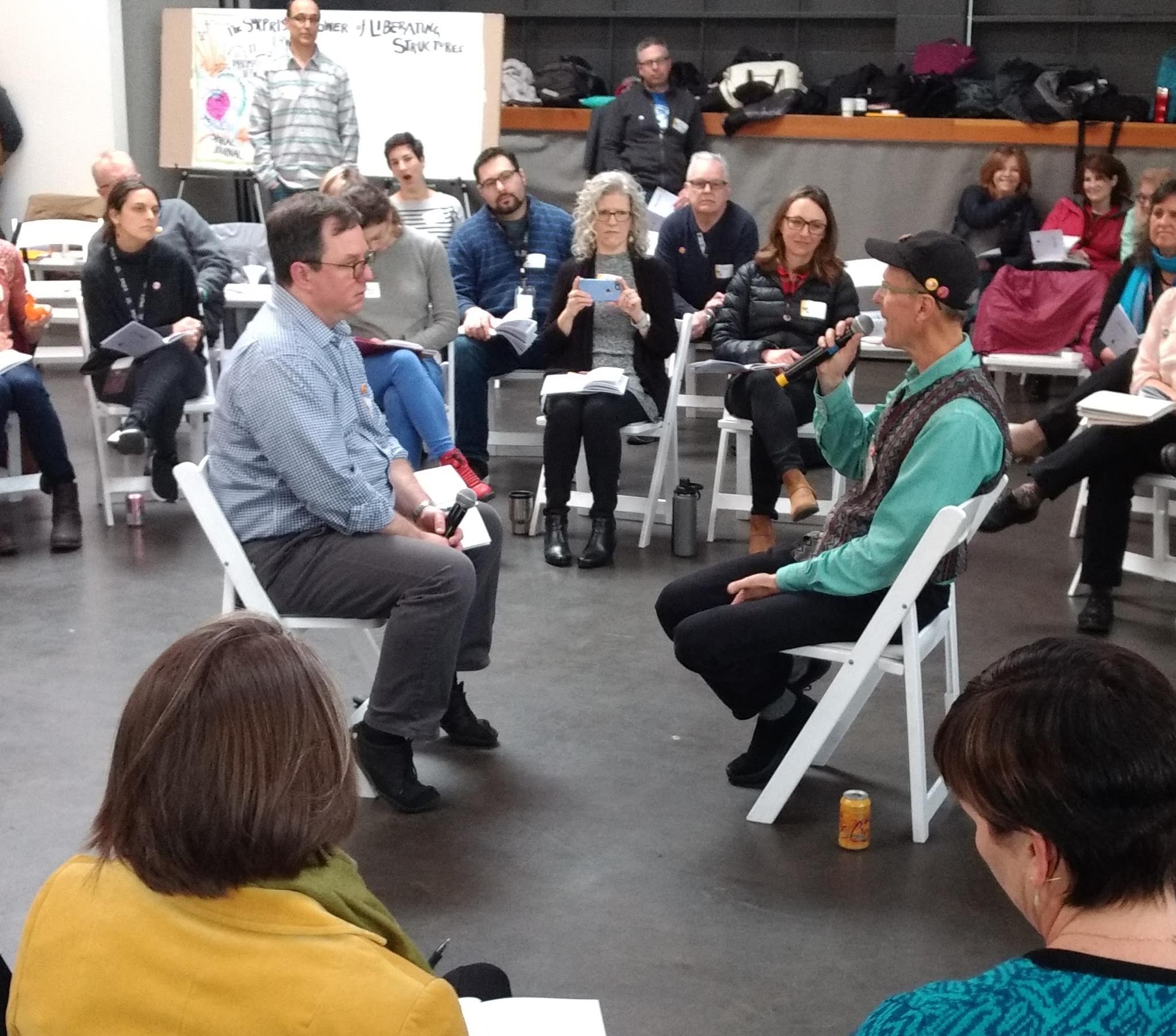
Tim (left) and Keith in a Liberating Structures immersion “Fish Bowl”

Right away I was taken by Tim. A lawyer by training and a dedicated advocate for child welfare by practice and passion, Tim showed me a whole new side of the legal profession. To watch him deftly weave networks, facilitate groups who were not necessarily all on the same side, nor interested in group process Tim was offering, was quite something. Tim embraced the wicked questions inside of all of us and inside himself. Sure of his way and open to other ways. Fierce advocate for kids and collaborator within a challenged child welfare system. Open to simple solutions like protein before family court hearings to keep everyone on an even keel, an approach he and his amazing wife, Dr. Kristin Allott. Even from a distance it was clear this was a remarkable partnership and Tim glowed when he introduced me to Kris.

I had the joy and pleasure to work a few times for and with Tim. They were always learning moments. To see how he viewed something and approached it opened new perspectives for my own practice. I am ever grateful.

I will miss Tim. We all will miss Tim. The world has a hole it in left by Tim.

Protocol and that which is sacred

https://aperture.org/editorial/a-photographers-unseen-archive-of-the-hawaiian-renaissance/

I am a member of The Well and one of the conversations/conferences I follow is called Hawaii. The above article was shared a while back and I continue to be moved by this article in Aperture magazine. Photographer Franco Salmoiraghi has taken pictures in Hawaii for decades. Not all of those are shared publicly because they are sacred to Hawaiian’s and their culture. There are things that are, by protocol, sacred. Images that are ONLY for native Hawaiians.

I remember working overseas many years ago and heard someone talking about my style and approach as that “casual American disregard of protocol and devaluing the role of the formal.” Guilty as charged and I often perceived that those protocols just slowed things down and did not amount to much. And from one perspective, that felt pretty accurate.

What I did not see nor school myself on was where protocol was, in fact, sacred, and when it was just a way to consolidate and preserve power. Or when it was both. Or neither. So when I read the article above, it opened up a new window through which I am now taking a longer peek. No conclusions here, just appreciation for another view.

Disability Justice Audit Tool

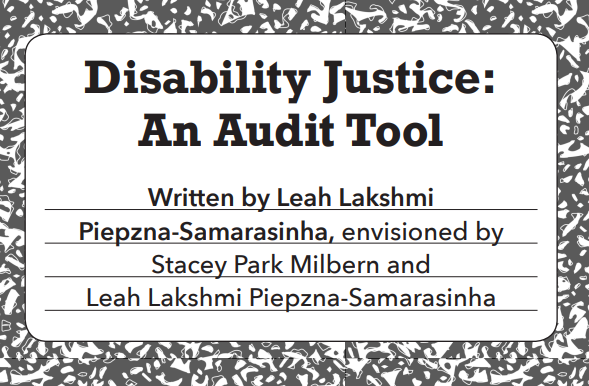
Screenshot of the cover of the audit tool reading: Disability Justice: An Audit Tool. Written by Leah Lakshmi, Piepzna-Samarasinha, envisioned by Stacey Park Milbern and Leak Lakshmi Piepzan-Samarasinha
Cover page

I recently downloaded Northwest Health’s “Disability Justice: An Audit Tool” at https://www.northwesthealth.org/djaudittool# – it is a quick, free download. From the website their description:

Disability Justice: An Audit Tool” is aimed at helping Black, Indigenous and POC-led organizations (that are not primarily focused around disability) examine where they’re at in practicing disability justice, and where they want to learn and grow. It includes questions for self-assessment, links to access tools, organizational stories and more.

While white facilitators aren’t the target audience, this is a terrific and more broadly useful piece. For me it stems from Intersectionality, one of the ten principles of disability justice. Intersectional work is one of the essential practices we all need to learn and use, especially those of us who call ourselves facilitators. While the checklist is organizational oriented, it is great food for thought and ACTION.

First, what is disability justice? From the tool:

Disability justice is a term and a movement-building framework (i.e. a way of envisioning the ways people can organize around and think about disability) that centers the lives and leadership of disabled Black, Indigenous and people of color and/or queer, trans, Two Spirit and gender nonconforming people.
To paraphrase Patty Berne, disability justice leader and co-founder of DJ performance and political collective Sins Invalid, disability justice steps into the “cliffhangers” left over from the disability rights movement.

Disability Justice: An Audit Tool

I was particularly taken by Patty Berne’s description about the cliffhangers left oer from the disability rights movement. It make me wonder about how we overlook something because we are focusing on something else we think is important. I reflect upon my feminism as a white woman and how it so thoroughly distracted me from racism for so long.

If we are not intimately involved in the issues of disability rights, we can forget about it. Time for action.

The action I put forth to myself is to read, journal and reflect upon the tool to identify first where I have an am falling short on disability justice in my life and work. It has been gratifying to see how many people have started to pay attention to things like access issues in online meetings, so that opens the door a crack for more and more fundamental changes. The checklist can help me go deeper. Thanks, NW Health and all the individuals who created this tool.

Read this Report Now: Black Women Thriving

Ericka Hines of Every Level Leadership and her network launched this project to deeply understand and provide data about Black women in the workforce. I’ve just starting reading and already find it full of compelling, clear data and recommendations. So I don’t want to wait to spread the word. From all Ericka’s good work, comes possibility for the rest of us to take action. THRIVING!

Update from the “fallow” period: hope

As some of you know, last Summer I declared a fallow period for myself. I was so tired.

Well, I’ve arrived at the cleaning stage. Clearing out books I’ll never open again. Going through files and digging into the huge (garbage) pile that is my office. Attacking deferred home maintenance projects.

What one can discover never ceases to amaze. Even some words that help me through a turn.

First I notice that I’m now rested enough that I can start and even ENJOY these tasks. It may be an indicator how far I’ve come from last summer’s burn out. And I can see the top of my desk! I feel comfortable giving away books and recycling piles of files. I’m scanning a few, offering some to folks who appreciate artifacts from the early days of online community, and holding on to some that are near and dear.

Some of the things I’ve unearthed remind me that phase changes are amazing moments to both reflect AND start out on new explorations and (learning) adventures. I found my independent study on solar algae ponds and the chemistry of phytoplankton in the aquaculture environment. Wow, I was smart back then! I found my high school year book. I realize no one knew me until I got the lead in the senior play. Invisibility, eh? I found printouts of the governance thrash when Electric Minds (snapshot here) lost its funding and in a hail Mary, became Eminds. (Howard wrote about that a bit here.) Names and personalities came flooding back. Moments of joy and moments of regret. The shattering of my naiveté about the possibilities of online community.

It was in one of these print outs that I found a response from the wise and wonderful Jay Rosen of NYU. I was deeply dispirited and Jay stopped into the conversation thread that I LOVED most, “How to raise the caliber of the conversation on the Net.” Jay wrote about the social critic Christopher Lasch and his distinction between optimism and hope. Here are a few snippets that Jay quoted.

Optimism is the belief that things will somehow get better because that is the direction things go.

Jay Rosen, paraphrasing Lasch

“Hope does not demand a belief in progress. It demands a belief in justice: a conviction that the wicked will suffer, that wrongs will be made right, that the underlying order of things is not flouted with impunity. Hope implies a deep-seated trust in life that appears absurd to those who lack it. It rests on confidence not so much in the future as in the past.

“It derives from early memories–no doubt distorted, overlaid with later memories, and thus not wholly reliable as a guide to any factual reconstruction of events–in which the experience of order and contentment was so intense that subsequent disillusionments cannot dislodge it.

“Such experience leaves as its residue the unshakable conviction, not that the past was better than the present, but that trust is never completely misplaced, even though it is never completely justified either and therefore destined inevitably to disappointments.

“If we distinguish hopefulness from the more conventional attitude known today as optimism–if we think of it as a character trait, a temperamental disposition…–we can see why it serves us better, in steering troubled waters ahead, than [optimism].

“Not that it prevents us from expecting the worst. The worst is what the hopeful are always prepared for. Their trust in life would not be worth much if they had not survived disappointments in the past, while the knowledge that the future holds further disappointments demonstrates the continuing need for hope… Improvidence, a blind faith that things will somehow work out for the best, furnishes a poor substitute for the disposition to see things through even when they don’t.

“… The disposition properly described as hope, trust, wonder–three names for the same state of heart and mind–asserts the goodness of life in the face of limits. It cannot be defeated by adversity. In the troubled times to come, we will need it even more than we needed it in the past.”

Christopher Lasch, “The True and Only Heaven: Progress and its Critics”

Then Jay left his advice to me.

One is to remain optimistic and say: everything will work out. A second is to give in to despair, or give up on politics entirely.

The third is to steel yourself with hope. Prepared for the worst, fortified by loving memory of what was best in the past, open to a future in which trust is never wholly misplaced. That’s hope, in its muscular variety.

Jay Rosen, E-Minds, 1997

Lately the news of the world – Ukraine, White Supremacy, striking down of Roe v. Wade, shootings, hate — it has been taking its toll on me. Then I picked up this old print out and Jay reminded me, I can choose hope. Thanks, Jay!