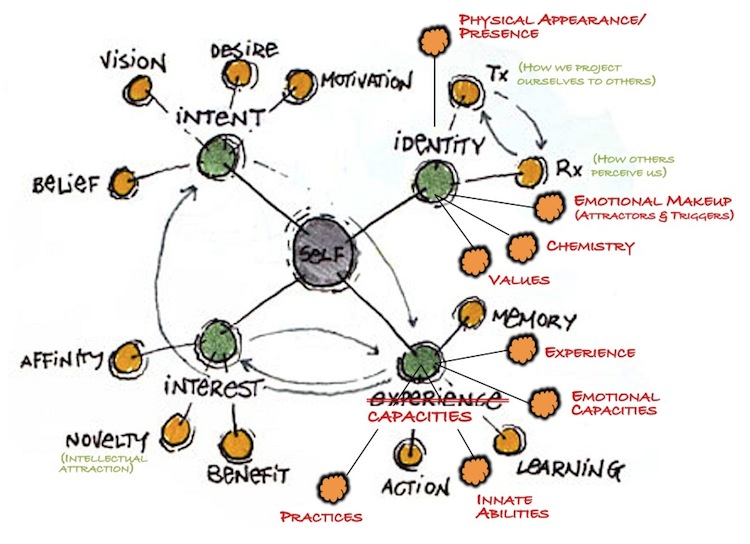
So as Aaron explains, where there are strong ‘overlaps’ between these aspects of self among members of a group, that group will emerge to be a community (note the names applied to these four types of community below are mine, not Aaron’s):
If the overlap is mainly common interests, it will emerge as a Community of Interest. Learning and recreational communities are often of this type.
If the overlap is mainly common capacities, it will emerge as a Community of Practice. Co-workers, collaborators and alumni are often of this type.
If the overlap is mainly common intent, it will emerge as a Movement. Project teams, ecovillages and activist groups are often of this type.
If the overlap is mainly common identity, it will emerge as a Tribe. Partnerships, love/family relationships, gangs and cohabitants are often of this type.
From the Drafts: something I wrote about community vs network a zillion dog years ago that showed up on the Peer to Peer Foundation wiki. Still works, but there needs to be an update. How would you describe the differences?
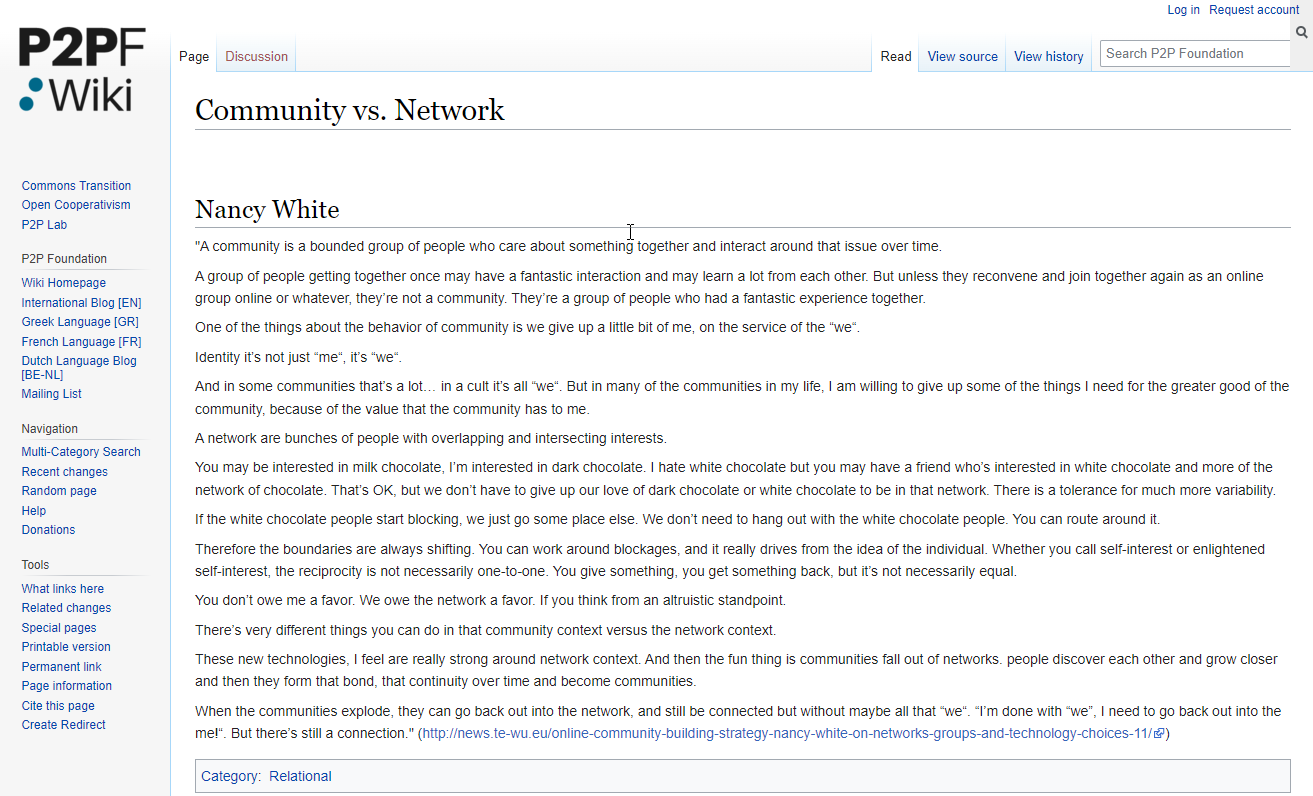
“A community is a bounded group of people who care about something together and interact around that issue over time.
A group of people getting together once may have a fantastic interaction and may learn a lot from each other. But unless they reconvene and join together again as an online group online or whatever, they’re not a community. They’re a group of people who had a fantastic experience together.
One of the things about the behavior of community is we give up a little bit of me, on the service of the “we“.
Identity it’s not just “me“, it’s “we“.
And in some communities that’s a lot… in a cult it’s all “we“. But in many of the communities in my life, I am willing to give up some of the things I need for the greater good of the community, because of the value that the community has to me.
A network are bunches of people with overlapping and intersecting interests.
You may be interested in milk chocolate, I’m interested in dark chocolate. I hate white chocolate but you may have a friend who’s interested in white chocolate and more of the network of chocolate. That’s OK, but we don’t have to give up our love of dark chocolate or white chocolate to be in that network. There is a tolerance for much more variability.
If the white chocolate people start blocking, we just go some place else. We don’t need to hang out with the white chocolate people. You can route around it.
Therefore the boundaries are always shifting. You can work around blockages, and it really drives from the idea of the individual. Whether you call self-interest or enlightened self-interest, the reciprocity is not necessarily one-to-one. You give something, you get something back, but it’s not necessarily equal.
You don’t owe me a favor. We owe the network a favor. If you think from an altruistic standpoint.
There’s very different things you can do in that community context versus the network context.
These new technologies, I feel are really strong around network context. And then the fun thing is communities fall out of networks. people discover each other and grow closer and then they form that bond, that continuity over time and become communities.
When the communities explode, they can go back out into the network, and still be connected but without maybe all that “we“. “I’m done with “we”, I need to go back out into the me!“. But there’s still a connection.”
Still a gem from 2009. I have always been reluctant to join in on credentialing and certification schemes. I resist it personally (my baggage, I know), it focus on the individual rather than the field, and, for process work, context is critical and practice is always evolving.
I loved how Tenneson Woolf talked about Credentials as Practice. I’ve put a few snips below, but please, go read the original post!
Tenneson Woolf: Credentials as Practice 1. Credential as Practice — An older kind of thought would be credential as certification. As bestowed. Yes, there is value in this…Yet, there is also immense freedom to think of being credentialed by our practice…
2. Work with Friends — Lots of friends. Practice together. Learn together. Feed off of each other to sharpen skills to see at the next level…
3. Offer Something — A harvest. A story. A poem. A question. An invitation to work together…
4. Learn in Public — Make it transparent. Open… Half-cooked ideas. Learnings. Insights. Learn on behalf of the whole.
5. Have a Presencing Practice — With my friends at The Berkana Institute, I learn that this work is about emergence…
6. Examine Core Beliefs — Keep this as an active conversation…
7. Learn Global. Connect Regional. Act Local … Doing the work in front of us.
From the dregs of drafts… I don’t think the advice has really changed and the relevance of the question may even be more than in 2008 when Beth Kanter blogged this. The very fabric of communities and the ideal of community is quite frayed since then.
Beth’s Blog: How Nonprofits Can Use Social Media: WeAreMedia Module 5: Nancy White Suggests Asking “Do You Really Need A Community?” Nancy is making a distinction between “traditional” online communities where there are relationships between people in the community and people connecting together around specific interest area or a Tribe. This module has originally put these together under one definition of “community” with the latter being “loosely-coupled” communities. But thinking we need to re-think this a bit. Off to ponder “Are You in the Tribe?”
Maybe the focus on this module should be more “engagement” strategies – and the ways you can do this. If you have a group of people that you don’t want to necessarily interact with one another, but want them to create content — you’d still need an engagement strategy to encourage participation. It would, definitely, as Nancy suggests, impact where and how you might do this.
From the draft posts I’m mining, I reread a fantastic 2008 post by Konrad Glogowski on his blog, Towards Reflective BlogTalk.
Remember blogs? Well, even if folks no longer blog per se, there is still a lot of writing we put out on the interwebs.
I was taken by his description of a reflective process he developed for his 8th grade students and their blogging. As I read it back in 2008, I immediately put his ideas into this stewpot of “5 minute reflective practices” I had had simmering in the back of my brain. I thought what Konrad wrote about could be used in teams and communities of practice, as well as in classrooms. With a few adjustments, it might be a very fine tool. This idea of “ripples” is very powerful.
Konrad wrote:
It’s not enough to know how to grow a blog, to pick a topic and keep contributing to one’s blog. Our students must also be aware of the class communities in which they learn. They have to have opportunities to think and respond to other writers. They need opportunities to engage in and sustain conversations about their own work and the work of their peers. Blogging is not about choosing a topic and writing responses for the rest of the term. It is about meaningful, thoughtful engagement with ideas.
You’ll need to go read the full post for the method. He links to his worksheet here.
All these years later, reflective practices remain useful and at the core of my process repertoire. Currently Keith McCandless and I are working on a draft of a new Liberating Structure (Strategic Knotworking) and we both feel strongly that evaluation should be woven into work from the start, not just at the end. I suggested that this is a form of reflective practice. I turn often these days to the work of the fine folks building the field of Developmental Evaluation (Michael Quinn Patton and many others), and to the work of Etienne and Bev Wenger-Trayner and their Value Creation Framework and subsequent book, Learning to Make a Difference.
Yes, it is about meaningful, thoughtful engagement…
We use cookies on our website to give you the most relevant experience by remembering your preferences and repeat visits. By clicking “Accept”, you consent to the use of ALL the cookies.
This website uses cookies to improve your experience while you navigate through the website. Out of these, the cookies that are categorized as necessary are stored on your browser as they are essential for the working of basic functionalities of the website. We also use third-party cookies that help us analyze and understand how you use this website. These cookies will be stored in your browser only with your consent. You also have the option to opt-out of these cookies. But opting out of some of these cookies may affect your browsing experience.
Necessary cookies are absolutely essential for the website to function properly. These cookies ensure basic functionalities and security features of the website, anonymously.
Cookie
Duration
Description
cookielawinfo-checkbox-analytics
11 months
This cookie is set by GDPR Cookie Consent plugin. The cookie is used to store the user consent for the cookies in the category "Analytics".
cookielawinfo-checkbox-functional
11 months
The cookie is set by GDPR cookie consent to record the user consent for the cookies in the category "Functional".
cookielawinfo-checkbox-necessary
11 months
This cookie is set by GDPR Cookie Consent plugin. The cookies is used to store the user consent for the cookies in the category "Necessary".
cookielawinfo-checkbox-others
11 months
This cookie is set by GDPR Cookie Consent plugin. The cookie is used to store the user consent for the cookies in the category "Other.
cookielawinfo-checkbox-performance
11 months
This cookie is set by GDPR Cookie Consent plugin. The cookie is used to store the user consent for the cookies in the category "Performance".
viewed_cookie_policy
11 months
The cookie is set by the GDPR Cookie Consent plugin and is used to store whether or not user has consented to the use of cookies. It does not store any personal data.
Functional cookies help to perform certain functionalities like sharing the content of the website on social media platforms, collect feedbacks, and other third-party features.
Performance cookies are used to understand and analyze the key performance indexes of the website which helps in delivering a better user experience for the visitors.
Analytical cookies are used to understand how visitors interact with the website. These cookies help provide information on metrics the number of visitors, bounce rate, traffic source, etc.
Advertisement cookies are used to provide visitors with relevant ads and marketing campaigns. These cookies track visitors across websites and collect information to provide customized ads.


 From the draft posts I’m mining, I reread a fantastic 2008 post by Konrad Glogowski on his blog,