From the Archives: Reason, Purpose and Getting to the NUBBINS!

Close up of a piece of driftwood on the beach that appears to have a face on it.
What do we see when we look in new ways?

This draft post from 2013 was worth my time to go revisit and read the three blog posts in the list below (two from 2006, one from 2013, one re-found via the Wayback Machine/Internet Archivedonate!) I’ve decided to pluck one thing from each list and comment on it below (in italics). These three lists, these three BLOG POSTS still open up new vistas for me. For you?


I am not a fan of lists, but I appreciate the value of the form. What I really dig is when the lists open up a new vista or light up a light for me.

  • Half an Hour: Things You Really Need to Learn, Stephen Downes, 2006  
    • Stephen’s post still rings true, and one of his bullet points relates to a conversation-in-comments that Alan Levine, Ton Zylstra and I have been having in a recent post of mind about what we pay attention to and how we pay attention. #3, How to Read and #10, How to Live Meaningfully seen particularly salient and poignant in our times where consumerism meets climate change meets pandemic meets threats of war. What matters. I know I want to pay more attention to what matters. And WHAT MATTERS. 
  • Ten Things to Learn This School Year 2006 Guy Kawasaki (Via the Wayback Machine)
    • I agree with Stephan that Guy’s list is more about how to succeed in business. It doesn’t inspire. But I have to chuckle when I see #2, How to Survive a Poorly Run Meeting and #3, How to Run a Meeting. We really don’t learn, do we. Why is this still an issue? Oi!
  • How to Create Your Reason by Umair Haque, 2013
    • Umair is regularly thought provoking and this is no exception. Plucking one from his list is as hard as plucking two from Stephens, but I’m going to hit one that has resonance for me, right now, as I reexamine my work/life. Radical Simplicity. What can I/we stop doing, right now, to make space for what matters? Creative destruction, my friends, is a super power. 
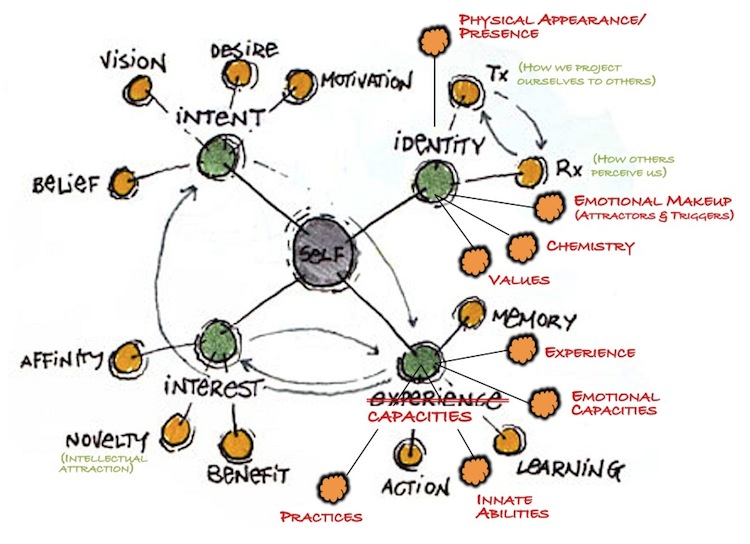
From the Blog Archives: Dave Pollard’s Model of Identity and Community

Dave’s thinking and writing is pretty damned evergreen. I’ll leave this here for your consideration!

———————-

A Model of Identity and Community « how to save the world.

So as Aaron explains, where there are strong ‘overlaps’ between these aspects of self among members of a group, that group will emerge to be a community (note the names applied to these four types of community below are mine, not Aaron’s):

  • If the overlap is mainly common interests, it will emerge as a Community of Interest. Learning and recreational communities are often of this type.

  • If the overlap is mainly common capacities, it will emerge as a Community of Practice. Co-workers, collaborators and alumni are often of this type.

  • If the overlap is mainly common intent, it will emerge as a Movement. Project teams, ecovillages and activist groups are often of this type.

  • If the overlap is mainly common identity, it will emerge as a Tribe. Partnerships, love/family relationships, gangs and cohabitants are often of this type.

From the Drafts: Choosing the path of humility with Lauren Vargas

Child's artwork, blue and white abstract figure pulling a blue and white abstract banner across a field of black and gray watercolors.
art by my youngest grandperson

Communicators Anonymous: Choosing the path of humility

Ah, this dive into the drafts of late 2008 brings a spark of kismet because this year I had the wonderful pleasure of reconnecting with Dr. Lauren Vargas. (Old site, new site) when she and Bill Johnston hosted me for a podcast: How the Pandemic Forced Online Collaboration to Mature with Nancy White. I found Lauren a kindred spirit, and here I unearth a blog post about humility that still resonates. Thanks, Lauren!

(And the rest of y’all, go READ it!)

Empathy Flowing in Many Directions

A friend shared a New York Times opinion piece by Kaitlyn Greenidge yesterday that really planted a seed in my brain. First of all, read the piece. Especially if you are a white woman, as am I. It is a tangible, down to earth example to help us understand white privilege. And that is work I am/need to be doing continually. It is an ever changing path; a rocky shoreline.

So when we as black girls read most books, we have to will ourselves into the bodies on the page, with a selectivity and an internal edit that white readers of the same canon do not necessarily have to exercise.

“So what?” one might think. Isn’t reading fiction an exercise in empathy?

But empathy for whom, and for what higher purpose, always complicates this supposedly benevolent action. Is empathy really empathy if it’s generally asked to flow in only one direction? Under those circumstances, empathy looks less like identifying with the other and more like emotional hegemony. – by Kaitlyn Greenidge, NYTimes, 1/13/2020.

The quote I pulled above was useful for me today both professionally and personally. As a group process geek in my work, I’ve always sought to cultivate empathy in any group. Ms. Greenidge helped me see that empathy might also be oppression. Is it right to claim empathy with another when we clearly don’t understand, see or acknowledge their world view and experience?

Though it’s examination of the Greta Gerwig movie version of Louisa May Alcott’s “Little Women” as viewed by women of color, Ms. Greenidge helps me raise some new questions for myself when working with people coming from different contexts.

When designing and facilitating group process, how are we discovering and staying conscious of our filters that may, if left unchecked, render even empathy as a deficit because it is “emotional hegemony?” Here are three starting points for me today.

  1. What values, myths or traditions of my own am I consciously or unconsciously calling on to frame group process?
  2. How am I broadening the range of values, myths and traditions I include to reflect the seen and potentially unseen contexts of people in the group?
  3. How does my language reflect my unconscious frames (and thus biases) and who can I call upon to help me by listening to my patterns and challenge them. Ideally, not asking a person of color to do this. This is not their job!

What recommendations do you have so that when we utilize our empathy, we are not inadvertently rendering it as a weapon? How do we find our path?

Context for Group Process for Reconciliation (and other hard things)

I snipped the quotes below from Chris Corrigan back in December (Some things that work in real reconciliation dialogue – Chris Corrigan ), meaning to write more about it. I think it is too important to wait for my “round to it” to happen, so here it is. Chris is writing about reconciliation. In our current political environment (especially here in the US) this is becoming a core competency, and can’t be left to luxury. The BOLDING is mine, with comments between points.

Very small groups – no more than four at a table – meant that there was no need for people to “take their best shot” as they would have in a larger plenary format. Groups smaller than five reduce the performative nature of conversation and allow dialogue to fully unfold.

This is where I constantly get push back from convenors and people in authority. They want whole group for fear of missing out on something, or having something happen that they can’t see/control. Working with positional leaders to move past these fears is important prep work, and resisting their urge to derail small group practices mid-stream.

The questions for the dialogue were very broad. Sometimes the most powerful question is “what are you thinking and feeling about what you just heard?”

This was interesting to me as part of me seems to push for sharper, focused questions. I think I have been confusing sharpness and focus. Broad questions can have the stimulating characteristics of broad questions. Or maybe it is the invitation process (see next point.) I clearly have more thinking/learning to do here.

The invitation process is everything. We helped our client design an invitation process but she took the lead in going to each group separately and talking to them about why they were needed in the conversation.

The practice of “everything from the front of the room to all groups” had not been working for me so I’ve started to encourage very broad instructions at the front, then travel to each table/group. People use their questions to me to sharpen their own thinking and understanding. It is far less passive than just waiting for instructions!

There were no observers. Everyone in the room was at a table except for me and our graphic recorder. Everyone at a table had a question they needed answered or a curiosity about the outcome.

I just say, “Amen!”

There was no certainty in the room, no positionality, and yet, each person spoke about their own experience and their own perspective and listened carefully to what others said.

It was interesting to see Chris put certainty and positionality in the same sentence. Chris, was there a reason?

 … everyone in the room had to stretch their perspectives to participate. This was not comfortable for anyone, because this work isn’t comfortable for anyone.  It is literally unsettling. …there is a tremendous amount of emotional labour involved in talking about traumatizing history.

Here is the other area I need to learn a LOT more about. It goes to the whole other side of preparation, including self awareness and my own power and how I do or do not use it.

What are your practices for context setting and facilitating for reconciliation?