You Can Observe a Lot By Watching – Yogi Berra

watchingbyAliaQunhuaFlickrCCThis is the second post in a series about how we learn from our work. The first one can be found here.

The great American baseball player/philosopher Yogi Berra, said “You can observe a lot just by watching.”

That quote popped into my mind when I was on a phone call with a group of Bill and Melinda Gates Foundation grantees of the Water, Sanitation and Hygiene program. We were on a great 90 minute call with those working on projects in Africa when one participant shared this story. The following is a total paraphrase!

I received this drawing of a septic tank from one of our colleagues in India. Looking at it, I saw it was a great design, but I closed the email and moved on. A few months later I visited and saw the remarkable tank and realized what a breakthrough it was and thought, why did I just close that email a few months ago? Why didn’t I share it with a colleague in Africa who I knew would be interested? What was it about that face to face moment that crystallized the learning for me?

“You can observe a lot just by watching.” All humor aside, I’d like to greet that with a rousing “Yes, AND…” The AND is that we are getting so programmed for efficiency, and addressing every little blip on the radar screen that we miss the importance of the things we are ostensibly “watching.” When we go into the field, many of those distractions are electronically de-tethered. We focus, focus, focus on what we actually see in front of us. We ARE watching with all of our attention and thus can reflect on the importance of what we are seeing.

So is the solution to simply go into the field? Well, not so practical. Not so sustainable. Sometimes not even possible, especially for anyone lower on the project hierarchy. It is not equitable.

So what do we do?

We are currently initiating two experiments to try and solve this problem. I’ll share the first here, and save the second for a follow up post. (Focus, focus, focus!)

Shared, Open-Topic Conversations

One is the semi-regular, open agenda telephone calls with subgroups of BDS grantees. The calls were initiated by the portfolio leader, as a response to working with the KM team and hearing needs from grantees. By walking the talk, our client is using his leadership position to invite conversation, versus disseminate requirements or content.

So far it feels like having between 8-12 people on the call is a good size. There is enough diversity, but not too many voices so everyone can have some air time and attention. We use a telephone bridge line and a shared note taking/chatting space. (Our “community technology configuration.”) Currently we’ve been experimenting with Meeting Words (http://www.meetingwords.com).

We do a quick check in, then each person is invited to share some insight about their current work. People use chat or voice to ask questions, answer, look for possible collaboration opportunities, but more importantly, pay attention for 90 minutes to thinking across the portfolio, not just within their project.

Because there are others there “listening” to us, we speak and pay attention differently than a quick scan of an email. My sense is that the more we can recreate the sense that we are together, the more this behavior shows up, rather than paying attention with half an ear whilst doing email and reading a note someone in the office just set in front of us. The shared note taking space helps focus attention and offer different means of engagement. We didn’t have it the first call and I personally felt less coherence. (That could just be me.) When we added it for the second call, people did not have to wait for “airtime” to talk – they could type. In addition, I did live note taking in the wiki side of the page and invited others to improve my note taking. In when the links! In went the correct spelling of a report. And we had very useful, collaborative notes ready by the end of the call. Boom!

The turn taking helps stimulate our past experience of being in a room, in a circle together sharing a beer or coffee, and simply talking with each other.  It helps the shyer people know there will be a space for them, even if they want to pass. It evens out some of the inevitable power dynamics of funder/grantee, boss/team member.

At the end of the second call we asked ourselves if we found value in the call and the meeting words and the quick informal feedback was very positive. I was even surprised at how positive. What did we do right? What could be improved? We still need to answer these questions.

The final piece of these calls is just starting up – following up with sharing of mentioned resources, setting up follow up actions for pairs with shared needs or interests, and development of asynchronous discussion threads of topics identified as useful for more depth.

My key questions going forward on this include:

  • How often do these calls need to be to build sufficient trust and practice to be, and be perceived as valuable and worth the time spent? In other words, what is the heartbeat of this practice? Time is always the scarce resource, so value MUST exceed time spent. This raises the question of what metrics help us understand received and perceived value. Is it important to have metrics or is informal feedback enough?
  • How will the proposed follow up items emerge and how will we discern the value of these experiments? Will we succeed in sustaining asynchronous interaction or is that even another step away from the “face to face attention.” Again, what are our metrics?
  • Finally, if these calls continue to provide value, who else would benefit from/want to attend? How far away from those in charge of the grants should we go? I personally think we miss a LOT by not having these conversations with front line staff, but it becomes increasingly logistically challenging and time is that darn choke point.

Have you done informal, regular knowledge sharing calls? What have you learned about convening them? Measuring their value? Let me know and I’ll share it back around! Because, after all, you can observe a lot by watching, right? J

Mirror Mirror, On the Wall: Learning in a Crowded Life

mirrorbyPhotoComiXonFlickrCC14 years ago I did my first overseas gig in Central Asia. I stayed with the project over three years including a number of trips to Armenia to work with the team on the ground. (See White-2005-Little) Ostensibly I was there to help facilitate learning around using online tools for community development, particularly in rural towns being connected via a school connectivity project. But in the end, what I realized was that my role was as a mirror for the team to see itself.

As we had our final closing circle for an After Action Review before the project began its transition away from the organization to the Ministry of Education, we started with the first question “What did we intend to do?” That was pretty easy. The project had a clear mandate, goals, and measurable intermediate outputs. We transitioned quickly into “What did we actually do.” There were the things we had dealt with, change, reformations of assumptions and operating conditions, etc. No big surprises.

When we got to the third question, “What did we learn?” we sat for a moment in silence, pondering. You could feel something change in the room. The concern that the Ministry would muck it all up, unspoken, but present. The acknowledgement of grief of having to let the program grow was palpable. Maybe even a sense of failure, fearing the transition was untenable.

Then one of the amazing women of the program opened her mouth and helped us begin. She said something to the effect of “Nancy Jan, you have helped me realize how much we have grown in our ability to really support change in our communities.” Then it began to flow, and the group unearthed first changes in themselves, the lessons they learned. From there insights about structural and environmental factors emerged in ways that were constructive for subsequent work – for the Ministry’s and their own. Something broke open. It was no longer a laundry list of things done.

The ability to learn lessons about projects, to surface them and analyze them with sufficient clarity starts with the ability to learn about ourselves. To reflect on our ways of working, of perceiving the work we do, of our assumptions and blind spots. This team had started with little appreciation of their own skills, their ability to influence their partners and stakeholders, and their deep creativity sprung from their even deeper commitment to their work. If anything, they hid their own light.

I’m currently working on two projects that are, in essence, about how we learn from our work. One is the development of a self-paced eLearning module on Experience Capitalization, which is a process for describing project work, extracting lessons and recommendations, creating communications products and channels for those lessons so they can be seen, adapted and used by others with similar interests and goals. How do we build our individual and organizational capacity to do that? My mirror role is to try and understand and interpret the content created by subject matter experts, and see it through novice eyes.

The second project is as a very peripheral participant helping a knowledge management initiative pick up clues to what is being learned about the learning in the project. How do we notice useful bits, pick them up, reflect on them and share them? The team leader has expressed a very open willingness to start with himself, which is rare and wonderful. So mirrors up!

I keep going back to that moment in Armenia, and the same element emerges. We often don’t (or can’t) see what is right in front of us, mostly because we are too busy, working too fast, and can’t seem to find the “mirror” to stop and look ourselves in the eye and reflect. We may lack some basic structure or affordances TO reflect. What if we took time to reinsert reflection and these affordances into our work? Would something change?

Is it that simple?

I don’t think it is that simple, or that learning from doing IS simple. But this pattern of finding a moment to “be heard” – even if by our own selves, is critical to both identifying and internalizing/applying learning. It is that moment of taking a breath before we do something new, something technical or challenging. Focus. Attention.

So back to the mirror. When you ask someone, heck, when you pay someone else to help you learn, you take the time to learn. One of those odd incentives that seem silly because of course we want to learn. But we don’t. That’s when the mirror role comes in very handy.

As much as I LOVE being the mirror (it is a fantastic role), it is not a sustainable strategy when learning becomes a matter of importance as it is in my work in international development. Think of the learning that is, or SHOULD be going on now with the Ebola epidemic.

I am going to write about this a few more times in the coming weeks and months to try and whittle down one or two things that are actionable, doable and can be motivated from within to leverage more learning from our work, and helping it connect with others who may be able to use our learning.

Image by PhotoComIX on Flickr, Creative Commons

Learning from the “Rules” of Etegami: It is fine to be clumsy

From DosanKodebbie's Etegami Notebook
There is so much to learn from the THE THREE “RULES” OF ETEGAMI, a Japanese style of painting. I could write so much more, but it could not add to these three amazing rules.

1 The motto of Etegami is “It’s fine to be clumsy. It’s good to be clumsy.” What matters is whether or not you have put your heart into your painting, not whether the painting is a fine work of art. Your earnestness communicates to the person who receives the card, and touches his heart. Each etegami should express something of the character of the person who painted it.

2 Etegami is a one-shot deal; there is no underdrawing or practicing on another piece of paper before doing the actual painting. Every time you paint an etegami, you are, so to speak, “broadcasting live.” There is no concept of a “failed” or “ruined” etegami. Every etegami you paint should be placed in the mail box and sent on its way to someone else.

3 Unlike many other forms of traditional Japanese art, there is no “model” etegami painted by a master for you to imitate. The flowers and vegetables created by the hand of God are your best “models.” Observe these models closely before you begin to paint them.

via dosankodebbie’s etegami notebook: a review of the “rules” of etegami.

And because it is Monday and it has been so long since I posted a Monday video, here is Etegami in practice:

The Value of Hybrid/Blended Learning

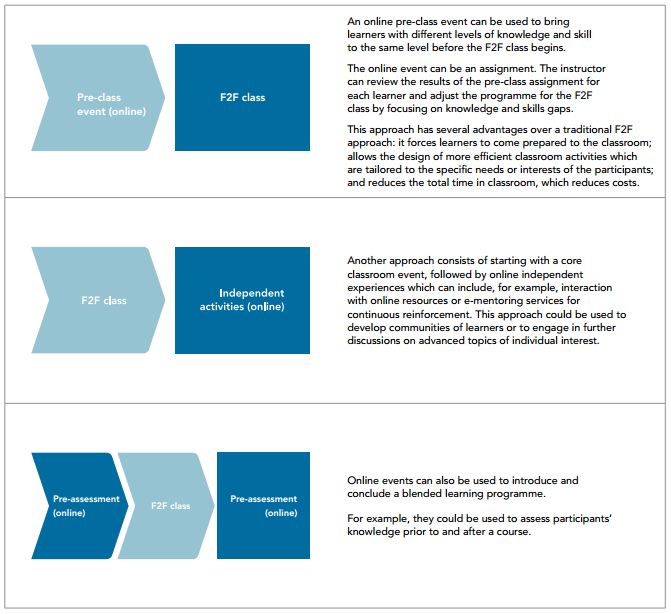
faoblended Image from From http://www.fao.org/docrep/015/i2516e/i2516e.pdf

Via Stephen Downes came this snippet that caught my eye.  Discussing design models for hybrid/blended learning and the impact on the campus ~ Stephen’s Web.

Tony Bates writes, “Despite all the hype about MOOCs, hybrid learning is probably the most significant development in e-learning – or indeed in teaching generally – in post-secondary education, at least here in Canada.” I think that if you look inside universities, this is true. But outside formal education institutions, the hybrid model is virtually nonexistent.

Hm, in my world, which is definitely outside post-secondary education and not in Canada, blended models are front and center. So I thought I’d leave Stephen a note and get Mike Culligan, a colleague from LINGOS and Last Mile Learning, to chime in. Here is what we replied in the comments. I have added some links to mine which were not in the original comments!

Re: Discussing design models for hybrid/blended learning and the impact on the campus

I wanted to give you a heads up that the hybrid model is indeed alive and well outside of formal education institutions. FAO’s most successful learning programs are now blended (particularly good examples in S. Africa around Food Security Policy learning projects) , LINGOS.ORG has been getting very good results w/ blended and showing significant resources savings from their traditional F2F offerings, and better results than pure play elearning, and other organizations in development are moving in the same direction. Little old me too – much of the capacity building/structured learning I facilitate is now blended. I think the problem is these different worlds don’t talk to each other very much. [Comment] [Permalink]

More examples – International Development

I work with LINGOs – the international development organization Nancy White mentioned above. In addition to the examples she provided, there are more examples from Plan International, Management Sciences for Health, etc.

> One of the programs with the longest track record is the Virtual Leadership Development (Program http://www.msh.org/resources/virtual-leadership-development-program-vldp ). Operating since 2002, the program’s website describes the learning experience as follows:

>”Rather than giving a few top level managers off-site leadership training for one to two weeks or more, the VLDP trains up to 12 teams of four to 10 people virtually over the course of 13 weeks. The VLDP requires approximately four to six hours of individual commitment per week. Team members work independently on the VLDP web site with additional support from the program workbook. They also participate in on-site team meetings within their organizations throughout the program. During the VLDP, each team plans and develops an action plan that addresses a real organizational or programmatic challenge facing them.

I recently completed a desk study with Scott Leslie for another organization (and I think we’ll be able to share it soon!) to review their elearning options and again, the blended learning option was high on our analysis. My work a couple of weeks ago in Kenya with leaders of agricultural networks which focus on learning across various ag domains again identified blended as a significant option, allowing both the deeper focus and relationship that we can wring out of F2F, with the ongoing, “home-based” learning that the network members can do online.

Formal, informal and in-between, blended RULES in my experience. What about in yours? Stephen, your post also reminded me we still have a lot of network weaving to do to help this type of learning permeate across the membranes of the .edu, .org and .com worlds!

Vectors of Learning

SharonI’m just back from a week in Nairobi, Kenya, with a group of amazing practitioners doing a wide variety of community based development work across Africa. They are masters of building value chains, community based learning, rural finance and many other domains. We gathered to spend four days expanding their practice of supporting communities of practice and networks of learning online. For me, these are yet another vector for learning.

Due to the travel, I missed the first week of my Acumen sponsored MOOC (Massively Open Online Course) on Human Centered Design. I have been one of those “enroll but never do anything” people and hoped the F2F gathering group here in Seattle would pull me in. I still have my fingers crossed. It’s about vectors for learning.

So I was delighted today to be pointed to a great post on “Charlie’s Blog: To Notice and to Learn” (Hat tip Stephen Downes). Charlie shares a reflection from a humanities professor on the depth of engagement in the online discussion threads of his MOOC, “The Fiction of Relationship” (Coursera link). This line summing things up from Charlie grabbed me.

Lifelong learning is a bouquet of flowers that we must gather and arrange ourselves, and MOOCs are the stem of new type of flower, on which beautiful new petals might blossom.

via A Heartfelt Note from a Humanities MOOC Professor | Charlie’s Blog – To Notice and to Learn.

The bouquet, if we follow the metaphor, is rich with possibilities. With people’s time more fractured than ever, there is a seemingly growing disbelief that we can meaningfully engage, build trust and relationships, learn, work and play — even in asynchronous discussion threads. That promise is there. It has been there for a long time. What we only need to add is our time, care and attention.  WE have the vectors. Now let’s learn.