Connectivism Course – Pre Assignment

Connectivism Course Wiki

As if I had time/attention for another workshop or course! I’m barely following Leigh’s  online facilitation workshop, running a workshop for a client, guesting in a South African workshop and now starts George Siemens and Stephen Downe’s

 Connectivism Course. But I’m weak. I can’t resist. So in the spirit of things, here is my first blog assignment. Rather than start a blog just for the course, I’ll do my posts right here on my home blog-base.

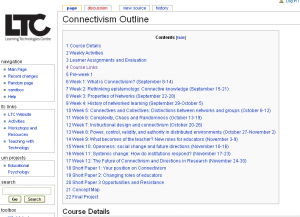
Connectivism Outline – LTCWiki
Activities:

  1. Set up your course blog (edublogs or WordPress are recommended, but you can set up your blog with any other service) DONE!
  2. Introduce yourself in the moodle forum or on your blog – be sure to use the CCK08 tag. For the introduction, let other participants know:
  • Where you’re from – Chocolandia, of course. In earth terms, I’m from Seattle, Washington in the upper left hand corner of the continental US. But lately I rarely seem to be here. Lots of travel, baby. My carbon footprint is horrible. At least I’m not the only person on those planes by my self. (However, I could use a little leg room!)
  • Why you’re interested in this course – for a variety of reasons. 1. To see how George and Stephen collaborate in running the course, both from a content, process and technological perspectives. I love this idea of open courses (with a paying option for credit). I want to see how they scale. I suspect they are a LOT of work for the convenors! 2. I’m interested in the topic and 3. Well, you already read – I’m a glutton for overscheduling myself.
  • What has to happen in order for you to consider this course a success. Actually, very little. Even “just watching” provides a learning experience. And that is the bottom line – did I learn?
  • Random information about yourself – your work, your experience with networked technologies, etc. – Well, I guess a quick scan of this blog will give a fast hint. And the nickname, choconancy.

Google Chrome – have to have a play

Google Chrome came out today in beta (of course) and instead of doing my to do list tasks, I had to download it and play with it. I had three motivations. From a selfish perspective, my main motivation is the crashing of firefox for the tab-addicted like me. I like to keep lots of tabs open and keep the browser open all the time. It seems like after about 18 hours, Firefox freezes up. My second motivation is I’m simply curious. But my more enduring motivation is that in my communities, people are always asking “should I download and use tool X?” Everyone isn’t technically curious, or has the time flexibility to try new tools and give some feedback. This is part of community technology stewardship. So I’m giving Chrome a spin today for me, for you, for anyone!

So far clean, if a bit ugly. So much blue! It feels speedier than FF. I like the tabs above the URL bar. I am able to blog easily from my WordPress “blog it” link as Chrome imported all my bookmarks and many settings. I am still playing around with the options.

So what would I advise my communities so far? Well, it doesn’t appear to be as buggy as some people said it might be. The download and install was painless. So for those seeking something new, go for it. For a transition for a community I still need to see if the web applications used in my communities function well in Chrome. That’s the acid test.

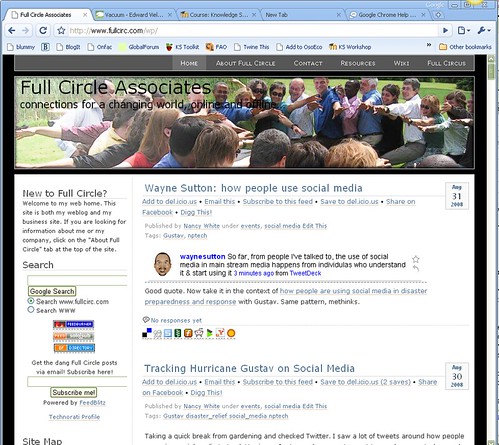
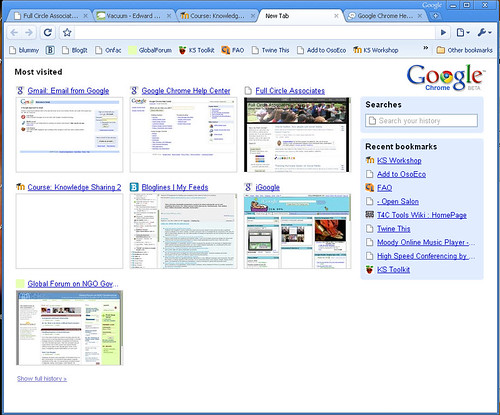
Here are a couple of screen shots.

Google's Chrome Browser
Chrome Page with my Most Viewed

Edited later: Downsides

Tracking Hurricane Gustav on Social Media

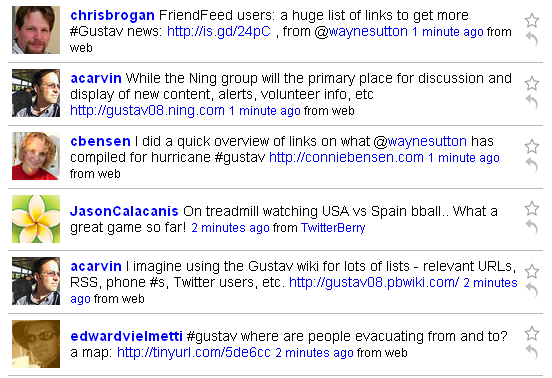
Taking a quick break from gardening and checked Twitter. I saw a lot of tweets around how people are using social media to track Hurricane Gustav and prepare to react to needs generated around the storm. Here are a few (Updated Sunday Aug 31, 4pm PDT, 6:20 pdt, 7:40 pm PDT, Updated September 1 9:35am):

  • And finally, a quick screen grab on Twitter as an example of the activity

Gustav and Social Media

From courses to community: Josien Kapma and Nancy White

This is an article that Josien Kapma and I wrote for the Dutch journal, “Leren in Organisaties”. I have posted it earlier as a PDF, but got the request to offer it as straight HTML. So here it is again! Also From Workplace Courses to Communities (PDF from the Journal)

From workplace courses to global conversations

Nancy White and Josien Kapma

A growing number of people and organizations in various sectors are focusing on communities (of practice) and networks, as a key to improving their performance. What are these forms for knowing and learning, and what are the ramifications for human resources management and development in organizations? What sparks their formation and creates engagement for members? How are communities related to globalization and an increasingly networked world? This article offers some pointers through the personal tales from two people who participate in communities for their own learning. They report their experiences and give their ideas as to how organizations could give space to this new way of learning.

A true story…

Rural Portugal/Josien:
I have a call scheduled for a tele-meeting. I’m helping coordinate our annual gathering, so I’ve proposed an agenda via email prior to the call. I call in from my home office. We share note taking responsibilities using a chat room, but I’ll make sure the final notes get on our project wiki. I’m surprised to see how well our small group of volunteers -who each are busy people with very full lives- responds to the tasks at hand. We set our standards high, even for the routine tasks, yet we work surprisingly efficiently. In this way, a 3 day event for 90 of our community fellows, all working in different organizations and from over 15 countries, is organized by volunteers without one single face-2-face meeting. In the process, I learn a lot; about the content of the event, and about design of learning events. My peers provide great role-models, and along the way we develop our skills for working in a distributed way. When I find myself looking forward to the next call, to seeing thoughtful additions in our wiki, I discover just how powerful a motivator ‘learning’ can be. Gradually, I begin to understand what it is that keeps these people together, although they are distributed over the world. They are together because it matters to them.

Urban United States/Nancy:
I ring into the bridge line to make sure it is working and I mute my microphone. It is early here in my time zone and I’m still eating breakfast, while others are at the end of their days. With a little flexibility, we work across geography, expanding the possibilities of what we can do. I am task oriented and like getting things done. With our set of tools, we assemble an amazing team with talent we’d rarely find in one place or organization. As the call starts, we identify ourselves: Marc is with his Swiss accent, living in Cape Town. Peter is now in Ghana, although he lives in Italy, Bertha (originally from Latin America) is at her desk in Switzerland, like -at a different organization – Riff, a Canadian. Allison (also Canadian) is visiting Lucie at her home in Brussels. We have interacted for many years, so the start of our meeting is full of greetings and “catch up” on our lives until everyone has joined the call. By the time we finish, we will have made several key decisions about our gathering, made sure we incorporated lessons from last year’s event, and broken up into teams for follow up actions. In 60 minutes, we’ve learned what we want to do and have a plan to do it. What’s more, I have learned new perspectives and ways to do this work. My community has expanded my capabilities.

The intersection of technology, practice, community and the world

The tale above is a glimpse into our small group of volunteers organizing an event for KM4dev (http://www.km4dev.org), a community of practice about “knowledge management for development”. In the community we work and learn together, at our own terms and pace; we share resources, ask for and offer help and information, share leads for learning and even jobs. In many ways we are like communities that have existed in the past. Social interaction provides the context for learning. Our learning is not mandated, it is voluntary. While we feel responsibility to our funders, we do not focus on some arbitrary benchmarks. We participate because we can and we want to improve our practice and we want to produce value for our community. With today’s technologies, we have both global potential and impact. We can tap into a broader set of skills, work with a wider set of perspectives and really work with a unique edge that is valued by ourselves and our organizations.

How would an organization use such community and network work and learning? How is this approach different from our traditional, internal HR-driven training approaches? What needs to shift from the traditional practices? Let’s look at six trends and see how they might manifest in your organization.

OldNew
1Training & classesInformal, personal learning
2Expert led learningPeer coaching, support and social learning; Communities of practice
3Formal AssociationsNetworks – informal connections, nodes, and ad hoc groups
4Behind the Firewall, local talentBeyond the Firewall – innovation from inside and outside with global talent
5Motivated by the bossBroader motivations
6Talking – the Big MouthListening – the Big Ear

From Training and classes, to communities and personal learning

Our organizational members and employees can no longer be sufficiently served by formalized internal training. The personal background and learning styles of employees are diverse, as are their job-contexts. This determines what and how people learn. More critically, much of what needs to be learned is ever-changing(1). It is moving faster than we can create structured learning opportunities. While traditional training methods are still useful for repeatable and repetitive tasks (i.e. learning a new software program, manufacturing, safety procedures) many training needs are about evolving practices such as marketing using social media, cross-organizational collaboration or responding to emerging markets. Informal and voluntary learning becomes a key strategy to move faster than we can accommodate with formally constructed training initiatives.

From Expert led to peer driven social learning

Two forces are driving the trend towards peer learning. One is technology.There is a new generation of Internet based tools (often called ‘web.2.0’ or ‘social networking’) which allow an individual to build a unique online presence and profile including what they know; and, they facilitate connections between individual users, allowing each user to build a personal network around a knowledge area. People can find, trace and track others who share the same interest, even if it is very specific, creating a group of knowledgeable peers, and learn with them. They don’t have to wait for the expert.

Second, the millennial generation has far less interest in authority or being “taught.” They learn with and from each others. As HR managers prepare for the future, training efforts must respond to this culture shift. Instead of connecting employees with a small defined set of experts, you help them tap into networks of expertise.

From formal associations to communities and loose networks

People flock together without the need for a mediating organisation. Instead of formal “expert” associations, loose “peer” networks are emerging. The resulting groups can be highly effective learning opportunities. We are used to team collaboration, communities and networks can add extra ‘layers’ to collaboration. (An interesting paper about collaboration in teams, communities and networks is here (in English): http://www.anecdote.com.au/whitepapers.php?wpid=15 ) Millions of people are gaining experience with these “new ways of learning”, but mostly in the hobby spheres, like sharing music or tips on travel. A great potential for more job-related, productive uses is waiting to be exploited.

From behind the firewall to beyond the firewall

The dramatic drop of costs of ICT (server space, memory, user hardware, bandwidth etc), combined with improved access and usability have transformed information scarcity to information overload. Control over sources of information or channels of communication is no longer the privilege of few. Before, the boss signed letters and the PR department made sure all corporate communications were checked for quality. Now organizations have to deal with the fact that they can no longer keep track of, let alone control all the communications flowing out of the organization. Maybe it doesn’t matter all that much, as what others say or write about the organization is at least as, if not more, important than formal company messages. In this new reality, not secrecy and walls, but transparency, openness, and compatibility with others, are determinants for success. This counts for learning and talent management as well. As people flow in and out of jobs and organizations; they form their personal networks and portfolio (which often span multiple organizations) along the way. The professional and personal, formal and informal increasingly get intertwined. Recognizing the role of these other communities and networks is a prerequisite for organizational vigor. Ignore them, and your talent will either be limited, or gone.

Addressing broader motivations

People’s motivations to contribute go beyond a paycheck or a demand from the boss. Identity and relevance of the job, feeling they are making a useful contribution as well as working on personal development and social capital, are important. You can’t control people; instead you can empower them. Personal motivation is also a prerequisite for innovation — one organization alone and classic knowledge transfer in itself are no longer sufficient for sustainable innovation in an ever more complex and interdependent world. Innovation requires connections and stimulation beyond the people in our organizations. So tapping into the motivations of employees to participate in the larger world is something else to consider.

From the Big Mouth to the Big Ear

With the advent of Web 2.0 the model for communication has been turned upside down. The “former audience” is now just as much a broadcaster as any large organization. The incredible abundance of information and communication has two effects. First, it created an attention scarcity and media fragmentation. Compared to before, our messages need to be very relevant or audiences filter them out. So instead of talking louder to unfocused audiences, now organizations need to engage in meaningful dialogue with relevant partners. Second, it created an immense pool of searchable communications among others. This buzzing universe of linked sites and blogs is an incredibly rich source of organizational information and learning… if we know how to listen. Organizations need to listen to conversations about them, niches or needs they can fill, feedback and suggestions for improving what they do. It is about tagging and remixing and mapping the network of relationships, looking for where to respond, and where to catalyze action. It is a little bit like listening to the universe.

These tasks can’t be done by an individual. They require the diverse “ears” of communities, the wider net of networks, seeking to make connections between people that advance our organization’s learning and goals. If all your employees are part of the Big Ear, you are ahead.

Tips for leading in a networked world

It is a brave new world for human resource development managers. It asks a lot of us – to shift both our world views and our practices. It asks us to work with, not try and resolve the polarities that we activate when trying to reconcile a network activity with a corporate structure. These include:

Planned <–> Evolving
When working beyond organizational borders and with complex systems, it is still important to plan, but to also be open to that plan evolving as you tap into the world and it’s complexities. Consider shorter iterations in your organizational learning and planning cycles.
Talking <–> Listening
When your employees can listen to the world, they will have another “voice” to compare against your organizational voice. Make sure you are also listening to that world so your voice has credibility and consistency internally and externally.
Centralization <–> Networked

Like the shift towards evolution and listening, organizational structures are rarely just hierarchical but are instead networked to individuals and organizations outside of your organization.
Mandate <–> Create enabling conditions
When you have to be flexible and open to the outside, it’s useful to remember that the outside world cannot be mandated like an employee. Consider how creating mutually beneficial interactions or simply an inviting set of circumstances can allow you to tap into learning with the outside world.

Here are a few general tips to get you started.

  • Be strategic. Identify specific, strategic knowledge transfer opportunities, applying learning to organizational goals. Reward knowledge application. Encourage and provide mechanisms from employees to share their knowledge through gatherings, blogs and wikis.
  • Grow a “big ear.” Listen for conversations inside as well as outside of the organization — Web2.0 — the new web technologies — provide some excellent tools like RSS, tagging, and automated searches. Use this to inform your subsequent learning strategies.
  • Support learning as a way of life. Create conditions for personal, informal2 and voluntary learning. Make sure there is time in busy employees’ days for participation in relevant communities and networks. Give people tools and light support. Ask what they are learning about. Role model by openly pursuing your own learning agenda, including making “not knowing” ok. This is a motivation to learn.
  • Balance control with emergence. In a network world, if you provide too much resistance in one place, people will easily route around you and you lose the opportunity to engage an employee. Build trust and share outcomes rather than a stack of rules and restrictions. The networked world requires more openness and this can be both uncomfortable and different than past organizational norms and practice.
  • Support key strategic communities and networks. Identify those which are important and relevant to your employees, both within and outside of your organizations. This could mean offering a collaboration platform, sponsoring online or face to face gatherings, or simply allowing people time to participate. Don’t try and run the communities – they should be run by the members.
  • Be prepared. Introducing CoPs and network ways of working introduces organizational change – so be ready.

What does the end of the story look like?

2013, the world
The KM4Dev gatherings this year have multiplied. There are now regional face to face gatherings, organized and fully funded out of appreciation by member organizations who have benefited from the community knowledge and support. Their human resources directors, in particular, have become champions of communities and networks that help their organization’s employees learn anytime, anywhere and with a diverse set of co-learners beyond the borders of the organisation itself.

Some things never change though. Josien ends her day with an online meeting, squeezing a telecon in between helping her children, now teenagers, with their home work and wrapping up her work nurturing a women’s dairy network that spans the globe, while Nancy, still in her pajamas, starts her day with tea and a little dose of community. Sometimes she has a grandchild painting at her desk. Their work has grown in harmony with their lives, making them productive contributors to the their group and the world, while retaining richness and diversity. A little laughter, a lot of warmth and affection and an ever-changing landscape of global learning.

———————

1. http://www.blackwell-synergy.com/doi/abs/10.1111/0019-8676.00123 “Fully 40 percent of private-sector workers surveyed report that in the space of just one year, a change occurred at work that required them to learn new job skills.”2. http://www.oise.utoronto.ca/depts/sese/csew/nall/res/21adultsifnormallearning.htm
http://www.jaycross.com/informal_book/map6.png
———————–

Founder of Full Circle Associates, Nancy White helps organizations connect through online and offline strategies. Nancy is an online interaction designer, facilitator and coach for distributed communities of practice, online learning, distributed teams and virtual communities. She has a special interest in the NGO and NPO sectors. Nancy teaches, presents and writes/blogs on online facilitation and interaction, social architecture and social media at www.fullcirc.com, www.fullcirc.com/weblog /onfacblog.htm

Josien Kapma works as independent consultant on knowledge mobility, communication and networking, mostly in rural environments. She is active in initiating, facilitating and participating in networks formed by farmers and rural inhabitants. She is also a dairy farmer, in Portugal.
www.josienkapma.com , jk@josienkapma.com

this article was published in: “Leren in organisaties” p. 30-34. 8e jaargang, nummer 6/7, juni 2008. Rotterdam.