 Note: I’m working a back log of “draft posts” that have yet to see the light of day. This is one from my trip to the Netherlands in December!)
Just a quick post from the Netherlands where I’ve been working with the fabulous Marc Coenders on an evaluation project for ICCO and it’s ComPart “project.” It has been lovely to work with the Compart team of Maarten Boers, Pier Adrea Pirani and Pete Cranston (the last two from Euforic Services and old KM4Dev pals.) It was a bit like “old home week” to use an American expression. The work has been fascinating, intense and challenging. The key word that keeps coming to me is fractal. Just when we get to one moment of understanding, things tilt just a bit and a new pattern slips in shifting things again. This is great for meaning making, not so great for finishing an evaluation report! 😉 It reminds us that we are working in a complex environment and if we are to succeed, we have to work with emergence. (See Peggy Holman’s terrific book, Engaging Emergence). We expect to be able to share the evaluation early in 2011 after the team has had time to absorb the findings!
As a little “side benefit,” Maarten Boers of ICCO hosted a borrel, or gathering for the knowledge sharing/KM/social media types in the area at the end of the day, some from my dear old KM4Dev network. It had been a long and intense day of meetings, plus silly me managed to catch quite a bad cold, complete with fever, etc. So I was really pushing my physical limits.
We planned a Fish Bowl for the borrel focusing on the interplay between organiztional change and technology, springing off of the evaluation work at ICCO with their “ComPart way of working.” I was greatful to be able to mostly listen from the outside of the fish bowl and took copious notes, some of which I’ll put below.
But I have to say, there were a few funny, wonderful moments when we, most of whom were working both in a second language and from a very tired state, misheard things and we created something new (and funny) out of it.
- What about “solo galaxies,” misheard from “solidarity.” Earlier in the day I was taking notes on the flip chart and I thought, hm, what a unique thing. Did that mean someone was really working in isolation, a “one star galaxy?”
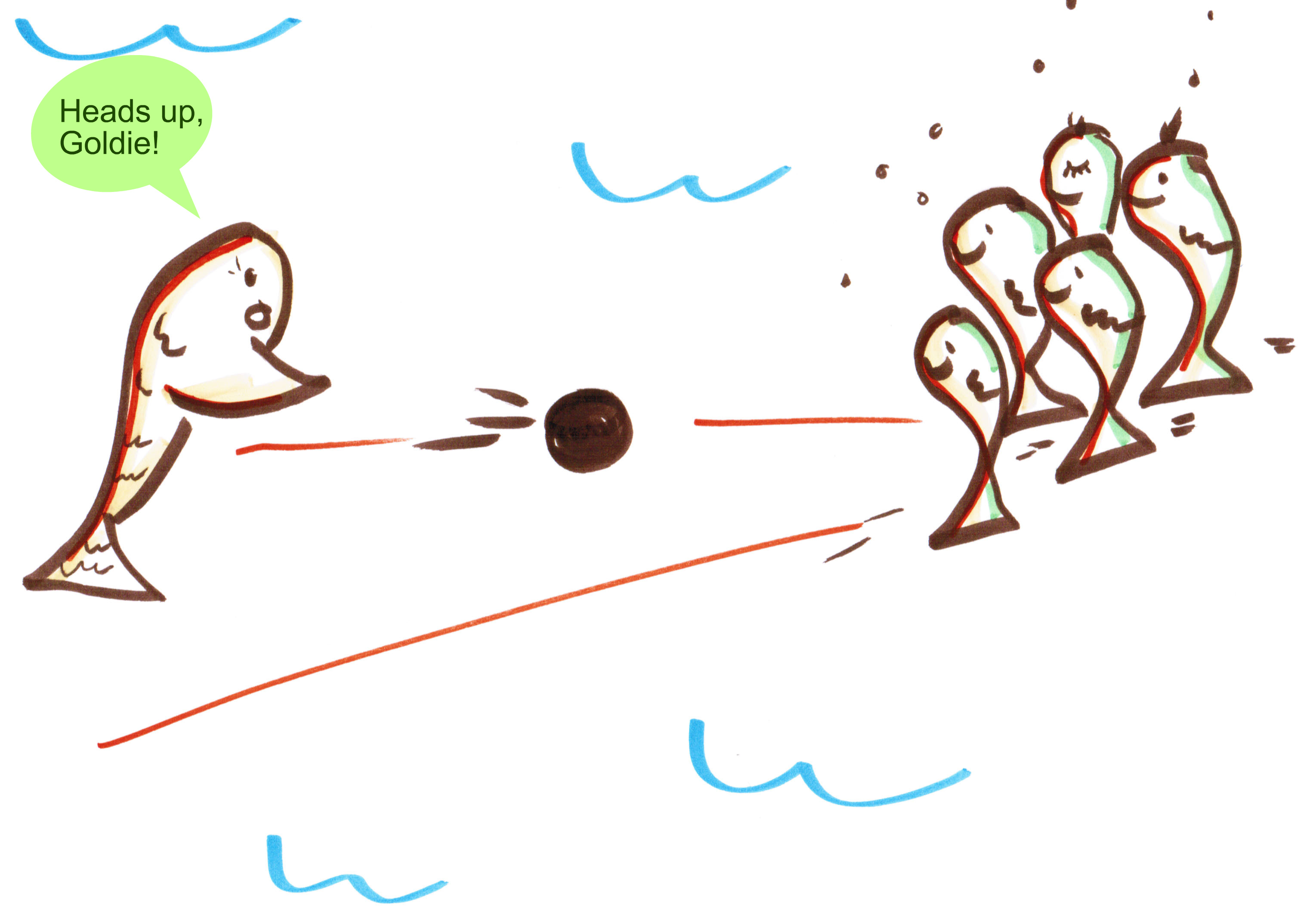
- We have the fish bowl method, but what comes to mind when you say “fish bowling?” Who is bowling? Are the fish the pins? My visual imagination went crazy.
- Later during the conversation I brought up the concept of “free riding” in networks and communities and how do we distinguish this from legitimate peripheral participation. Some one wanted to know what writing had to do with it and wasn’t free writing good for getting past writer’s block?
I love this stuff.
Anyway, here are the notes — there are some terrific one-liners. I apologize for not catching who said what, nor for having a list of participants. Not such great network weaving on my part!
On December 9th a group of practitioners joined up at ICCO’s headquarters in Utrecht, the Netherlands for an informal borrel (drinks) and conversation about the interaction between organizational change and technology. We used a “Samoan circle” variation of the fishbowl process, starting with ICCO’s ComPart team (originators of a new way of working and a wiki-centric platform of tools) sitting with evaluator and learning consultant, Marc Coenders. As the other evaluator, I (Nancy White) started on the outside and took very random notes… these are far from complete or fully accurate, but reflect the things that caught my interest. And of course the notes reflect nothing I said when I stepped into the fish bowl. Heh!
- Disruption <–> Opportunity
- ComPart’s original motivation – learning networking, but that wasn’t actually where things went
- Learning can bring discomfort (my question, do we make that discomfort visible and discussable?)
- “It is good if you like a lovely, really rocky ride” Pete Cranston
- Introducing a suite of web 2 tools is different than when we introduced email into our organizations. yet both changed our organizations. With Compart and web2, tools are always/quickly evolving. Faster, more complex vortex of change as tools impact organizations and organizations shape tools.
- Some teams took to the ComPart way – “just flew” – others did not (Why?)
- Start with need or start with tool exposure and find needs? (or both?)
- “No one is waiting for tools” and “everyone is waiting for a solution” and “if you don’t know what a wiki is and how to use it, you won’t ask for it.”
- Finding the balance between the polarity of “demand” and “offer.”
- The organizational level is too big and generalized to be the locus for focus. (Locus focus? Hocus pocas? Yes, I was tired.)
- The beginning of ComPart showed possibilities more broadly. Now need to narrow.
- What are the cost/benefits with respect to tool and process adoption?
- People like to ask a colleague how to use a new tool.
- Impact of new tools and processes spread beyond the actual users
- what is the ‘ripple’ impact?
- is this a form of ‘legitimate peripheral participation?’
- is this a form of free riding? (Tragedy of the commons)
- what does technological peripheral participation look like? Do for people?
- is this related to the problem of “you do this for me” or “we do this for us”?
- what is obligation of employer?
- Point to ODI’s six functions of a network.
- How do we take into account the expense/value of facilitation (budget)?
- rhythm of pumping the “knowledge heart beat”
- mandate (which people resist) and voluntary (which people deprioritise)
- is “particpation” just more jargon these days?
- To take seriously, and to seriously involve.
- Mandatory stuff –> unconcious, power politics, fragmentation
- Face the truth sooner when things are/aren’t working and respond versus sticking to your plan.
- Do NGOs do this less often than businesses?
- Go where there is interest.
- Role of leadership – walk the talk, model collaboration. If leadership does not have comfort wading into new tools and practices, not likely organization will fully move tere.
- Lack of clarity of what our “partners” really need or want, all the while we talk about putting them i the center.
- In the ComPart learning history, it was noted that in the early days it was difficult to even get names of partners to contact.
- Negotiating with internal/external boundaries is tricky
- How do we relate internal learning networks to external related networks?
- tap into existing communities before creating own
- intrinsic value of both inside and outside communities, but caution of overload and overlap
- Individuals often have their own “eccentric” routings to get to knowledge that are useful for them, but foreign to others and hard to share w/ others.
- how they negotiate boundaries is also individual
- What is the role here for network weaving?
- “Empherality is ok”
- personal and professional motivation
- What if ICCO celebrated the learning that came from the “inssurection” of ComPart?
- “inovation always starts bottom up” (the guy in the blue sweater)
- sooner or later management gets involved for positive or negative reasons
- that’s how organizations learn
- How to recognize when we are “in over our heads” and not make wrong headed moves
- Watch for experiments that are “too high risk”
- “Most ICT programs fail due to lack of user participation and lack of WIFM (whats in it for me)/motivation