Dave Snowden on Rendering Knowledge

Dave Snowden has updated his principles on “Rendering Knowledge” on Cognitive Edge  These are worth reblogging. I encourage you to go in and read the full post for all the context. I have added a few comments of my own in italics. I can’t resist the meanings of the word “rendering.” At the farmer’s market last week, I could by leaf suet (rendered pig fat), candles made from rendered fat, and all sorts of things that have been transformed through heat. What is the heat of knowledge sharing?

  • Knowledge can only be volunteered it cannot be conscripted. You can’t make someone share their knowledge, because you can never measure if they have. You can measure information transfer or process compliance, but you can’t determine if a senior partner has truly passed on all their experience or knowledge of a case.  So for me in practice, this means creating conditions where people are more apt to volunteer. Or perhaps better said, recognizing those condtions. I don’t think we can always “create” them!
  • We only know what we know when we need to know it. Human knowledge is deeply contextual and requires stimulus for recall. Unlike computers we do not have a list-all function. Small verbal or nonverbal clues can provide those ah-ha moments when a memory or series of memories are suddenly recalled, in context to enable us to act. When we sleep on things we are engaged in a complex organic form of knowledge recall and creation; in contrast a computer would need to be rebooted. In practice, I’ve found the introduction of multiple modalities, especially visual and kinesthetic practices, allow us to stimulate recall better than just words – written or verbal.  This is not about flashing a slide, but using visuals in the charting of our knowledge.  I’m not sure how to describe this, but I am experiencing it a lot lately. 
  • In the context of real need few people will withhold their knowledge. A genuine request for help is not often refused unless there is literally no time or a previous history of distrust. On the other hand ask people to codify all that they know in advance of a contextual enquiry and it will be refused (in practice its impossible anyway). Linking and connecting people is more important than storing their artifacts. I suspect there are layers of cultural implications when we look at this one. Any readers with a deep knowledge of the cultural implications of knowledge sharing? 
  • Everything is fragmented. We evolved to handle unstructured fragmented fine granularity information objects, not highly structured documents. People will spend hours on the internet, or in casual conversation without any incentive or pressure. However creating and using structured documents requires considerably more effort and time. Our brains evolved to handle fragmented patterns not information.  Some people are better at fragments than others. Does the current online environment favor global vs linear thinkers?
  • Tolerated failure imprints learning better than success. When my young son burnt his finger on a match he learnt more about the dangers of fire than any amount of parental instruction cold provide. All human cultures have developed forms that allow stories of failure to spread without attribution of blame. Avoidance of failure has greater evolutionary advantage than imitation of success. It follows that attempting to impose best practice systems is flying in the face of over a hundred thousand years of evolution that says it is a bad thing. So we had better get more compassionate about failure if we really are going to learn, and not hide from it.
  • The way we know things is not the way we report we know things. There is an increasing body of research data which indicates that in the practice of knowledge people use heuristics, past pattern matching and extrapolation to make decisions, coupled with complex blending of ideas and experiences that takes place in nanoseconds. Asked to describe how they made a decision after the event they will tend to provide a more structured process oriented approach which does not match reality. This has major consequences for knowledge management practice. All I can do is nod vigorously in agreement. 
  • We always know more than we can say, and we will always say more than we can write down. This is probably the most important. The process of taking things from our heads, to our mouths (speaking it) to our hands (writing it down) involves loss of content and context. It is always less than it could have been as it is increasingly codified.

The next interesting thing would be to explore these items and see how they show up in individuals, groups and networks. The same, or variations?
Learning: more than conversation

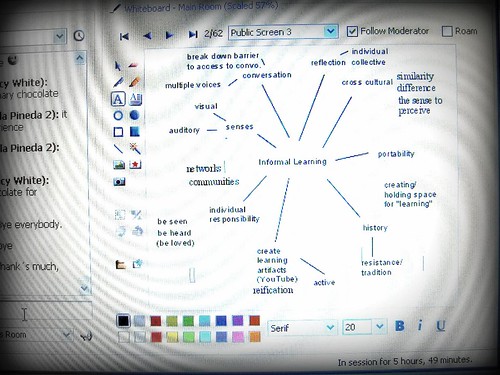
Mind Map from Informal Learning SessionToday I took part in a small portion of a larger online/F2F event originating in Germany from LearnTec.

It was fun to trade ideas with Heike Philips, Dave Cormier and Jay Cross (and I am sorry Jennifer Jones was unable to chime in due to timing/home rhythms at the early time of day). We all were strong proponents of the value of conversation in learning (informal or otherwise) but I found myself backing off a bit and reminding myself that conversation is one of the three legs of my learning stool.

  • Conversation – making meaning, getting different perspectives, trying out and testing ideas, challenging assumptions.
  • Individual reflection – (because group reflection is a subset of conversation, no?) Stepping back, reviewing, observing, evaluating our own learning both in terms of process and content. Reflection provides us needed self awareness and the ideas we bring back into conversation.
  • Reification – borrowing from Communities of Practice theory, what we create that expresses what we are learning or have learned. With internet tools makeing self publishing so easy, this area has blossomed – videos, images, blogs — things that manifest both our conversations and our reflections and put them out for wider consideration.
These three are a vortex, always intersecting with each other, even competing for our attention, eh? I wish I had paid more attention to reflection when I was younger. 😉
I have a habit of worshippping at the altar of conversation. But like all things, I must not let that blind me to other elements. It is in the interplay, the fluctuation between things, the margins, the tensions of what we know and don’t know, that learning happens.

Interested in Informal Learning? Join us at LearnTec 2009

Tomorrow I’ll be the guest of Heike Philip (in Germany) along with Jay Cross and Ken Thompson for an online roundtable on virtual learning, informal learning and virtual teams. We’ll mix it up, I’m sure. It is part of a larger day of activities that are F2F and online in GERMAN in the morning, German time, and in English in the afternoon, German time (early morning for us on the US West coast). Join us!

DateFebruary 4, 2009
Time1:30pm – 6pm Middle European Time
Duration4,5 h
BusyPeople
World Timewww_timeanddate_com
PlaceElluminate
TagsLearnTec 2009 , Simulcast, European Telecoaches Institute
Max. no of participantsNo limit live online, entrance fee at the LearnTec conference 49 €
ProgramProgram in pdf-format in ENGLISHGERMANSPANISH
Registrationhttp://www.lancelotschool.com/index.php/services/events/registration
RecordingThis event will be recorded

Meeting Point @ LearnTec 2009
4:30pm  Virtual Collaboration Moderation Heike Philp
Introduction with Lutz Berger, free journalist 2.0, Science&Faction
Virtual Round Table – Panel Discussion

4:30pm  (GMT +!)   Virtual Collaboration Moderation Heike Philp
Introduction 
with Lutz Bergerfree journalist 2.0, Science&Faction
Virtual Round Table – Panel Discussion

Jay Crossauthor of the book ‘Informal Learning’, Nancy Whiteconsultant for communities of practise and Ken Thompsonvirtual team expert and author of the ‘Bioteaming Manifesto’, meet live online to discuss strengths and opportunities as well as weaknesses and threats for virtual teams.
This is an unusual and an explosive mixture of experts and trendsetters who have been doing the ground work of connecting people. We are looking forward to hearing their views on the ‘next 5000 days’ of the Internet, an Internet that appa rently took 5000 days to reach the same amount of connections than our brain has todate. Heike Philp will be moderating the discussion and invites all present, namely all ‘virtual’ and all ‘local’ participants to testdrive virtual collaboration and to freely share ideas.

E-Stuffed

Just a quick surfacing… this morning I had the good fortune to snag some of Derek Wenmouth and Margaret McLeod’s time. They were in town for a conference on the School of the Future. I asked if I could take them out a bit for breakfast and to see a bit of Seattle outside of the downtown core. This shot is looking east from the Hiram Chittenden locks, in the Ballard neighborhood. It was great to get outdoors and enjoy a rare sunny winter Seattle day.

As we chowed down on some delicious breakfast, we talked about this idea of “blended learning” and what it means to discern what medium and what approach at what point in time. How do our choices reflect the developmental and content needs of the learners? For children, how does it balance freedom and safety? How do you keep an eye on the polarity between individually driven learning and the experience of learning with others — which has more to do than just learning about something. It is about learning together and social interaction. It is a complex and interesting stew. My head was stuffed full of ideas.

This dovetails in with something that came up last week at the United Nations University meeting on e-Learning that I facilitated in Bonn – the idea that the “e-learning” is not just about classrooms and courses, but about “e-stuff” –> how tools and processes can enable us to weave in and make visible learning an any turn, in many places, formal and informal. Virginie Aimard and I want to write up this “E-Stuff Manifesto” — in our spare time. (I hope you appreciate the humor here.)

I don’t have time or mental bandwidth to capture it all now, but this is a little bookmarker for those interested in this more systemic approach. What do you think?

Don’t Vote for Me – Edublogger Awards (but vote!)

Edublogger Lifetime nomineeI’m sure you don’t really care about why I have not blogged (travel, work, need a new roof and have to get quotes and references, blah blah blah). I have about 4 posts I really want to write – and odd for me, write well and thoughtfully. I’m feeling quite inadequate. Then I see this… Lifetime achievement award 2008 The Edublog Awards. Oh my. Look who is on the list:

OK, folks, all those other folks are amazing. They really ARE focused on education, while I meander all over the place. Yes, learning is a passion. But vote for one of them. They are really amazing, generous people who have taught me a ton.

To whomever nominated you, bless your sweet heart. I am deeply appreciative and there is a big smile on my face. Being in this group of people is the best reward. But don’t vote for me — vote for one of the other fabulous people on the list.

I also have to giggle. LIFETIME! A lifetime in blogging years, eh? I think I started in 2004, but my short term memory and my lack of affinity for numbers may prove me wrong. 😉 And if you have a magic wand, do you have a way to build a free week into my life this month?