Reflecting on my TAFE Workshop Approach

Phew! I’ve run workshops in 7 Australian TAFEs in Victoria and Tasmania states in the past three weeks – 3 hours of “intro” in the morning and 3 hours for “advanced” practitioners in the afternoon. Time to debrief!

I had a couple of underlying principles: provide the participants options and agency in the workshops, and to “walk the talk” of engagement rather than simply presenting.  At dinner one night just past the mid-point, my host Brad Beach and I were debriefing and he wondered if this approach was recognized or “seen” by the participants (between 20-35 people per session. It led me to wonder about those who also saw me for a keynote, an advanced online facilitation workshop, and 30 or so at KMLF and another 10 in a medical practitioners community of practice workshop. Wow, more than 650 people in 10 days! Reflect, reflect, reflect.

I have been thinking about this and have two somewhat contrary thoughts. One is really a question:  does it matter if they explicitly understood my approach? The other is, if we can’t walk our talk, then we can’t keep moving our teaching and learning practices forward.

First, a bit about my approach – I welcome your feedback. Based on some preparation with the workshop sponsors (all TAFEs (Technical and Further Education, sort of like our community colleges in the US but not really…) in Victoria and Tasmania states), we identified 7 “clumps” or areas related to teaching and learning online including:

  • using a communities of practice lens to help make the social aspects of learning more visible/usable
  • critically looking if “community” is useful in any particular context
  • purpose
  • relationship
  • engagement and support
  • activities
  • monitoring and evaluation

To back this up I prepared a huge slide deck of back up material we could select from depending on what people wanted to hear about. Of course as a whole this heaps too much.  In retrospect, too much even for choosing, especially with the diverse groups I had. And it requires spending quite a bit of time “explaining” to even begin to select. So I realized I had to structure some activities to surface what issues people were interested in.
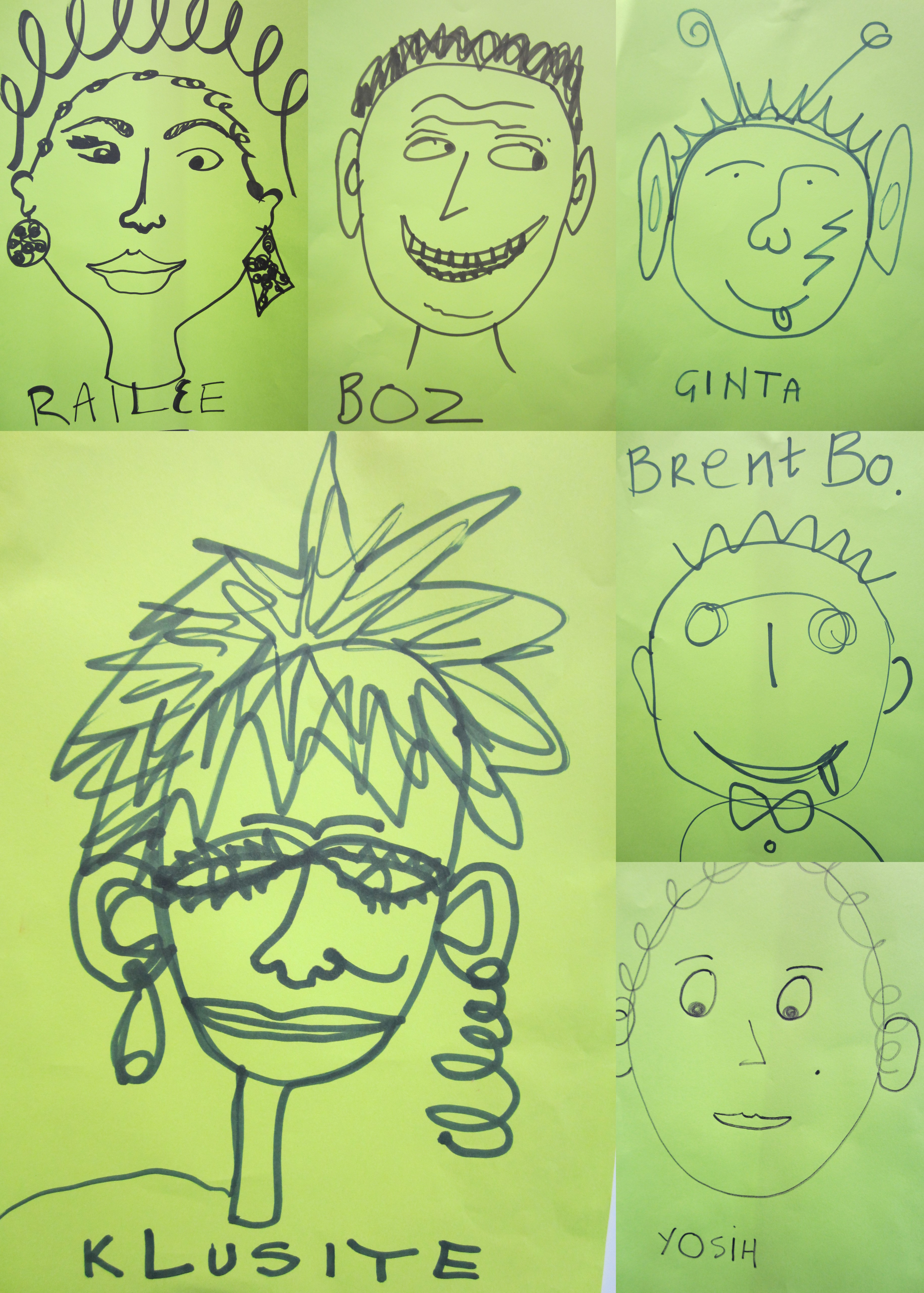
For the morning sessions I used the paired face drawing  (for details, see  here and here) to both make space for paired introductions and as a metaphor for how we work online with others… being open, trusting, not-knowing, and the power of open turn taking. Plus its unexpected and fun. Then I was going to do the “35” exercise (which I did not know by this name until a weekend last week with Viv McWaters and Geoff Brown.. credit to Thiagi) but the rooms I was in didn’t have enough space for the circulating needed.

In the smaller groups, we went around the circle sharing names and “what brought you here today.” In most cases, each person’s reason prompted a comment from me which sometimes turned into mini conversations so this took up to an hour.  I kept a flip chart of these ideas and referred back to it throughout the workshop. But the concept was that even just sharing what we were interested in brought us deep into domain conversations without a presentation or “content” delivered by me.

At this point I asked if people were interested in a short presentation on the communities of practice perspective and some reflections on how it might be useful in designing, doing and evaluating teaching and learning online. (By the way, these few slides were the ONLY slides I ended up using, but you can find the whole, annotated deck at the end of this post.)  As the week proceeded, I realized that this design approach was a nice way “in” on these conversations and I built on it, combining with a “design for at LEAST three perspectives” of institution/administration, teacher/facilitator/leader and learner/student. All week long as I heard people’s stories I heard, I felt, a lot of pressure to design for compliance and administrative needs, even while there is a ton of emphasis on the learners. I kept feeling that if we were able to look across these three audiences and across the “community-domain-practice” of the CoP lens, that we’d see a fuller perspective of the online learning offerings and find a fuller way to evaluate the whole, instead of just on completion rates, compliance to government vocational training requirements and student satisfaction surveys. But I’ll write more about that in a future blog post.
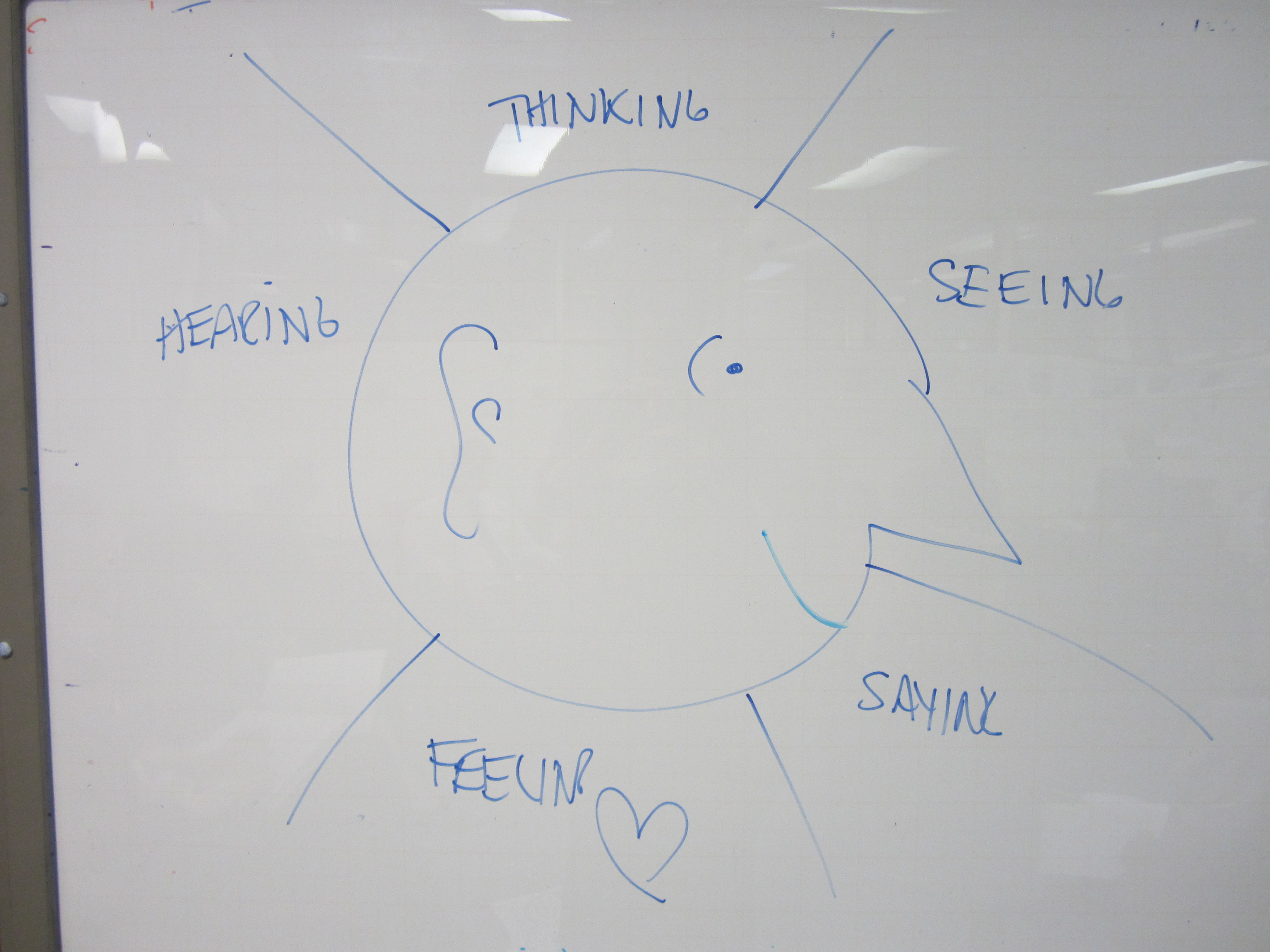
After that, we needed to mix things up with a break. In some of the workshops we did Dave Gray’s “empathy map” exercise to expand what we consider about ourselves and the learners. It is a useful, visual way to test if we ARE designing for students.

Other times — both in the morning and afternoon sessions — we did case clinics using various “fishbowl” formats. I think the Samoan Circle variation worked best because we did not fall into the challenging whole circle – everyone wanting to talk problem. The bottom line with these case clinics was that one person with a real problem or opportunity benefited from the experience of the group, everyone saw more clearly that each other was a resource and that this online learning offering is not a solo practice. I could have just thrown up a few slides and said that in 5 minutes, but I think the conversations in the fishbowl were some of the most engaging in all the workshops.

The afternoon workshops were intended for teachers who have been teaching online for some time. To surface both their context and what they wanted to talk about, we first brainstormed some of their major challenges. We picked one and ran a reverse brainstorm in teams of 5.  Some of the challenges they picked to design for “100% failure” ranged from the generic “all online learning” to “focusing student engagement.” As usual, this activity generates laughter, then good reflective conversations about real issues in their institutions. Sometimes I probed with the “four why’s” approach as it can be easy to sit at the symptom level, rather than get to the underlying or systemic issue.  Again, through a conversational format using small and large group issues were surfaced. I like the reverse brainstorm better than a straight up brainstorm as I think it is easy to get stuck both in our ruts and our “that’s the way it always is” attitude. By designing for failure rather than success, we shift our frame far enough that new perceptions can emerge.

The afternoon then also had some sort of fishbowl case clinic. The clinics seem to tap into the knowledge and experience in the room and most people mentioned in the debrief how useful this was. We did a modified fishbowl “Samoan Circle” style where we started with three people in the middle, with one of the people being the person with a challenge or case, one colleague they picked and me. We started by hearing the case person’s story and then asked clarifying questions. Those questions alone can trigger a great deal of insight. Then we’d segue into ideas, followed by the case person reviewing what they heard/learned and planned to do. People said they planned to use this method back at work!

In some of the workshops people had technology questions and we were able to successfully play using Twitter as both a note taking and “tapping into the outside world” experiment. I need to write this up separately as there were many insights. (Ah more time, eh?)

Finally, in all the workshops I asked people to “Pay it forward” by suggesting what they heard in the workshop I should make sure to share with the next group. This was a twist on “what did you learn.” You can see what they said in the early slides in the deck annotated below.  Sometimes we finished with a round of “just three words” on “your experience of the last three hours.” I always love the words – predictable and unpredictable – which come out.

Here is the PDF file of the annotated resources slides…NOT a presentation!  FacilitatingOnlineInteractionforLearningAU11

 

conVerge11 Keynote, Workshop and Reflections

I’ve been home just over a week after three great weeks in Australia, which started off with a keynote and workshop at ConVerge11 in Melbourne. (You can access all the session notes here.) The keynote was at 4pm on the first, packed day and I was asked to help encourage people to come to the cocktail reception afterwards. So I took my charge as “drive them to drink!”

Keynote

My goal was to provoke some thought about how we step beyond this idea of “creating communities for learning online” and instead think about connecting for learning — across cohorts, with the outside world, with our sponsoring institutions and with ourselves. After all, we can’t simply keep joining more groups. That does not scale. When we do utilize community approaches, we also need to think about how we make them the best they can be.  So I wove in the idea of the social artist (borrowing from Wenger and Houston). I confess, I dumped a LOT on people in an hour. If they didn’t need a drink when we started, I’m sure they did when I finished!

Below are my annotated slides because, as usual, my slides make no sense on their own. First is the Slideshare deck, and below is the PDF handout which is actually easier for reading the annotations.

Workshop: Advanced Online Facilitation Practices
Friday afternoon we had a great group for the workshop. Since I dumped a million ideas on everyone the day before, my approach to the workshop was full on participatory. At the last minute I decided to run an online experiment with Google+ at the same time to both capture what we did and to bring in any outside voices from my network who happened to be awake. (Not many… it was Thanksgiving weekend in the US.) 55 comments later… Do read the comments. There is a lot of insight that people contributed and a big thanks to Evan for scribing! (most of the comments under my name are Evan capturing conversation from the room.)
I started by asking people to write their teaching and learning strengths via key words on paper, then share and talk about them with others around them — especially to move away from the people they know. Sort of unmasking the superpowers in the room.
We then went with Dave Gray’s Empathy Mapping exercise to help surface different perspectives. That generated some fantastic insights about our own teaching approaches and what we know or assume about our learners. Somehow someone asked about how to get people in a comfortable place to talk about what they think and I mentioned the Human Spectrogram. Instead of telling, we DID it!  By the time we did both of these activities the 50 minutes had disappeared, we were running five minutes late and everyone was coming in for the closing session. Poof! And ConVerge11 was history.
I also have a Tweetdoc of the Tweets I was able to capture Nancy-White-at-Converge11
All in all, it was a great re-entry into my network of teachers and learners in Australia, a well run conference and …as always, when I present, I present from my own edge to deepen my own learning.

Valerie’s Amazing Thinking About Social Artists

(Note: this is a re-do of a post from this week lost due to hardware crash of my host. Sorry for the bad link at http://fullcirc.com/wp/2011/12/13/valeries-amazing-thinking-about-social-artists/)

As a followup from my week facilitating Change11, the amazing Valerie blew my mind with her video summary and synthesis of the week. No, it was much more than that. WOW. Take a look if you are interested in this idea of the social artist. Valerie, you ROCK!

Why chat streams are critical to live events

handcuffs cc Some rights reserved by incognito2020
cc Some rights reserved by incognito2020

AK nails it!

Last week I was a virtual attendee at the annual Sloan-C conference. It was fun and educational enough to spend 3 days watching live streamed sessions, and a saturday catching up on some recorded ones. The recorded ones are not as fun since you dont have the twitter stream going :-

via Multilitteratus Incognitus: Campus vs. Online: fighting in the family.

This is what I’m ‘talkin about! And it is not just applicable to webinars but to all synchronous online interactions regardless of the tool. It applies to telephone calls. Providing and/or encouraging text based peer to peer and peer to the world interactions creates opportunities to engage those who would otherwise tune out. Does it distract? It sure can. Does it fracture engagement into smaller cohorts or with those “outside” of the virtual room? You bet. And we can use that as an asset, not a strength.

The risk? The presenter will become irrelevant. And that too may be a good thing. If the presenter cannot skillfully engage, and they become only a conveyance for content… well, maybe they should switch roles and we run a video with a chat channel. I’m only partly kidding. How often have you clicked into a webinar on one of those platforms which makes you send all your comments to a moderator, which has no participate peer to peer chat room and felt like a prisoner with your hands tied? Last night I was talking with the fab Michael Coghlan of Australia (we were talking about flexible learning, natch!) and those were the words he used. “I felt like my hands were tied.” Is that any way to have a meeting, to work together or to learn together? NO WAY, BABY! (yes, I’m ranting this morning)

There are  SO MANY ways we can use chat streams productively. Here are two sets of tips – one for the “presenter” or leader, and one for participants. This is just a starter. What are YOUR tips? COMMENT PLEASE (and feel free to SHOUT. This feels like a SHOUTING topic!)

A Few Tips for  Presenters and Webinar Leaders

  • Ask great questions and have people answer in the chat room. If there is no chat room in the tool you are using, make one else where or use a hashtag and Twitter. Don’t let the technology stop you. (I did in a webinar last month and I regret it. )
  • If you can’t track the chat room and present, get someone to help you to recap and weave in the chat with your work. Some people can do this while they are presenting, some need to wait until a designated Q&A time. Both are legitimate approaches but it is worth TELLING the participants what you need to best engage with them instead of feeling over stressed yourself. That does no one any good. Be honest. People will support you when you ask for their help. They will detest you if you simply ignore them!
  • If the topic is NOT suitable for public sharing via Twitter, say that upfront and ask people to “keep it in the room.” Don’t assume people will automagically know this. Transparent ommunication is a great thing!
  • Keep the chat transcript and or Twitter hashtag aggregation (ask me if you don’t know what this is) and look at it afterwards. If there is more to follow up with, create a blog post or other appropriate mechanism to share that follow up. (Example here) People love it when you show active listening even if it is asynchronous. They are being heard. That is part of being a #socialartist! (First link is explanation, second is Twitter hashtag)
  • Frustrated that no one is “listening” and they are all chatting? After the event, review your presentation and figure out how to make it more interesting/compelling and DESIGN for participation next time. If you are just delivering content or a performance, record it. Sweet!

A Few Tips for  Participants

  • Find out or ask what the practice/conventions are for chat in the event you are joining. If they don’t know what you are talking about, share some ideas. Don’t be the victim. It’s a waste of time and energy!
  • If you are a fast typer, be careful not to dominate and squeeze out others. Take  a break every now and again. A hog is a hog in text or through speaking!
  • Ask good questions if the presenter isn’t or is unable to. This helps engage your peers. Again, avoid victimhood!
  • If Twitter/public interaction is OK and there is no hashtag, suggest a nice short one and get things going. Leadership!
  • Capture and share Twitter and chat transcripts for the uninitiated. There is often a pile of gems waiting in these artifacts.
  • Think the presenter could have done better? Walk in their shoes a few times, and if you are great at it, offer to give them coaching. If not, remember the power of compassion…

OK, add your ideas! Let’s liberate webinar participants from listen only confinements.

Reflecting on #socialartists and #change11

My week facilitating #change11, a very massive MOOC, flew by too fast for me to blink. (See these previous posts for more background.) Between being on the road so much and the distributed nature of the conversations, my head was spinning by Friday and it has taken until today to slow down, reflect and write. I’d like to reflect on both the content and process of “week 8” where we focused mostly on the idea of “social artists” in learning and technology. Well, honestly, mostly just on the social artist bit. As always, I was too ambitious in my planned scope. I am happy it narrowed down to social artists. That was enough!

First, the process. #Change11 is structured around whatever theme or idea the facilitator of the week offers. Up until now that has been kicked off by a piece of writing, a recording or some structured artifact where the facilitator shares his or her big ideas around change, technology and learning. There is at least one synchronous event per week (more often two) hosted on the platform formerly known as Elluminate (now BB Collaborate, and I think worse for the transition). There is the #Change11 daily which aggregates posts from the lead facilitators (George Siemens, Stephen Downes and Dave Cormier), posts and tweets tagged with #Change11. There are some quasi-centralized discussion outposts on Facebook, Google+ (see this tool to find Change11 circles on G+)  and Moodle, but most of the action seems to be on blog posts/comments and Twitter. In other words, the landscape one might traverse for learning and sensemaking is broad and diverse. I’m not the only one trying to make sense of this. See “We are always catching up” http://squiremorley.wordpress.com/2011/11/04/change11-playing-catchup-part-3/#comment-190 and https://jennymackness.wordpress.com/2011/10/26/the-selfish-blogger-syndrome/#comment-1666

Of course, I didn’t structure my week around a piece of writing. I was interested in explore the experience of change and how the social artist plays a role in that experience. Instead of content slides, I ginned up a deck full of questions and whiteboard templates inviting people to express themselves together visually, textually and if so moved, to grab the mic. (The before and after slides are here, but don’t expect them to make much sense as a stand alone presentation, and more like digital traces of what we did together. ) I ended with a challenge to find stories of social artists in their learning lives and to blog and or tag them #socialartist. And of course I scheduled both session late in the game, giving few time to get it on their calendar. Did I mention I have been busy? Can you read my sense of guilt between the lines? Yup. Giulia Forsythe then invited me to a follow up session later on Monday, and we had a final hour on Friday where George and Stephen interviewed me which was both interesting and weird. I think I got a little verclempt. Ahem! Judge for yourselves!

I then tracked tags to try and read and comment on most of the blogs that either blogged in general on the #socialartist idea or took up my challenge. Here are a few of the links (and yes, I’m still catching up commenting on some of them! DO look at the comments in these posts! Lots to think about)

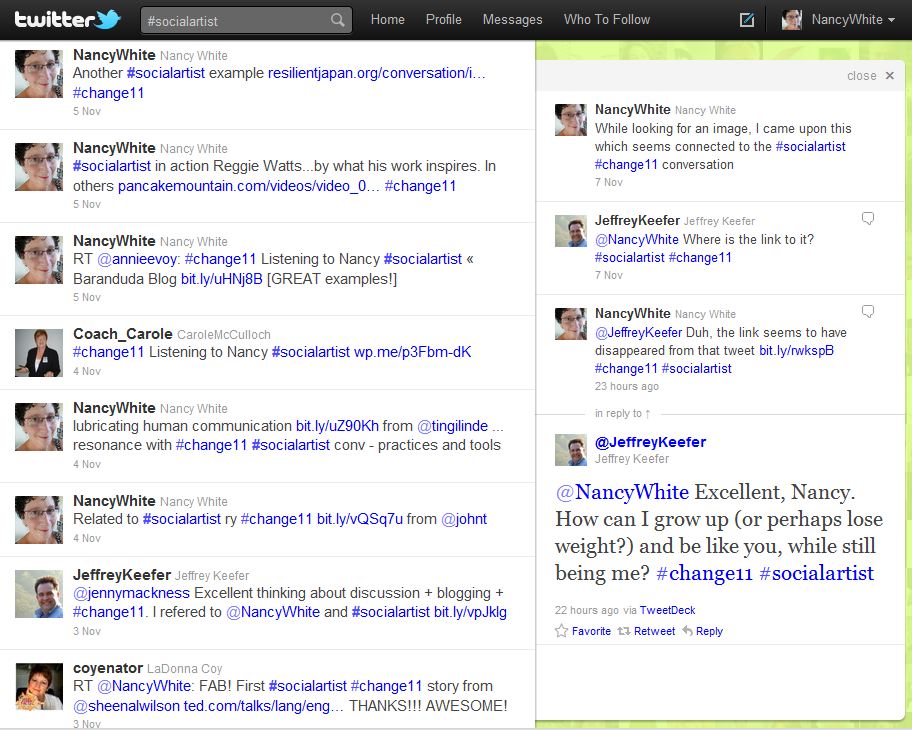
Here are some of the tweets archived into a Tweetdoc.

So now the content. The alleged synthesis and sense making. NOT! I don’t think I can do it, but here are the things that have been emerging for me through all these distributed conversations.

What IS a social artist?

So, what is a social artist and why did I think it might be relevant to #Change11? I’m not sure we landed on a clear definition. I started with the concept I borrowed from Etienne Wenger-Trayner, who has talked about the social artist as a person who makes the space for the social aspect of learning. Here is a quote from him from 2008 on David Wilcox’s blog which really resonates for me:

“The key success factor we’ve found is learning citizenship where learning citizenship is a personal commitment to seeing how we are as citizens in this world. Let me give you an example: I know an oncological surgeon in Ontario, Canada who asks himself how to provide the social infrastructure for patients to learn about cancer. An act of learning citizenship is to be able to use who you are to open this space for learning. I’ve come to call these people social artists, people who can create a space where people can find their own sense of learning citizenship.

“I love social artists. In fact I worship them. First because social artists know how to do what I only know how to talk about; and second because I care about the learning of this planet. I think we are in a race between learning and survival. We live in a knowledge economy where any expertise is too complex for any one person. One person can’t be an expert so anyone who can give voice to that need to work together is a social artist.

“I do a lot of consultancy work for training community leaders, but in my heart of hearts I know the real secret of those social artists is not something I can teach. The real secret of those people is knowing how to use who you are as a vehicle for opening spaces for learning.  I don’t really have the words – but I just know when I see it. It is a way of tapping into who you are and of making that a gift to the world … it’s about being able to use who I am to take my community to a new level of learning and performance.

“I want to leave you with three questions…

  • How can you act as a learning citizen in this world?
  • How can we as a group help , sustain, celebrate that capability among ourselves? If EQUAL has done a bit of that – how do we capture it, nurture it cherish it?
  • For those of you who are movers and shakers – how can you build an institutional structure that enables people to find their voice in the interests of the people they want to serve? Social artists need to fight … How can we enable a structure that enables those people to do the work that they do?

“These are urgent questions. Social innovation is a matter of the heart, not just projects. We need you to do that for the world, not just Europe”.

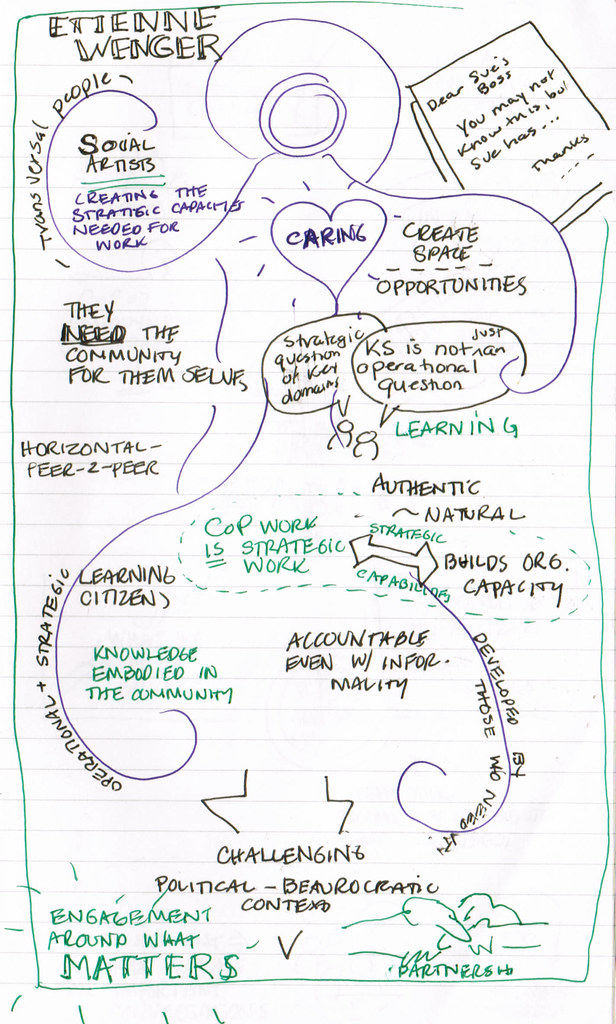
You can also hear Etienne talk about social artists (as well as other community issues) in this keynote from September’s ShareFair in Rome. The sketchnote above is from that session.

Jean Houston defines social artistry as:

Social Artistry is the art of enhancing human capacities in the light of social complexity. It seeks to bring new ways of thinking, being and doing to social challenges in the world.

…Social Artists are leaders in many fields who bring the same order of passion and skill that an artist brings to his or her art form, to the canvas of our social reality. (See also the Jean Houston Foundation page)

As I juxtapose Etienne and Jean’s meanings of the concept, I am finding out how to link  the roles to learning. From Etienne’s questions “How can you act as a learning citizen in this world? How can we as a group help , sustain, celebrate that capability among ourselves?” I hear the call to recognize the social acts of learning more explicitly and to attend to the people with social artistry skills. Nurture and recognize them. At the least, remove barriers to their participation. From Jean, I glean the parallels of passion and skill from art forms, to the social canvas.

The other thread was the juxtaposition of “social” and “artist” — where some had the concept of the solo artist, working alone to create a product of their work, while here the canvas is not only ephemeral through the interaction of people, but the role is inherently WITH people and social, not solitary. One person also noted the tension between the idea of a scientist and an artist which is to me one of the artificial constructs we create by dividing art and science. They have roots which intermingle.

Here are some links where people really picked up on the art part, which thrilled me.

In case you want more on visual practices, check out https://onlinefacilitation.wikispaces.com/Visual+Work+and+Thinking

Why is social artistry useful?

As the week went on and we sought out examples of social artists, and as we did this, I also realized it was useful to tease apart the social artist as a person (their role, skills, talents, way of being in the world) and the practices of social artistry which are often named as process arts, facilitation, network weaving, etc. People pointed a lot to specific practices, like the power of engaging people in using the white board in the online webinar space, how to use both silence and music instead of talking all the time, commenting on others’ blogs, helping them feel heard, designing connecting out into the world into her classroom, asking great questions, and such. I think people really resonated with these familiar practices, but we struggled with the less tangible ones. Like the kinds of people who just open up and hold space for people to be together and learn. The people who do that lightly and without manipulation. The people with big ears, big hearts and generosity of spirit. How do you tie that tangibly to education when we haven’t a clue how to measure it and I think many of us wonder if it can be learned, or it is something some of us just carry with us. The “fluffy bunny” stuff which I know, in my heart, is not fluffy at all, but very profound. I have seen the difference “being seen, heard and loved” means to people. But I can’t call it out in clear, intellectual terms that some people sought. I could not answer them. At the same time, I felt a quick kinship to those who recognized it. Are we finding our tribe? I don’t know.

Finally, it was very interesting to note that both the experiences of the synchronous gatherings (particularly the first one) and the concept of social artistry really seemed to resonate with some people, baffle some people and find no relevance for others. This was VERY interesting to me. In The Queen Has No Clothes, George wrote about feel-good commentating:

This week’s MOOC #change11 has not held my interest. Without doubt, Nancy White is a charismatic facilitator, using graphical tools to have participants express themselves and develop a particular view. I think this approach (using such graphical tools) is excellent for the participants.
I learned long ago that my wonderfully produced mathematical notes were excellent – for me. The iterrative process of producing these and improving them was valuable to me, the writer. My students needed to produce their own versions (yes, to construct their own knowledge), for this to be valuable for them. So the outcome of the process did not mean much without being a participant.
Also, there seemed to be an inordinate amount of “feel-good” commentating. Why? Could there be a cultural difference?
Hence my Tweet: the Queen has got no clothes on. There, I said it.

Tonight I responded:

I’m still chewing on what I understand to be underneath – the lack of resonance for you (and others!) about social artistry in the context of change, learning and technology.

When we moved into “interview Nancy” mode during the Friday session and George started asking me questions which felt more academic to me, I started to get some insight into the fact that while I know “inside” what social artistry is because I believe I practice it, I still can’t clearly articulate it in a way that fits in with learning theories and the deeper, intellectual grounding that many of you have. I’m a simple practitioner. So making that leap is .. well, hard.

As I listened to today’s session w/ Dave and rhizomatic learning, I kept being troubled by his reference of the rhizomatic learner as a nomad. The metaphor of the nomad — at least the romanticized notion of a nomad is a solitary being, forging off on her or his own.

This has a disconnect for the social aspect of learning for me. I’m not saying all learning must be in a social context, but a heck of a lot of it is. Those who pay attention to making that space where this learning happens play and important role. Thus the social artist.

We ran out of time and never got to the transversalist. That’s another interesting kettle of fish!

I need to go back and dig into what George meant about “feel good comments” — what makes a comment feel-good? What other qualities of comments might we use or name? A whole ‘nuther interesting thread.

The loose ends…Onward

You know what they say. Once you start looking for something you had not noticed before, you start to see it everywhere. Like when I became pregnant with my first child, I saw pregnant women everywhere where before they didn’t even show as a blip on my radar screen. So as the week went by, I kept Tweeting related #socialartist  links. For example, not change11 directly, but related social artist practices from Barbara Ganley http://community-expressions.com/2011/11/04/lessons-learned-part-one-listening/ and from the  Facebook Convo, an link to  http://en.wikipedia.org/wiki/Habitus_(sociology) from Vanessa Vaile who wrote “PS I see strong traces of habitus in Digital Habitats” which of course tickled me! I can even see glimpses of social artistry in this more general reflection on Change11 https://bigreturns.posterous.com/change11-looking-forward-and-looking-back

Habitus is the set of socially learnt dispositions, skills and ways of acting, that are often taken for granted, and which are acquired through the activities and experiences of everyday life. Habitus is a complex concept, but in its simplest usage could be understood as a structure of the mind characterized by a set of acquired schemata, sensibilities, dispositions and taste.[1] The particular contents of the habitus are the result of the objectification of social structure at the level of individual subjectivity. Hence, the habitus is, by definition, isomorphic with the structural conditions in which it emerged.
The concept of habitus has been used as early as Aristotle but in contemporary usage was introduced by Marcel Mauss and later re-elaborated by Pierre Bourdieu. Bourdieu elaborates on the notion of Habitus by explaining its dependency on history and human memory. For instance, a certain behaviour or belief becomes part of a society’s structure when the original purpose of that behaviour or belief can no longer be recalled and becomes socialized into individuals of that culture.

Habitus is the set of socially learnt dispositions, skills and ways of acting, that are often taken for granted, and which are acquired through the activities and experiences of everyday life.Habitus is a complex concept, but in its simplest usage could be understood as a structure of the mind characterized by a set of acquired schemata, sensibilities, dispositions and taste.[1] The particular contents of the habitus are the result of the objectification of social structure at the level of individual subjectivity. Hence, the habitus is, by definition, isomorphic with the structural conditions in which it emerged.The concept of habitus has been used as early as Aristotle but in contemporary usage was introduced by Marcel Mauss and later re-elaborated by Pierre Bourdieu. Bourdieu elaborates on the notion of Habitus by explaining its dependency on history and human memory. For instance, a certain behaviour or belief becomes part of a society’s structure when the original purpose of that behaviour or belief can no longer be recalled and becomes socialized into individuals of that culture.

Here are some other places where Social artistry appeared in front of me this week

Want more #Change11? The schedule is here.

The beauty of a MOOC is the way you can sail into ideas, people, memes, and streams. Here are some people and their streams I want to read more of: